International Big Cat Alliance and Wildlife Conservation
Source:Indian Express ↗
આ શા માટે મહત્વનું છે
Important for understanding India's proactive role in global wildlife diplomacy, multilateral environmental frameworks (like IBCA), and biodiversity protection strategies under GS Paper III.
સારાંશ
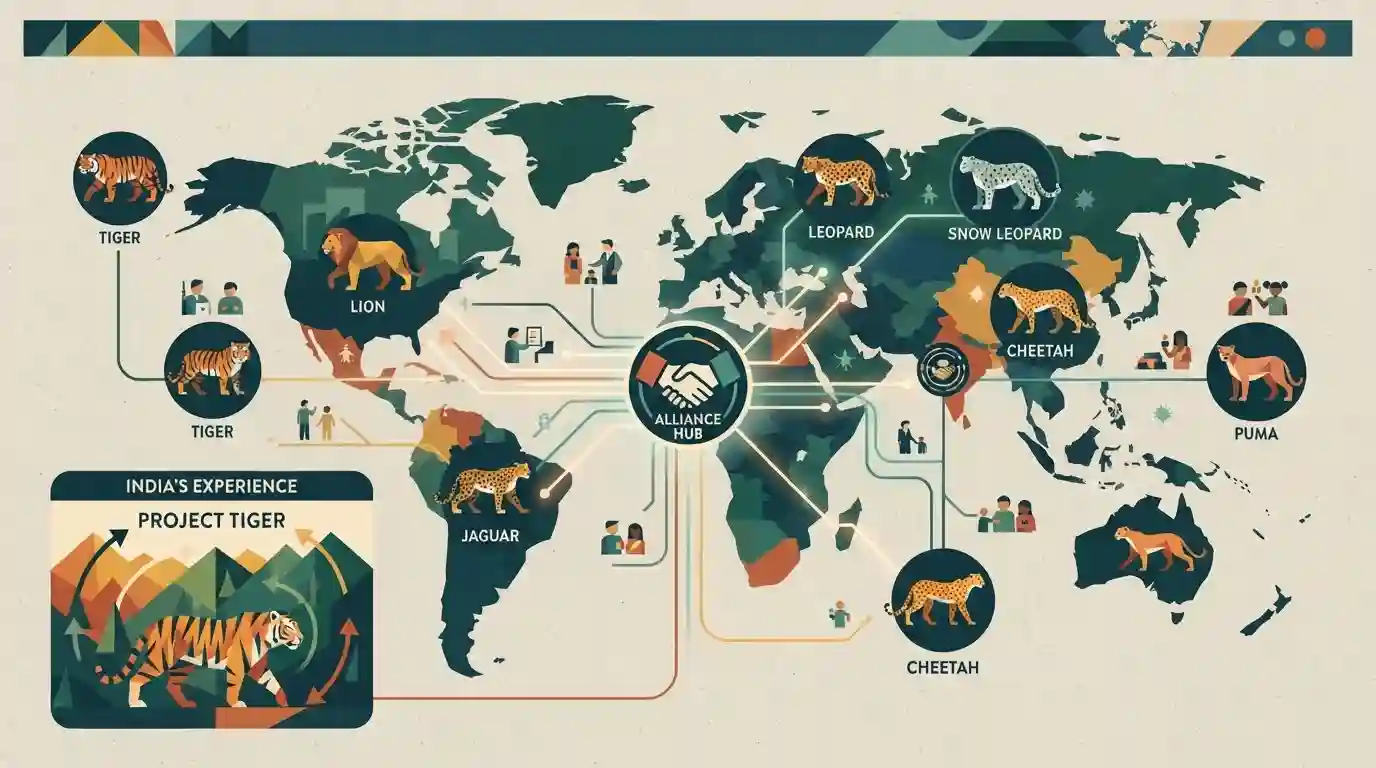
The article discusses global big cat conservation frameworks, focusing on the International Big Cat Alliance (IBCA) and India's extensive experience with Project Tiger, emphasizing international cooperation to protect seven major big cat species.
મુખ્ય મુદ્દા
- The article highlights global big cat conservation efforts, focusing on India's leadership through initiatives like the International Big Cat Alliance (IBCA) and Project Tiger.
- It underscores the significance of preserving seven major big cat species (tiger, lion, leopard, snow leopard, jaguar, puma, and cheetah) for shared ecological health and biodiversity.
- Stresses the need for cross-border collaboration, habitat connectivity, and community-driven conservation models to secure a shared future for big cats.
મહત્વપૂર્ણ શબ્દો
International Big Cat Alliance (IBCA)

A global initiative launched by India to ensure the conservation and habitat protection of seven major big cat species: tiger, lion, leopard, snow leopard, cheetah, jaguar, and puma.
UPSC context
GS Paper III (Environment and Biodiversity Conservation); tests knowledge of international environmental bodies, wildlife diplomacy, and conservation frameworks.
Project Tiger
India's pioneering wildlife conservation program launched in 1973 to protect and revive declining tiger populations through designated reserves and dedicated funding.
UPSC context
GS Paper III (Biodiversity Conservation); tests understanding of flagship species protection schemes and historical milestones in Indian wildlife management.
National Tiger Conservation Authority (NTCA)
A statutory body under the Ministry of Environment, Forest and Climate Change established to provide oversight, statutory backing, and policy direction for tiger conservation in India.
UPSC context
GS Paper III (Environment & Ecology); tests awareness of statutory environmental institutions, governance frameworks, and wildlife regulatory authorities.
પ્રિલિમ્સ ટ્રેપ
International Big Cat Alliance is restricted to Asian big cat range countries or species exclusively native to India.
Aspirants assume IBCA protects only species found in India or only Asian species, whereas its mandate covers seven big cats globally, including the jaguar and puma found in the Americas.
સંલગ્ન સ્થિર ખ્યાલો
What are the key features and statutory backing of the National Tiger Conservation Authority (NTCA)?
- Statutory Body: Established in Dec 2005, following the recommendation of the Tiger Task Force, under the enabling provisions of the Wildlife (Protection) Act, 1972.
- Composition: Chaired by the Union Minister for Environment, Forest and Climate Change with an expert Vice-Chairperson.
- Mandate: Provides statutory authority to Project Tiger, allocates funds, and oversees the implementation of tiger conservation plans across Tiger Reserves.
આંતર-વિષય પેટર્ન
Wildlife Diplomacy + Multilateral Coalition Building
India leverages domestic flagship wildlife schemes (Project Tiger) to build multilateral coalitions (IBCA), mirroring its approach with ISA for solar energy.
Transboundary Conservation + Regional Geopolitics
IBCA's focus on transboundary migration corridors and range countries connects wildlife corridors directly with regional geopolitics and India's neighbourhood first policy.

IBCA membership scope (all 7 species vs range countries) and HQ location frequently tested in multi-statement prelims questions.
સંલગ્ન PYQ · 2
સંલગ્ન PYQ · 2
- 2020PrelimsGS1
Among the following Tiger Reserves, which one has the largest area under "Critical Tiger Habitat"?
- 2026PrelimsGS1
With reference to Madhav National Park, which of the following statements is/are correct ? 1. It was declared a Tiger Reserve in India in 2025. 2. Sakhya Sagar, which is designated as a Ramsar Site, is situated within this National Park. 3. Its area is shared between Madhya Pradesh and Rajasthan. Select the answer using the code given below :
