Maharashtra Tribal Health Panel Recommends Separate System for Care
Source:hindustantimes ↗
Why It Matters
It addresses critical gaps in health administration and social welfare policy for marginalized tribal populations in Maharashtra, directly connecting to state-level governance and nutrition schemes like Amrut Ahar Yojana.
Summary
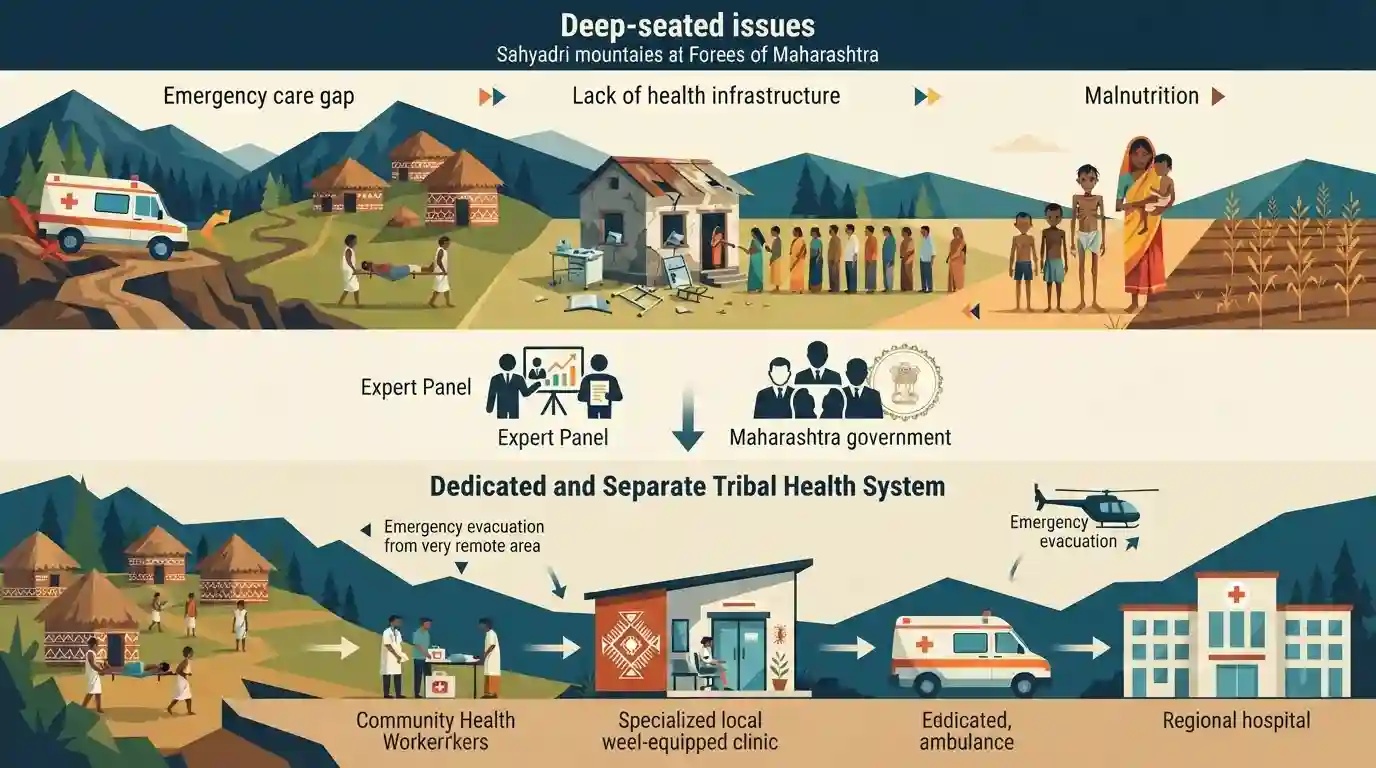
An expert panel has advised the Maharashtra government to set up a dedicated and separate tribal health system, citing deep-seated issues regarding lack of emergency care, health infrastructure, and high rates of malnutrition among tribal communities in the state.
Key Points
- An expert panel has recommended that the Maharashtra government establish a separate tribal health system to address severe deficiencies in emergency care and nutrition.
- The recommendation highlights critical gaps in healthcare access, medical infrastructure, and chronic malnutrition prevalent in tribal areas of Maharashtra.
- It emphasizes the need for tailored administrative structures and resource allocation separate from the general public health framework to properly cater to tribal populations.
Important Terms
Bharat Ratna Dr. A.P.J. Abdul Kalam Amrut Ahar Yojana

A nutrition welfare scheme under Maharashtra's ICDS program providing a free, full hot cooked meal to pregnant women and lactating mothers in designated tribal regions for six months.
UPSC context
MPSC GS-2 (Social Justice/Welfare Schemes): Tests knowledge of state-specific tribal nutrition, maternal health initiatives, and ICDS integration.
Integrated Child Development Services (ICDS)
A flagship centrally sponsored child development scheme implemented via Anganwadi centers in Maharashtra to deliver supplementary nutrition, immunization, and healthcare to children and mothers.
UPSC context
MPSC GS-2 (Welfare Schemes & Governance): Crucial for questions on public health delivery, child malnutrition, and grassroots welfare administration.
Expert Panel on Tribal Health
An advisory committee appointed to evaluate systemic healthcare gaps, maternal-child mortality, and high rates of malnutrition in Maharashtra's tribal areas.
UPSC context
MPSC GS-2 (Health Governance / Social Justice): Tests awareness of state administrative reforms, committee recommendations, and tribal welfare policies.
Prelims Trap
general public health framework is sufficient for tribal health delivery without separate administrative structures
Aspirants often assume general public health infrastructure covers scheduled areas adequately, missing the specific need for dedicated budgetary earmarks like the 12-15% TSP allocation.
Static Concepts Connected
What are the constitutional provisions for the administration of Scheduled Areas and Tribes in Maharashtra?
- Fifth Schedule: Fifth Schedule outlines administration of Scheduled Areas with provisions like Tribes Advisory Council (TAC).
- Article 275(1): Article 275(1) provides grants-in-aid from the Consolidated Fund of India for promoting the welfare of Scheduled Tribes.
- Article 244: Article 244 governs the administration of Tribal Areas through Scheduled Areas and Tribal Areas provisions.
Cross-Topic Patterns
Tribal Sub-Plan and Public Health Finance
Tribal health deficiencies directly connect constitutional welfare mandates with decentralized resource allocation under the Tribal Sub-Plan framework.
Malnutrition Interventions and Scheme Implementation
High malnutrition and anaemia rates in scheduled areas reflect systemic gaps in the implementation of the National Health Mission and ICDS.

MPSC may ask statements combining tribal population demographics (2011 Census percentage) with specific expert panel recommendations.
Linked PYQs · 2
Linked PYQs · 2
- 2018MPSC_PRELIMSGS1
In Maharashtra, Dr. Abdul Kalam Amrut Ahar Yojana is related with
- 2025MPSC_PRELIMSGS1
Program/s implemented under the Integrated Child Development Services Scheme ________. A. Nutrition supplemental program B. Health check-up C. Worker's training D. Gender inequality
