Parliamentary Procedures and Executive Accountability Deviations
Source:Indian Express ↗
Why It Matters
Understanding parliamentary conventions is crucial for UPSC aspirants as they form the bedrock of India's unwritten constitutional practices. Deviations such as the PM not replying to the Motion of Thanks reflect directly on executive accountability to the legislature (GS Paper 2).
Summary
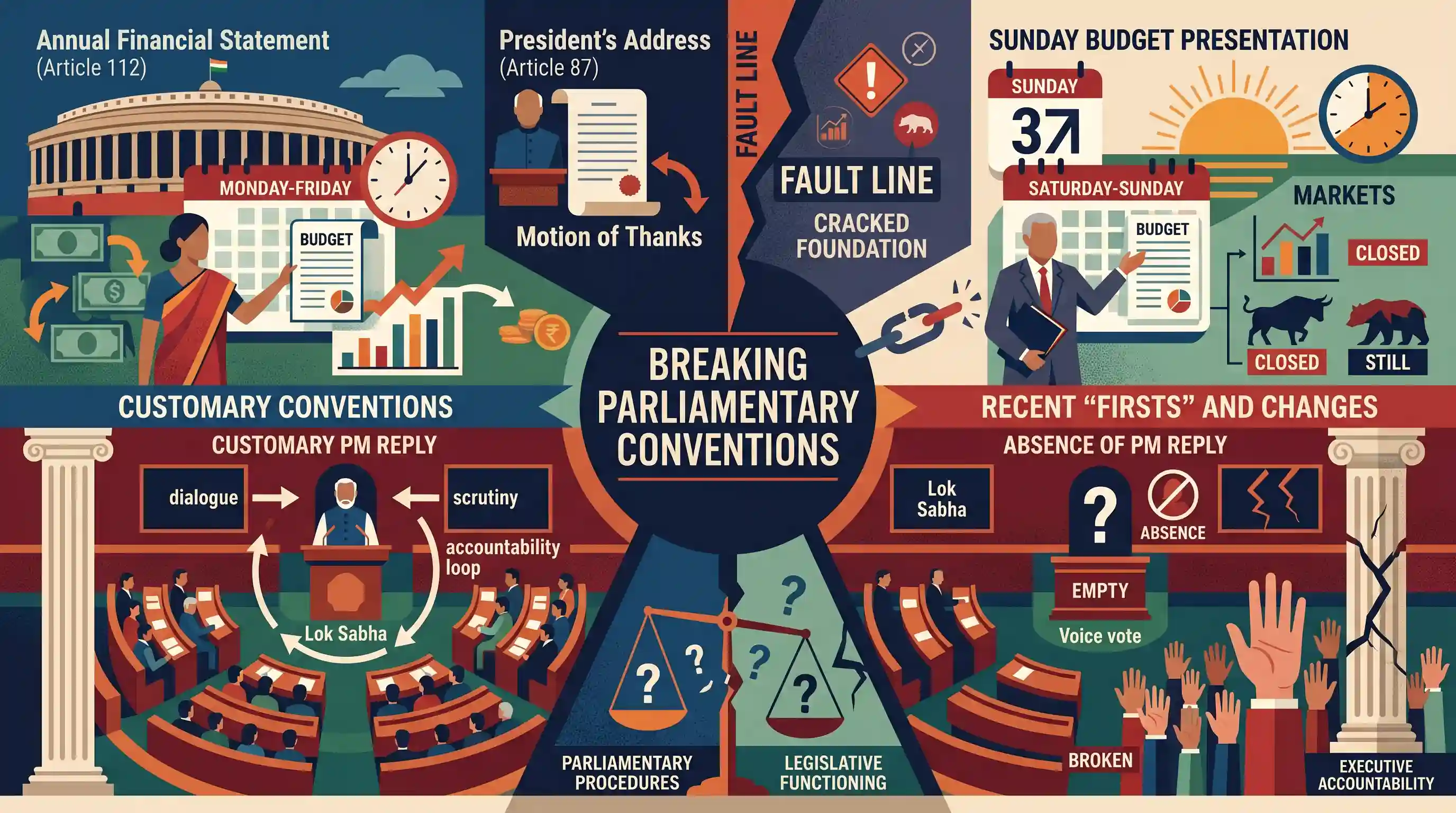
The recent parliamentary session broke several historical conventions, notably featuring the presentation of the Union Budget on a Sunday and the absence of the Prime Minister's customary reply to the Motion of Thanks in the Lok Sabha. These 'firsts' underscore significant changes in parliamentary procedures and raise questions regarding established traditions of executive accountability and legislative functioning.
Key Points
- The recent Budget Session witnessed notable departures from established parliamentary conventions, earning the moniker of a 'session of many firsts.'
- The Union Budget was presented on a Sunday, an unusual procedural scheduling for the annual financial statement.
- The Prime Minister did not deliver the customary reply to the debate on the Motion of Thanks on the President's Address in the Lok Sabha.
- These deviations highlight ongoing shifts in parliamentary conduct, the nature of executive accountability to the legislature, and the evolving dynamics between the ruling party and the opposition.
Important Terms
Motion of Thanks

A formal motion moved in Parliament following the President’s special address under Article 87. It serves as a debate on government policies; its defeat in the Lok Sabha necessitates the government's resignation.
UPSC context
GS II/Parliament. Tests knowledge of parliamentary devices, constitutional mandates, and mechanisms for ensuring executive accountability to the legislature.
Annual Financial Statement
Mandated by Article 112, this is the official constitutional document detailing the Central Government’s estimated receipts and expenditures for a financial year, laid before both Houses of Parliament.
UPSC context
GS II & III/Polity & Economy. Tests understanding of Article 112, fiscal transparency, and the legislative procedure for financial oversight.
Union Budget
The popular name for the Annual Financial Statement. It outlines fiscal policy, tax proposals, and spending. Recent sessions saw a break in convention with a Sunday presentation and no Prime Ministerial reply.
UPSC context
GS III/Economy. Tests the budgetary process, government spending priorities, and the significance of parliamentary conventions in financial planning.
Lok Sabha
The lower house of India’s Parliament, directly elected by the people. It is the house where the Council of Ministers is collectively responsible and where the Motion of Thanks must pass.
UPSC context
GS II/Polity. Tests the structure of the legislature, the principle of collective responsibility (Article 75), and the house’s role in confidence motions.
Parliament of India
The supreme legislative body of India, comprising the President, Lok Sabha, and Rajya Sabha. It holds the executive accountable through discussions, motions, and control over the national exchequer.
UPSC context
GS II/Polity. Tests the functions of the legislative branch, the relationship between its components, and the procedural rules governing sessions.
Prelims Trap
The Constitution of India explicitly defines the 'Motion of Thanks' under Article 87.
Article 87 only mandates the President's Address. The 'Motion of Thanks' itself is governed by the Rules of Procedure of the Houses, not the Constitution.
Static Concepts Connected
What governs the Motion of Thanks and its defeat in the Lok Sabha?
- Constitutional basis: Article 87 mandates the President's address, but the term 'Motion of Thanks' is born entirely from the Rules of Procedure and Conduct of Business.
- Defeat implies: If the Motion of Thanks is defeated in the Lok Sabha, it is treated as a loss of confidence in the government, akin to a no-confidence motion.
- Rajya Sabha limits: Only the Lok Sabha's vote determines the government's survival; a defeat of the Motion in the Rajya Sabha does not force resignation.
How is the scheduling of the Union Budget determined?
- Article 112: Article 112 requires the Annual Financial Statement to be presented but strictly avoids setting a specific date, day, or time for it.
- President's prerogative: The exact date of the Budget presentation is fixed by the President of India on the aid and advice of the Council of Ministers.
Cross-Topic Patterns
Constitutional Rules vs. Conventions
UPSC frequently tests the blurry lines between strict Constitutional mandates (e.g., Article 112) and parliamentary conventions (e.g., Budget dates, Motion of Thanks terminology).
Executive Accountability Shifts
The PM skipping the customary reply reflects evolving legislative dynamics, linking directly to the concept of collective responsibility and executive accountability under Article 75.

Expect a 2026 prelims statement mixing up strict constitutional mandates (Art 87) with parliamentary conventions (Motion of Thanks terminology).
Linked PYQs · 4
Linked PYQs · 4
- 2020PrelimsGS1
Consider the following statements: 1. The President of India can summon a session of the Parliament at such place as he/she thinks fit. 2. The Constitution of India provides for three sessions of the Parliament in a year, but it is not mandatory to conduct all three sessions. 3. There is no minimum number of days that the Parliament is required to meet in a year. Which of the statements given above is/are correct?
- 2024PrelimsGS1
With reference to Union Budget, consider the following statements : 1. The Union Finance Minister on behalf of the Prime Minister lays the Annual Financial Statement before both the Houses of Parliament. 2. At the Union level, no demand for a grant can be made except on the recommendation of the President of India. Which of the statements given above is/are correct?
- 2021MainsGS2
To what extent, in your view, the Parliament is able to ensure accountability of the executive in India?
- 2020PrelimsGS1
Along with the Budget, the Finance Minister also places other documents before the Parliament which include 'The Macro Economic Framework Statement'. The aforesaid document is presented because this is mandated by
