Addressing Systemic Accountability and Pendency in Indian Judiciary
Source:The Hindu ↗
Why It Matters
Judicial independence and accountability are foundational to Indian democracy. This critique is vital for UPSC aspirants as it touches upon core GS2 syllabus themes like the functioning of the judiciary, the collegium system, pendency of cases, and the ethical dimensions of public institutions (GS4) regarding conflicts of interest.
Summary
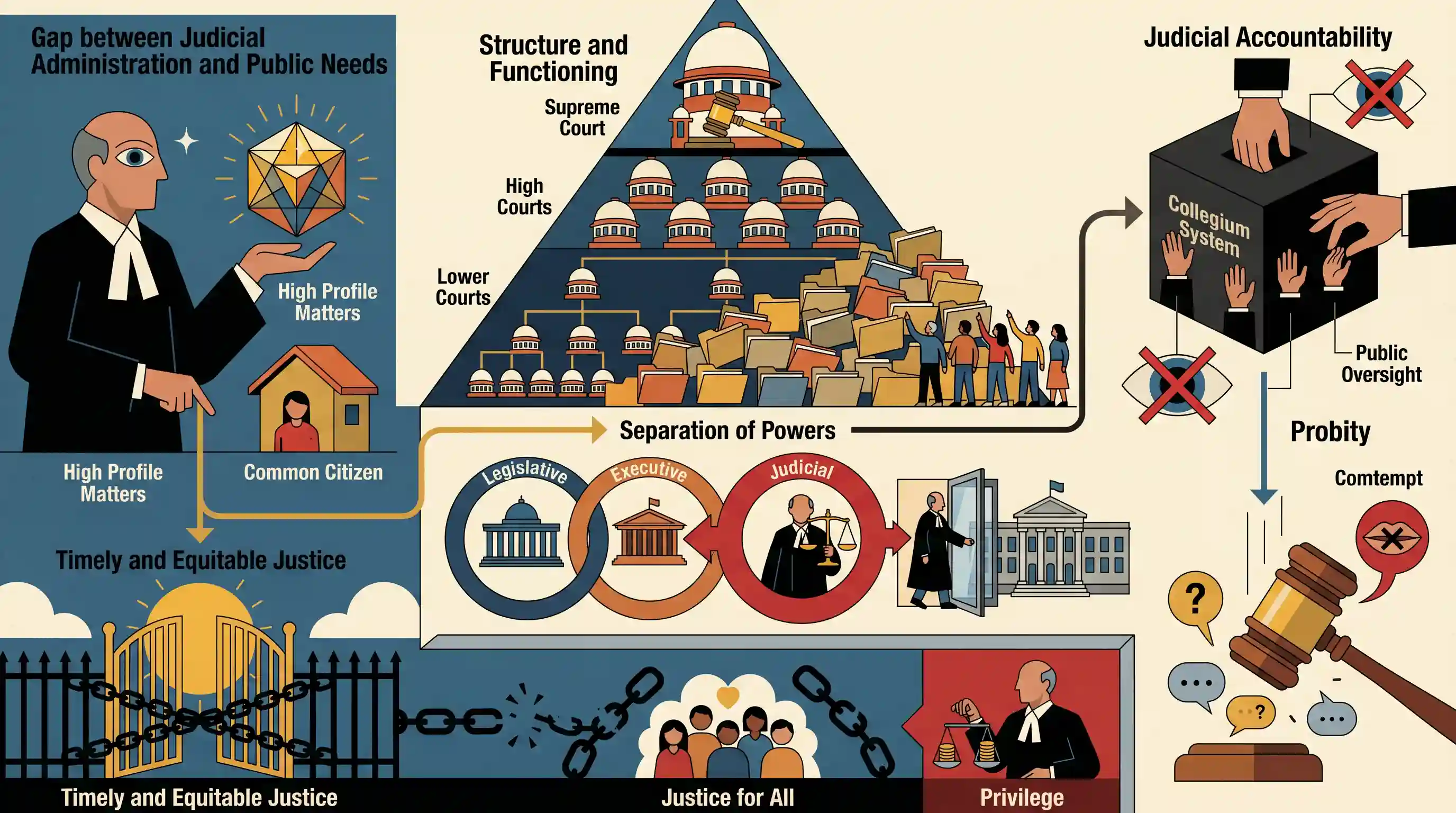
The article critiques the Indian judicial system, arguing that its operational mechanisms often serve the interests and privileges of judges rather than delivering timely and equitable justice to citizens. Highlighting the massive pendency of cases, the unequal prioritization of high-profile matters, and the misuse of contempt powers to stifle criticism, it emphasizes the growing gap between judicial administration and public needs. The piece also raises concerns over post-retirement appointments and the opacity of the collegium system, asserting that without robust accountability measures and systemic reforms, the judiciary risks functioning as an institution that serves its justices rather than the constitutional mandate of justice for all.
Key Points
- The Indian justice delivery system frequently faces criticism for prioritizing the privileges, sensitivities, and administrative comforts of judges over the timely dispensation of justice to ordinary citizens.
- A stark contrast exists between the massive pendency of over 50 million cases and the expedited hearings often granted to high-profile individuals, raising questions about equality before the law.
- Frequent use of contempt of court powers to shield the judiciary from legitimate criticism undermines judicial accountability and stifles freedom of speech.
- The prospect of post-retirement appointments continues to cast a shadow on judicial independence, creating potential conflicts of interest for serving justices.
- There is an urgent need for citizen-centric systemic reforms, including a robust mechanism for judicial accountability, better case management, and greater transparency in appointments and the allocation of cases.
Important Terms
Collegium System

The system for appointing and transferring judges to the Supreme Court and High Courts, consisting of the Chief Justice and senior-most judges. It evolved through judicial precedents rather than constitutional provisions.
UPSC context
GS Paper II: Judiciary. Tests knowledge of the 'Three Judges Cases' and judicial independence.
National Judicial Appointments Commission (NJAC) Act
A 2014 constitutional amendment aimed at replacing the collegium with a multi-stakeholder body for judicial appointments. It was struck down by the Supreme Court in 2015 for violating the basic structure.
UPSC context
GS Paper II: Constitutional Amendments. Tests understanding of the separation of powers and judicial primacy.
Master of the Roster
The administrative prerogative of the Chief Justice of India (or High Courts) to constitute benches and allocate cases. It grants the Chief Justice exclusive control over the court's judicial roster.
UPSC context
GS Paper II: Judiciary. Relevant for debates on judicial administration and internal accountability mechanisms.
Contempt of Court
The power of higher courts (Articles 129 and 215) to punish acts that scandalize the court or obstruct justice. The 1971 Act distinguishes between civil and criminal contempt.
UPSC context
GS Paper II: Judiciary/Rights. Tests the balance between freedom of expression and judicial dignity.
Judicial Accountability
The principle that judges must be responsible for their conduct and decisions without compromising independence. Mechanisms include impeachment (Article 124) and the 'Restatement of Values of Judicial Life.'
UPSC context
GS Paper II/IV: Governance and Ethics. Tests concepts of transparency and probity in the judiciary.
Separation of Powers
A constitutional doctrine dividing government into the Legislature, Executive, and Judiciary to prevent the concentration of power. India follows functional separation with a system of checks and balances.
UPSC context
GS Paper II: Constitution. Fundamental for understanding the relationship between state organs.
Post-Retirement Appointments
The assignment of retired judges to executive or quasi-judicial roles. It is often criticized for potentially influencing judicial decisions prior to retirement, leading to calls for a mandatory 'cooling-off period.'
UPSC context
GS Paper II/IV: Ethics and Judiciary. Tests understanding of conflict of interest and judicial independence.
Prelims Trap
"The Constitution of India explicitly defines 'Civil' and 'Criminal' contempt of court."
The Constitution grants the power to punish for contempt (Art 129/215) but does NOT define it. The definitions of civil and criminal contempt are in the Contempt of Courts Act, 1971.
Static Concepts Connected
What are the constitutional and statutory provisions for Contempt of Court?
- Supreme Court: Article 129 makes the Supreme Court a Court of Record with the power to punish for its contempt.
- High Courts: Article 215 grants similar powers to High Courts to punish for their contempt.
- Statutory Framework: The Contempt of Courts Act, 1971 provides the statutory framework, defining and limiting civil and criminal contempt.
What does the "Master of the Roster" principle entail?
- Administrative Prerogative: The Chief Justice (of the SC or HC) holds exclusive administrative power to constitute benches and allocate cases.
- First Among Equals: Judicially, the Chief Justice remains 'first among equals' (primus inter pares) and has no superior adjudicatory authority over other judges.
- Convention Basis: It is an administrative convention upheld by the Supreme Court to ensure discipline and efficiency, not a strictly codified constitutional rule.
Cross-Topic Patterns
Post-Retirement Jobs & Separation of Powers
Acceptance of executive roles like Governors or tribunal heads by retired judges links GS2 Judicial Independence with GS4 Probity and Conflict of Interest.
Digital India & Judicial Pendency
The National Judicial Data Grid (NJDG) ties GS2 governance reforms with GS3 e-governance, acting as a real-time monitor for tracking case backlogs and systemic inefficiencies.

Expect a 2026 prelims multi-statement question mixing 'Master of Roster' convention with constitutional limits on Contempt.
Linked PYQs · 4
Linked PYQs · 4
- 2023MainsGS2
“Constitutionally guaranteed judicial independence is a prerequisite of democracy.” Comment.
- 2025MainsGS2
Discuss the evolution of collegium system in India. Critically examine the advantages and disadvantages of the system of appointment of the Judges of the Supreme Court of India and that of the USA.
- 2017MainsGS2
Critically examine the Supreme Court's judgement on 'National Judicial Appointments Commission Act, 2014' with reference to appointment of judges of higher judiciary in India.
- 2022MainsGS4
Discuss the significance of 'Conflict of interest' in the context of public administration.
