Systemic gaps and judicial pendency in child sexual abuse cases
Source:The Hindu ↗
Why It Matters
It underscores critical systemic failures in protecting vulnerable sections (children), highlighting how high judicial pendency, ineffective punitive laws, and urban design flaws negate the intended benefits of social justice policies.
Summary
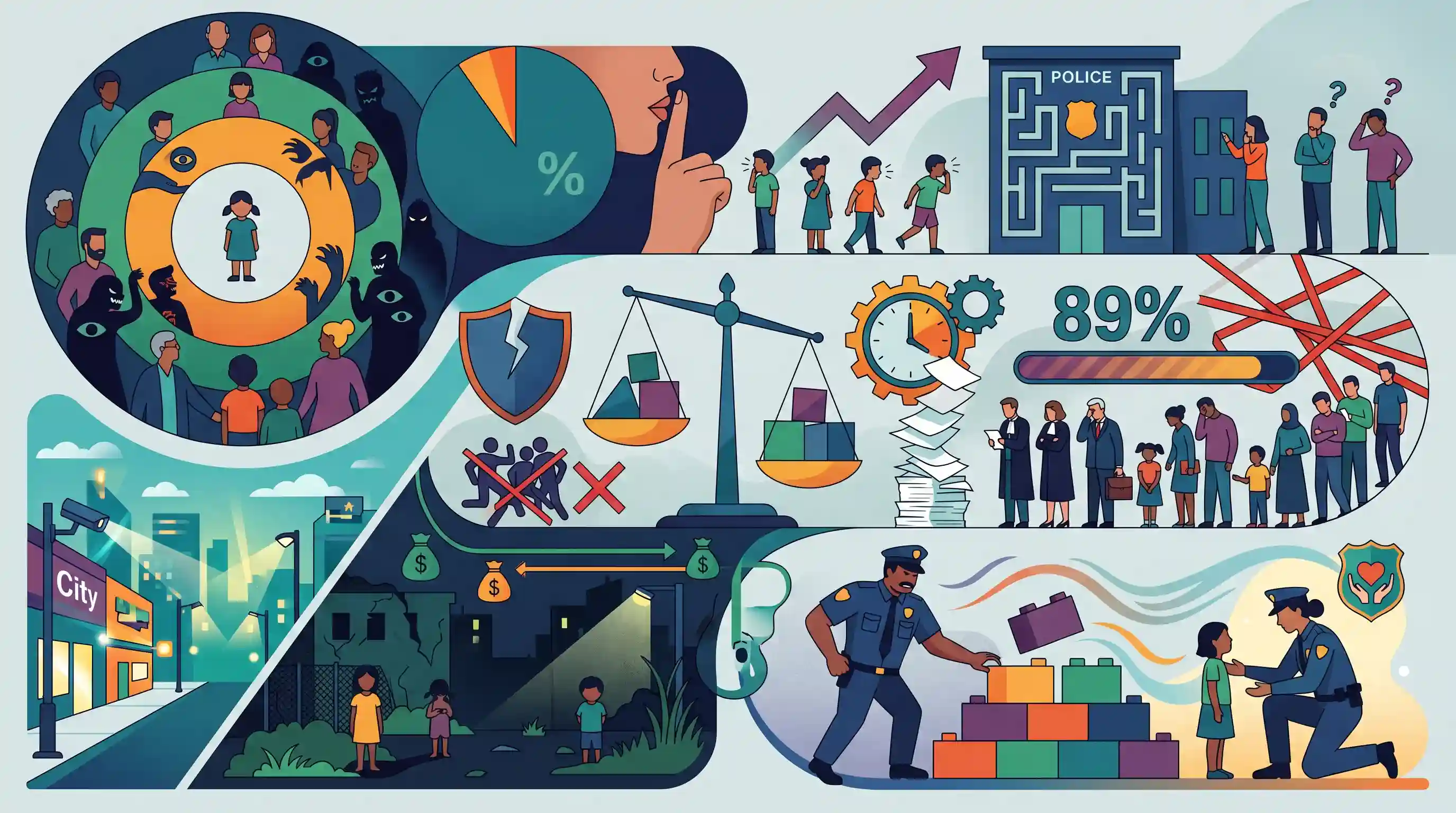
Child sexual abuse in India is persistently under-reported, with over 90% of threats originating from trusted circles. While the state's response has primarily focused on increasing penalties through the 2018 and 2019 POCSO Act amendments, these harsh punishments fail to deter offenders and inadvertently suppress reporting. Systemic inefficiencies, including public distrust in police, insensitive administration, and an 89% pendency rate in POCSO trials, further undermine justice. Additionally, urban development initiatives like the 'Safe City' project often neglect marginalized spaces—such as abandoned sites and common lands—where such crimes frequently occur.
Key Points
- Over 90% of child sexual abuse incidents involve perpetrators known to the victim, significantly suppressing reporting rates.
- Urban development paradigms, including 'Safe City' projects, overlook marginalized spaces like abandoned industrial sites and unmaintained common lands that often serve as crime scenes.
- The judicial process for POCSO cases suffers from an 89% pendency rate and a dismal conviction rate ranging between 3% to 30%.
- Harsher penalties introduced via the 2018 and 2019 POCSO Act amendments have failed to act as deterrents, instead leading to secondary victimisation and reduced reporting.
- A lack of trauma-informed policing and stigma-induced distrust in law enforcement exacerbate the vulnerabilities of victims.
Important Terms
Protection of Children from Sexual Offences (POCSO) Act

A 2012 law protecting individuals under 18 from sexual abuse, harassment, and pornography. It is gender-neutral, mandates reporting, and defines 'aggravated' offenses for those in positions of trust.
UPSC context
GS II: Governance and Social Justice. Tests knowledge of child rights, legal safeguards, and the impact of punitive vs. reformative justice.
Safe City project
A Ministry of Home Affairs initiative under the Nirbhaya Fund to improve urban safety for women and children through tech-based policing, CCTV surveillance, and AI-driven monitoring in eight major cities.
UPSC context
GS III: Internal Security/Infrastructure. Evaluates tech-interventions in urban policing and the effectiveness of safety initiatives for vulnerable groups.
National Crime Records Bureau (NCRB)
A central agency under the Ministry of Home Affairs responsible for collecting and analyzing crime data, publishing the annual 'Crime in India' report, and maintaining national criminal databases.
UPSC context
GS II: Governance. Crucial for data-driven policymaking, tracking crime trends (like POCSO pendency), and assessing the effectiveness of the criminal justice system.
Prelims Trap
"The 2019 POCSO amendments introducing the death penalty successfully increased the reporting and conviction rates of child sexual abuse."
Because over 90% of abusers are known to the child, extreme penalties create immense familial pressure to suppress cases, paradoxically lowering reporting.
Static Concepts Connected
What are the key statutory mandates of the POCSO Act, 2012?
- Gender Neutrality: It recognizes sexual abuse against children of all genders, departing from traditional gender-specific rape laws.
- Mandatory Reporting: Makes it a legal obligation for anyone aware of suspected abuse to report it; failure to report is a punishable offense.
- Time-bound Trial: Statutorily mandates the completion of trials within one year of taking cognisance of the offense.
How is the Nirbhaya Fund administered and utilized?
- Non-lapsable Corpus: It is a non-lapsable corpus fund established in 2013 dedicated to implementing initiatives aimed at enhancing the safety and security of women.
- Nodal Agency: Administered by the Department of Economic Affairs, but the Ministry of Women and Child Development is the nodal agency to appraise schemes.
- Key Beneficiary Schemes: It funds the 'Safe City' project, Fast Track Special Courts (FTSCs), One Stop Centres, and the Emergency Response Support System.
Cross-Topic Patterns
The paradox of harsh punishments
Links POCSO's death penalty amendments to broader penology debates, illustrating how extreme statutory penalties can depress reporting rates when the offender is a family member or trusted acquaintance.
Urban marginal spaces vs. Safe City tech
Connects tech-heavy surveillance (AI cameras in city cores) with the geographical neglect of peri-urban and abandoned spaces, highlighting spatial inequality in public safety planning.
Special courts and structural pendency
Highlights the gap between statutory mandates (1-year trial conclusion) and reality (89% pendency), linking POCSO's failure to broader GS2 themes of criminal justice system under-capacity.

POCSO's death penalty amendments paradoxically lowering reporting rates is highly likely to feature as an 'Assertion-Reason' in 2026.
Linked PYQs · 3
Linked PYQs · 3
- 2025MainsGS2
The National Commission for Protection of Child Rights has to address the challenges faced by children in the digital era. Examine the existing policies and suggest measures the Commission can initiate to tackle the issue.
- 2016MainsGS2
Examine the main provisions of the National Child Policy and throw light on the status of its implementation.
- 2019MainsGS2
Performance of welfare schemes that are implemented for vulnerable sections is not so effective due to absence of their awareness and active involvement at all stages of policy process. Discuss.
