Serentica Announces Rs 1 Trillion Renewable Investment in Rajasthan
Source:renewablewatch ↗
Why It Matters
Rajasthan has India's highest solar potential, and massive corporate investments like Serentica's Rs 1 trillion project highlight the shift towards commercial-scale solar-plus-storage (BESS) infrastructure. This is critical for grid stability, clean energy targets, and transitioning towards decarbonization.
Summary
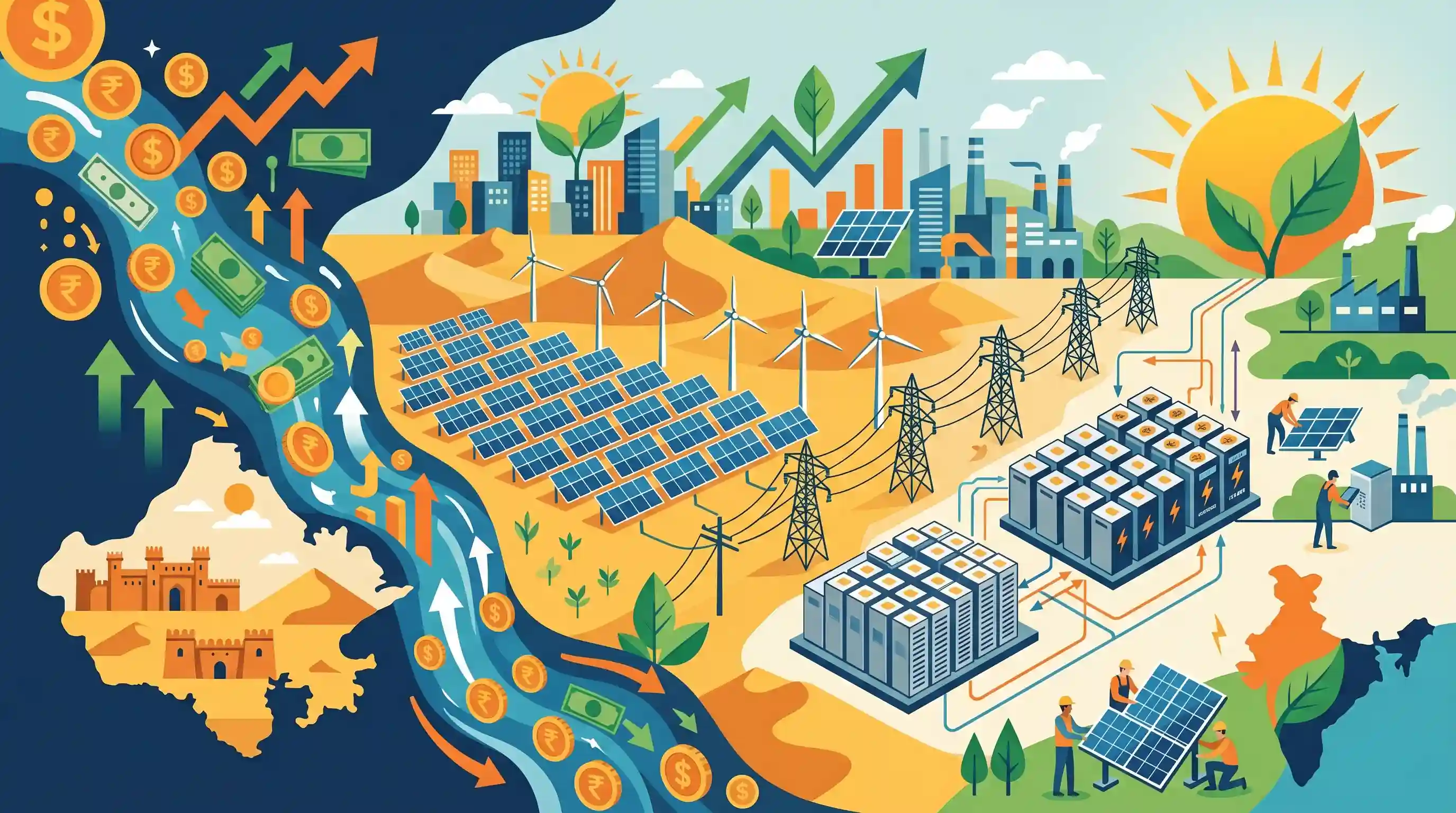
Serentica Renewables has announced plans to invest Rs 1 trillion (Rs 1,000 billion) in Rajasthan to expand its renewable energy portfolio, which is already backed by over Rs 100 billion of investments in the state. Rajasthan represents more than 50% of the firm's solar footprint, which includes projects in Bikaner and Jaisalmer, and a pipeline extending to Bhadla. To handle grid integration and peak load, Serentica is deploying massive Battery Energy Storage System (BESS) assets: a two-phase 1,000 MWh BESS in Bikaner and a 2,500 MWh BESS in Fatehgarh (scheduled for FY 2026-27) alongside major solar expansion. This development highlights Rajasthan's pivotal role in India's green transition, driven by robust renewable policies and its vast geographical advantages.
Key Points
- Serentica Renewables plans to invest Rs 1 trillion (Rs 1,000 billion) in Rajasthan for renewables expansion, with over Rs 100 billion already deployed.
- Rajasthan accounts for over 50% of the company's total solar portfolio, with operational projects in Bikaner and Jaisalmer, and a planned expansion to Bhadla.
- The company is establishing massive Battery Energy Storage System (BESS) projects in Bikaner, where Phase I (200 MWh) is being commissioned and Phase II (800 MWh) is expected within three months.
- In Fatehgarh, Serentica is expanding its solar project with an initial 1,270 MWp capacity, followed by another 500 MWp, alongside a 2,500 MWh BESS planned for FY 2026-27.
- The projects are part of Serentica's 27,000 MW pipeline, which aims to supply 67 billion units of clean electricity annually and reduce carbon dioxide emissions by 47 million tonnes.
Important Terms
Battery Energy Storage System (BESS)

Electrochemical systems that store electrical energy (primarily from intermittent sources like wind and solar) for later use, helping balance grid supply and demand, manage peak loads, and enhance grid stability.
UPSC context
GS Paper III: Infrastructure & Energy. Tests awareness of technologies ensuring grid stability and managing renewable energy intermittency.
Rajasthan Renewable Energy Corporation Limited (RRECL)
A state-owned enterprise formed by merging RSPCL and REDA, acting as the nodal agency for the development, registration, and facilitation of renewable energy projects and solar parks in Rajasthan.
UPSC context
GS Paper III: Energy Infrastructure. Tests knowledge of key state-level public institutions driving India's decentralized green transition.
Rajasthan Solar Energy Policy
A state initiative (integrated into the Renewable Energy Policy) aimed at leveraging Rajasthan's high solar radiation, providing land, transmission concessions, and grid-access guarantees to scale solar installations.
UPSC context
GS Paper III: Government Policies & Infrastructure. Tests understanding of regional fiscal incentives and land-allotment frameworks promoting solar power.
Serentica Renewables
A private Indian green energy provider that develops hybrid solar, wind, and storage facilities to deliver round-the-clock carbon-free power to energy-intensive industrial and commercial sectors.
UPSC context
GS Paper III: Economic Development & Energy. Tests appreciation of private sector investments and industrial decarbonization pathways in India.
Prelims Trap
PM-KUSUM Component-A allows farmers to set up decentralized solar plants on highly fertile agricultural land to maximize their supplementary income.
Under PM-KUSUM Component-A, projects are explicitly restricted to barren, fallow, uncultivable, pasture, or marshy lands to prevent the diversion of fertile, double-cropped agricultural soil.
Static Concepts Connected
What are the three core components of the PM-KUSUM Scheme?
- Component-A: Set up 10,000 MW of decentralized, grid-connected solar power plants (0.5 to 2 MW) on barren or uncultivable lands.
- Component-B: Install 20 lakh standalone solar-powered agriculture pumps for off-grid irrigation.
- Component-C: Solarize 15 lakh grid-connected agriculture pumps, enabling farmers to use solar power and sell surplus electricity to DISCOMs.
What is Battery Energy Storage System (BESS) and why is it critical for the grid?
- Peak Shaving: Stores surplus power generated during peak production times (e.g., solar noon) and discharges it during peak demand hours.
- Grid Stability: Mitigates the intermittent nature of solar and wind energy by maintaining grid frequency and preventing voltage fluctuations.
- Decarbonization: Reduces the reliance on fossil-fuel-based "peaker plants" (usually coal or gas) during sudden demand spikes.
Cross-Topic Patterns
Renewable integration vs DISCOM health
Mega solar expansions in states like Rajasthan strain local DISCOMs with integration costs, linking renewable targets directly to federal energy reforms like RDSS.
Green infrastructure vs Biodiversity protection
Concentrating solar parks in arid zones of Rajasthan triggers direct conflicts with Great Indian Bustard (GIB) conservation, intersecting green energy with environmental law.

PM-KUSUM components and grid-scale BESS solutions for renewable intermittency will likely be tested in a single GS-3 question in 2026.
Linked PYQs · 3
Linked PYQs · 3
- 2021RPSC_PRELIMSGS1
In which year was the Rajasthan Solar Energy Policy announced?
- 2023RPSC_PRELIMSGS1
Which agency has been given the responsibility of implementing the PM-KUSUM scheme (Component A) in Rajasthan, which involves the establishment of solar power plants with a capacity of 0.5 MW to 2 MW?
- 2012RPSC_PRELIMSGS1
Which institution plays an important role in promoting the production of non-conventional energy in Rajasthan?
