Serentica Commissions First Phase of BESS Project in Bikaner
Source:energy-storage-news ↗
Why It Matters
BESS (Battery Energy Storage Systems) is a crucial emerging technology required for grid stability and to ensure round-the-clock renewable energy supply. Given Rajasthan's prominence as India's top state for solar capacity, such large-scale storage projects are highly relevant for state-specific economic, geographical, and technological topics in RPSC RAS Prelims.
Summary
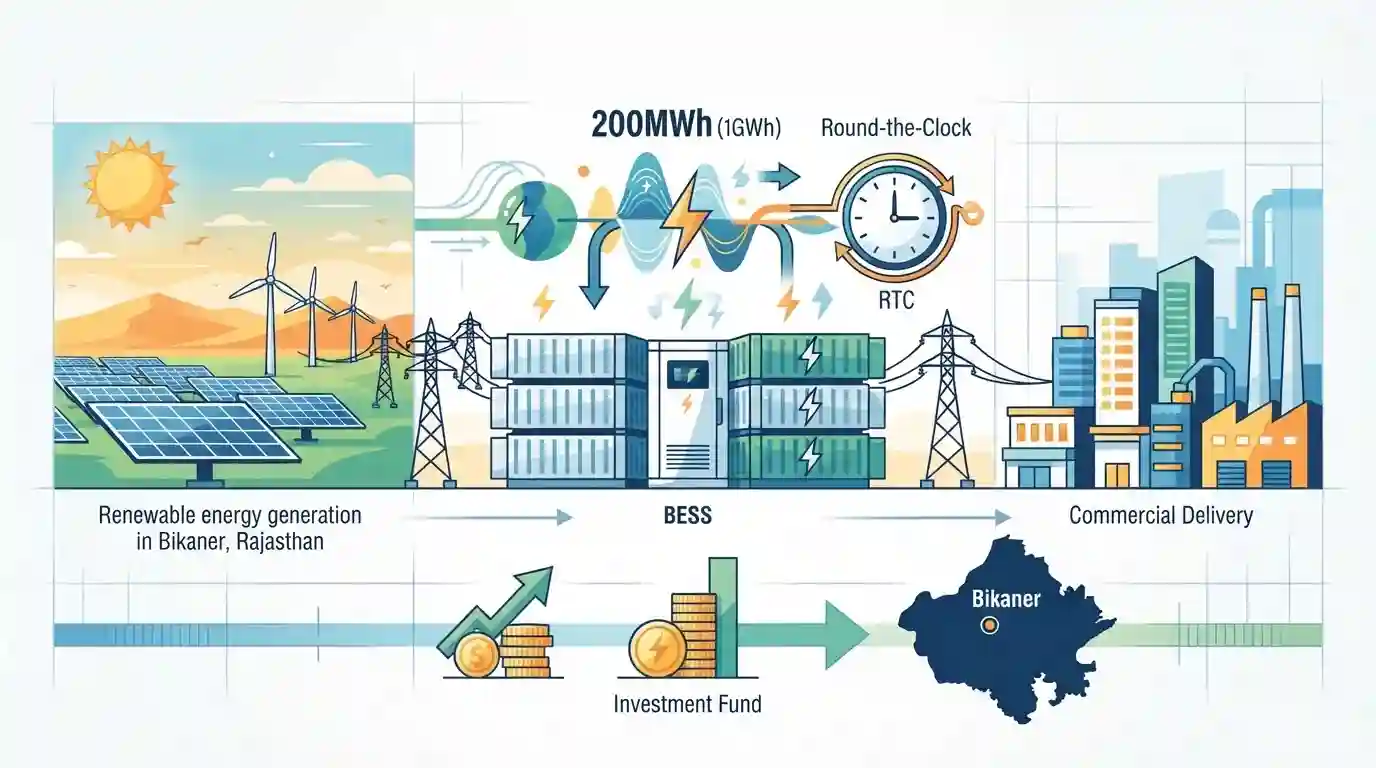
Serentica Renewables has officially commissioned the first phase of a 1GWh Battery Energy Storage System (BESS) project in Bikaner, Rajasthan. This 200MWh initial phase is designed to support the delivery of firm and dispatchable round-the-clock (RTC) renewable energy to commercial and industrial customers, mitigating the inherent intermittency of solar and wind power. This BESS development is a critical component of Serentica’s broader INR 1 trillion (US$ 10.5 billion) investment strategy in Rajasthan. The project highlights Bikaner's rapid emergence as a central hub for utility-scale solar and storage projects in India, further consolidating Rajasthan's leading position in the nation's renewable energy transition.
Key Points
- Serentica Renewables has commissioned the first phase of a 1GWh Battery Energy Storage System (BESS) in Bikaner, Rajasthan.
- The initial phase features a 200MWh capacity and will supply round-the-clock (RTC) renewable energy to commercial and industrial (C&I) customers.
- This initiative represents a portion of Serentica’s comprehensive INR 1 trillion (US$ 10.5 billion) investment plan focused on Rajasthan.
- Rajasthan continues to be a major renewable energy hub, accounting for approximately a third of all new utility-scale solar installed in India in the previous year.
- The Bikaner region hosts a massive concentration of renewable facilities, including projects by SJVN, ArcelorMittal, Tata Power, and Avaada Group.
Important Terms
Solar Energy Corporation of India (SECI)

A Central Public Sector Enterprise (CPSE) under the Ministry of New and Renewable Energy that facilitates solar energy implementation and conducts renewable energy tenders.
UPSC context
GS Paper 3 (Infrastructure: Energy). Tests knowledge of nodal agencies driving India's clean energy goals and policies.
Power Purchase Agreement (PPA)
A long-term bilateral contract between an electricity generator and a buyer that defines the tariff and terms for off-taking power, crucial for project bankability.
UPSC context
GS Paper 3 (Energy Infrastructure & Investment Models). Tests mechanisms of financial viability and regulatory stability in utility-scale projects.
Serentica Renewables
A prominent Indian independent power producer and decarbonization platform backed by Vedanta Group and KKR, focused on delivering round-the-clock clean energy to industrial segments.
UPSC context
GS Paper 3 (Economic Development/Infrastructure). Evaluates the role of private developers and global investments in industrial decarbonization.
SJVN Green Energy Limited (SGEL)
A wholly-owned subsidiary of SJVN Limited, a Navratna CPSE, tasked with rapid capacity additions in solar, wind, hybrid, and battery storage projects.
UPSC context
GS Paper 3 (Infrastructure). Tests public sector contributions to India's goal of 500 GW non-fossil fuel capacity by 2030.
Avaada Group
A prominent Indian clean energy conglomerate specializing in solar power, green hydrogen, and battery storage, known for developing mega-scale renewable energy infrastructure.
UPSC context
GS Paper 3 (Environment/Energy). Analyzes private sector scaling, domestic solar manufacturing, and green fuel development in India's transition.
Tata Power
A major Indian integrated power utility company leading utility-scale solar, wind, and energy storage developments, and pioneering private investment in domestic nuclear energy.
UPSC context
GS Paper 3 (Energy Infrastructure). Tests corporate diversification into green technologies and private participation in national energy security.
ArcelorMittal
A global steel giant investing heavily in large-scale renewable and battery storage projects in India to facilitate transition toward low-carbon and clean steel manufacturing.
UPSC context
GS Paper 3 (Environment/Industry). Evaluates corporate decarbonization, industrial emission reductions, and clean energy supply chains in core sectors.
Prelims Trap
The VGF scheme for BESS fully subsidizes capital costs to enable round-the-clock renewable power.
The Viability Gap Funding provides financial support up to 40% of the capital cost, not 100%, aiming to reduce the levelized cost of storage.
Static Concepts Connected
What is Viability Gap Funding (VGF) and how does it apply to BESS?
- Definition: Grants provided to support infrastructure projects that are economically justified but fall short of financial viability due to high upfront capital requirements.
- BESS Application: The government provides up to 40% of capital costs for BESS projects to significantly reduce the Levelized Cost of Storage (LCoS).
- Objective: Makes round-the-clock (RTC) renewable energy dispatchable and commercially viable for both discoms and commercial & industrial (C&I) consumers.
How is renewable energy intermittency managed on the power grid?
- Battery Storage: Large-scale BESS (like lithium-ion) stores peak-generation surplus energy for use during evening peak-demand hours.
- Pumped Hydro: Pumps water to a higher reservoir during low demand or high generation, releasing it through turbines when demand peaks.
- Grid Integration: Storage minimizes the curtailment (waste) of solar/wind power and helps maintain grid frequency and voltage stability.
Cross-Topic Patterns
Energy Storage & Critical Mineral Security
The massive 47 GW BESS requirement by 2032 directly links to India's push for lithium and cobalt supply chains, driving diplomacy through the Quad and Mineral Security Partnership.
Arid Geography as an Economic Asset
Rajasthan's vast arid tracts with high solar insolation (Bikaner, Bhadla) are transforming from agricultural liabilities into high-value utility-scale renewable energy hubs, redefining land economics.

Expect a multi-statement question linking BESS VGF limits (40%), grid stability mechanisms, and India's critical mineral supply chain.
Linked PYQs · 3
Linked PYQs · 3
- 2021RPSC_PRELIMSGS1
In which year was the Rajasthan Solar Energy Policy announced?
- 2012RPSC_PRELIMSGS1
The first solar energy policy was announced by the Government of Rajasthan in -
- 2016RPSC_PRELIMSGS1
The photovoltaic cell is related to
