Bikaner Battery Energy Storage System And Renewable Power Integration
Source:indian-infrastructure ↗
Why It Matters
Rajasthan's renewable energy sector is a highly tested topic in RPSC Prelims. The shift from pure solar generation to integrated Battery Energy Storage Systems (BESS) is the next frontier in India's energy transition, and large-scale projects in places like Bikaner are prime candidates for current affairs questions.
Summary
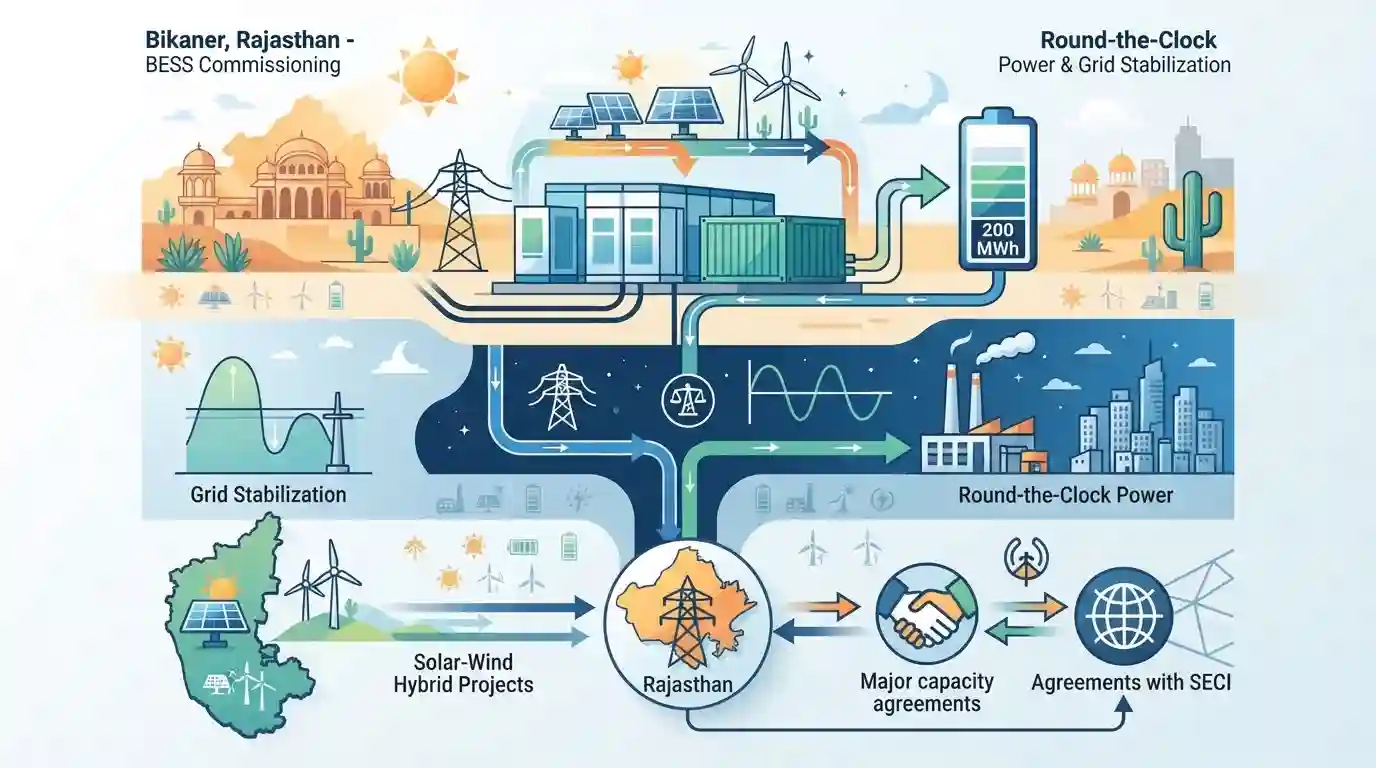
Serentica Renewables has successfully commissioned a 200 MWh Battery Energy Storage System (BESS) in Bikaner, Rajasthan, marking the first phase of its ambitious 1 GWh storage project. The facility is designed to deliver round-the-clock renewable power to industrial clients by mitigating the intermittency of solar and wind generation. This development highlights Rajasthan's growing importance not just in solar generation but also in critical grid-stabilization technologies like large-scale battery storage. In addition, Serentica has ongoing solar-wind hybrid projects in Karnataka and major capacity agreements with SECI.
Key Points
- Serentica Renewables has commissioned a 200 MWh Battery Energy Storage System (BESS) in Bikaner, Rajasthan.
- This is Phase I of a larger 1 GWh BESS project intended to supply round-the-clock (RTC) renewable power to industrial consumers.
- The company recently secured loan facilities for a solar-wind hybrid project in Karnataka and signed a Power Purchase Agreement with SECI for a 600 MW/2400 MWh project.
- The Bikaner project further consolidates Rajasthan's position as a major renewable energy and power storage hub in India.
Important Terms
Battery Energy Storage System (BESS)

Electrochemical systems that store surplus electrical energy generated from intermittent renewable sources, like solar and wind, and discharge it during peak demand periods to ensure a continuous power supply.
UPSC context
Crucial for GS Paper 3 (Energy, Infrastructure); directly addresses the grid stability and intermittency challenges of renewable energy integration.
Solar Energy Corporation of India (SECI)
A Navratna Central Public Sector Enterprise under the Ministry of New and Renewable Energy. It serves as India's primary nodal agency for implementing large-scale solar, wind, and hybrid renewable energy projects.
UPSC context
Highly relevant for Prelims (Institutions) and GS Paper 3; central to achieving India’s 500 GW non-fossil fuel capacity target.
Round-the-Clock (RTC) Renewable Power
An energy supply model that pairs intermittent renewable generation with energy storage or hybrid systems to guarantee a firm, continuous, 24/7 dispatchable supply of clean electricity.
UPSC context
Important for GS Paper 3 (Energy); represents the next phase of India's green transition by replacing baseload thermal power.
Serentica Renewables
A renewable independent power producer (IPP) focused on supplying utility-scale, round-the-clock clean energy and battery storage solutions to commercial and industrial sectors to aid in industrial decarbonization.
UPSC context
Useful case study for GS Paper 3 (Infrastructure) demonstrating private sector investment in large-scale energy storage and grid resilience.
Prelims Trap
"The Solar Energy Corporation of India (SECI) is a statutory body established under the Electricity Act."
SECI is a Central Public Sector Undertaking (CPSU) incorporated under the Companies Act, not a statutory body created by an Act of Parliament.
Static Concepts Connected
What is Round-The-Clock (RTC) Renewable Energy?
- Definition: A mechanism to provide 24x7 carbon-free electricity, overcoming the inherent intermittency of solar and wind generation.
- Mechanism: Achieved by blending solar and wind power (which peak at different times) and integrating them with energy storage like BESS or pumped hydro.
- Significance: Eliminates the need for fossil-fuel backup (baseload) power, accelerating the decarbonization of the industrial and commercial sectors.
What is the grid function of Battery Energy Storage Systems (BESS)?
- Load Shifting: Stores surplus renewable energy during high generation periods (e.g., daytime solar) and discharges it during peak demand hours (evening).
- Frequency Regulation: Provides rapid response to supply-demand fluctuations, maintaining the grid's standard frequency (50 Hz) and preventing blackouts.
- Government Support: The Government recently approved a Viability Gap Funding (VGF) scheme to develop 4,000 MWh of BESS capacity by 2030-31.
Cross-Topic Patterns
BESS + National Critical Minerals Mission
Large-scale BESS deployment relies on lithium and vanadium, directly linking this grid infrastructure push to India's recent critical mineral block auctions and the National Critical Minerals Mission.
RTC renewables fueling Green Hydrogen
Continuous, cheap renewable energy (RTC) is the primary prerequisite for economically viable green hydrogen production via electrolysis, reducing the carbon footprint of fertilizer and refinery sectors.

Expect a 2026 multi-statement question linking Round-The-Clock (RTC) power guidelines, SECI's role, and Battery Energy Storage.
Linked PYQs · 3
Linked PYQs · 3
- 2023RPSC_PRELIMSGS1
Which agency has been given the responsibility of implementing the PM-KUSUM scheme (Component A) in Rajasthan, which involves the establishment of solar power plants with a capacity of 0.5 MW to 2 MW?
- 2021RPSC_PRELIMSGS1
In which year was the Rajasthan Solar Energy Policy announced?
- 2016RPSC_PRELIMSGS1
The photovoltaic cell is related to
