Bikaner Battery Storage Project Boosts Rajasthan Clean Energy Grid
Source:renewablewatch ↗
Why It Matters
Rajasthan is a major hub for renewable energy in India. The establishment of large-scale battery storage is crucial for managing the intermittency of solar and wind power, directly contributing to India's clean energy targets and supporting industrial growth in the state.
Summary
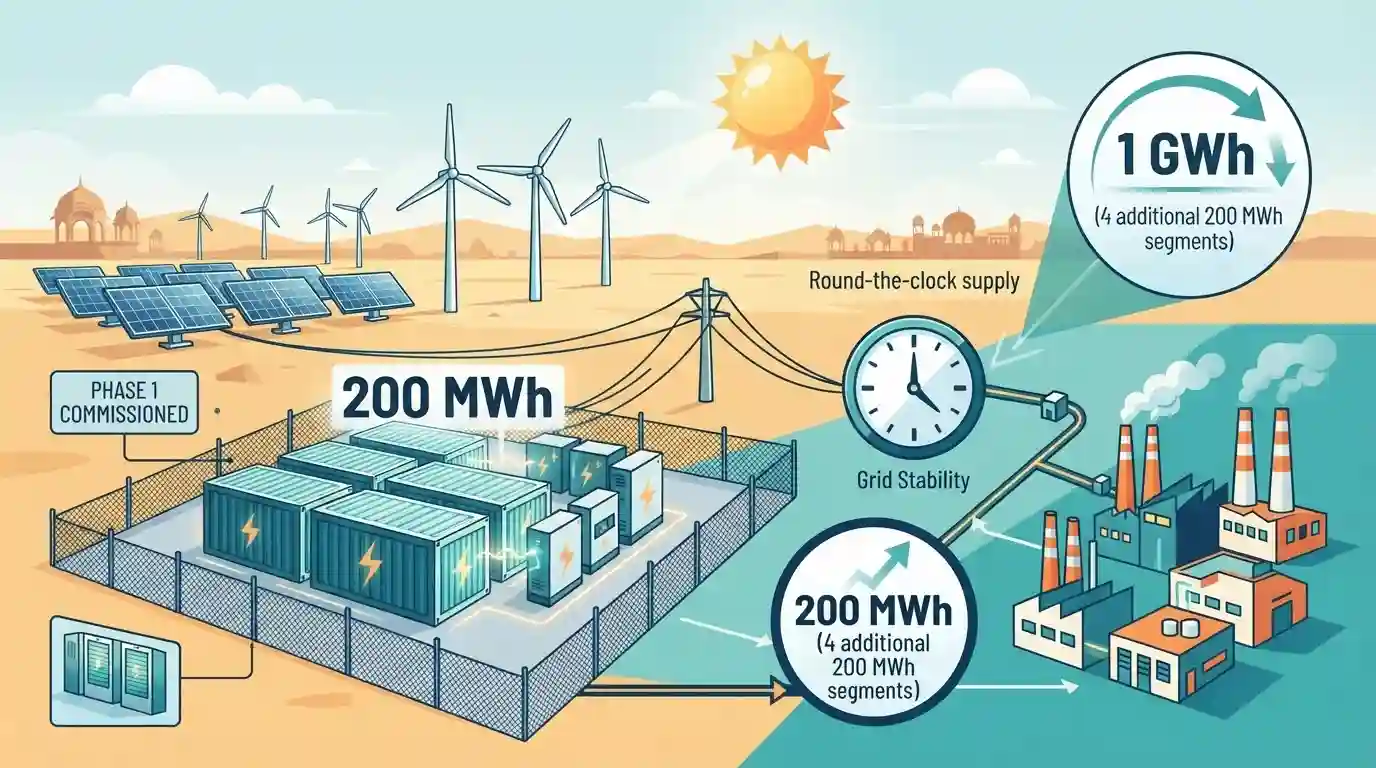
Serentica Renewables has commissioned a 200 MWh battery energy storage system (BESS) in Bikaner, Rajasthan. This marks the first phase of a larger 1 GWh project designed to supply reliable, round-the-clock renewable energy to industrial consumers and support grid stability.
Key Points
- Serentica Renewables has commissioned the first phase of its 1 GWh battery energy storage system (BESS) project in Bikaner, Rajasthan.
- The commissioned phase features a 200 MWh BESS.
- This storage facility aims to provide round-the-clock (RTC) renewable power arrangements for industrial consumers, ensuring grid stability.
Important Terms
Battery Energy Storage System (BESS)

Electrochemical devices that store excess electrical energy (particularly from variable sources like solar and wind) in chemical form and release it back to the power grid when demand peaks.
UPSC context
GS Paper III (Infrastructure/Energy); tests understanding of grid integration technologies, clean energy transition, and targets for non-fossil fuel capacity.
Round-the-Clock (RTC) Renewable Energy
A power supply model pairing hybrid renewable energy sources (like solar and wind) with storage technologies to deliver continuous, uninterrupted clean electricity against a fixed schedule or 24/7 demand.
UPSC context
GS Paper III (Infrastructure/Energy); tests strategies for overcoming renewable energy intermittency and policy frameworks like Firm and Dispatchable Renewable Energy (FDRE).
Grid Stability
The capacity of an electrical power network to maintain continuous equilibrium between electricity generation and demand, keeping voltage and frequency within safe limits despite power fluctuations.
UPSC context
GS Paper III (Infrastructure/Energy); tests challenges in integrating variable green energy, power infrastructure reforms, and national grid security.
Serentica Renewables
An Indian independent power producer, backed by the Vedanta Group and KKR, focused on providing round-the-clock renewable energy solutions to heavy commercial and industrial consumers.
UPSC context
GS Paper III (Investment Models/Energy); tests private sector participation, corporate power purchase agreements, and industrial decarbonisation in India's green transition.
Prelims Trap
Energy Storage Systems (ESS) are excluded from India's Harmonised Master List of Infrastructure.
ESS was added to the Harmonised Master List in October 2022, enabling access to long-term, cheaper credit. Many candidates mistakenly believe storage is still classified under commercial manufacturing.
Static Concepts Connected
What is the Harmonised Master List of Infrastructure and its significance?
- Definition: A consolidated list updated by the Ministry of Finance classifying sectors eligible for concessional infrastructure-lending benefits.
- Key advantage: Allows developers to secure low-cost, long-tenure loans and access foreign direct investments and pension funds easily.
- Energy storage: Added to the list in 2022 to attract high-volume capital for grid-scale renewable energy storage systems.
Explain the three components of the PM-KUSUM Scheme.
- Component A: Focuses on setting up 10,000 MW of decentralized, land-based, grid-connected renewable power plants up to 2 MW capacity.
- Component B: Aims for the installation of 20 lakh standalone solar-powered agriculture pumps for off-grid irrigation.
- Component C: Enables solarisation of 15 lakh existing grid-connected agricultural pumps, reducing farmer dependency on state electricity grids.
Cross-Topic Patterns
Grid stability and RE penetration
High renewable generation states face intense duck-curve challenges. Grid-scale battery storage acts as the critical bridge to prevent curtailment and manage peak-load demand.
Sub-national climate diplomacy
States like Rajasthan customize policies (90 GW target) to leverage Union VGF schemes, driving national COP commitments through localized industrial energy transition.

Multi-statement questions on India's BESS target (2031-32) and its status under the Harmonised Master List of Infrastructure are likely in 2026.
Linked PYQs · 2
Linked PYQs · 2
- 2021RPSC_PRELIMSGS1
In which year was the Rajasthan Solar Energy Policy announced?
- 2023RPSC_PRELIMSGS1
Which agency has been given the responsibility of implementing the PM-KUSUM scheme (Component A) in Rajasthan, which involves the establishment of solar power plants with a capacity of 0.5 MW to 2 MW?
