Parvati II hydro project tunnel leakage raises safety concerns
Source:sandrp ↗
Why It Matters
The article addresses vital concerns regarding infrastructure development, ecological risks, and geological vulnerabilities in Himachal Pradesh's hydropower sector, directly aligning with HPAS Prelims topics on regional geography, environmental degradation, and developmental issues.
Summary
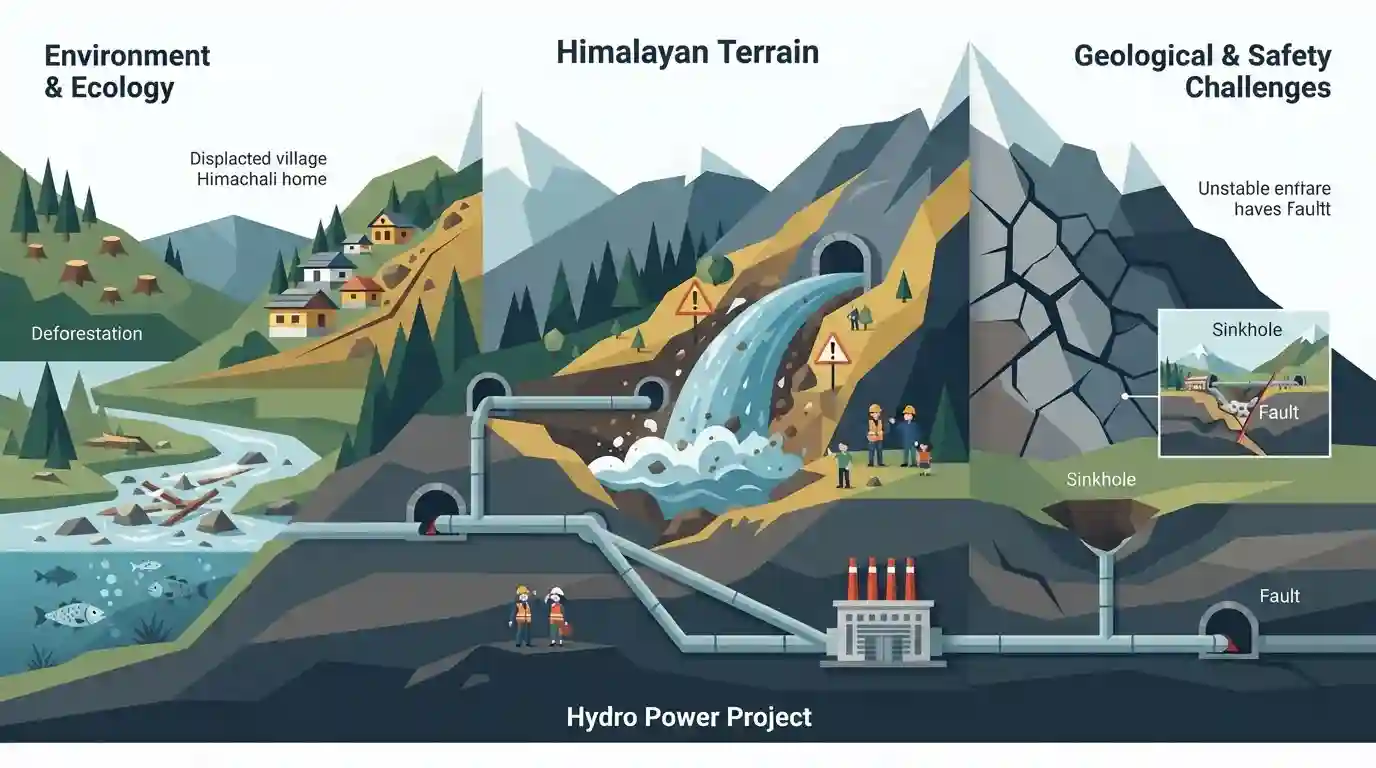
The article discusses the tunnel leakage incident at NHPC's Parvati II Hydro Electric Project (HEP) in Himachal Pradesh, underlining the recurring ecological, geological, and safety challenges posed by major hydropower and tunneling projects in fragile Himalayan terrain.
Key Points
- Tunnel leakage incidents in hydropower projects like NHPC's Parvati II HEP raise critical environmental and structural safety concerns in Himachal Pradesh.
- Such incidents highlight vulnerabilities in tunneling through fragile Himalayan geology, leading to water leakage, ground subsidence, and local hazards.
- Emphasizes the need for stringent geological assessments, monitoring, and accountability in large hydro projects in ecologically sensitive mountain regions.
Important Terms
Parvati II HEP

An 800 MW run-of-the-river hydroelectric project developed by NHPC in the Sainj Valley of Kullu district, HP, featuring a massive head-race tunnel prone to recurrent leakages and muck-dumping disasters.
UPSC context
HPAS Paper III (Infrastructure & Disaster Management): Tests knowledge of major hydropower projects, ecological fragility, and tunneling hazards in Himachal Pradesh.
NHPC
A premier public sector undertaking under the Ministry of Power, Government of India, engaged in planning, executing, and operating hydroelectric power projects across the country.
UPSC context
HPAS Paper III (Economy/Energy): Evaluates the role of central public sector enterprises in India's power sector and infrastructure development.
SANDRP
An informal network and watchdog body that monitors, documents, and critically analyzes the environmental, social, and geological impacts of large dams and water infrastructure projects in South Asia.
UPSC context
HPAS Paper III (Environment & Ecology): Useful for civil society perspectives on developmental projects, environmental governance, and ecological critique in the Himalayas.
Prelims Trap
Run-of-the-river hydropower projects in the Himalayas do not involve major ecological or geological risks due to the absence of large storage reservoirs.
Aspirants often confuse run-of-the-river projects as environmentally benign with zero displacement or geological risks, ignoring sub-surface tunneling hazards.
Static Concepts Connected
What are the primary ecological and geological risks associated with large hydropower projects in the Himalayas?
- Fragile Geology: Himalayan terrain features fragile, faulted young fold mountains prone to massive landslides, cloudbursts, and seismic activity.
- Sub-surface Disruption: Extensive tunneling alters sub-surface hydrology, drying up local natural springs (naulas) and destabilizing hill slopes.
- Muck Disposal Hazards: Improper muck dumping blocks natural drainage channels, dangerously exacerbating downstream flash floods during heavy precipitation events.
Cross-Topic Patterns
Hydropower Expansion vs. Himalayan Geological Vulnerability
Himachal Pradesh's rush for run-of-the-river hydro projects collides with fragile young fold mountain geology, turning routine civil engineering failures into systemic disaster management crises.

Himalayan tunneling disasters + EIA compliance failures are prime candidates for Mains GS-3 questions on disaster management and infrastructure.
Linked PYQs · 2
Linked PYQs · 2
- 2018HPAS_PRELIMSGS1
The impacts caused by construction of dams and reservoirs include all, except :
- 2024HPAS_PRELIMSGS1
Arrange the following climatic zones of Himachal Pradesh according to rainfall amount from lowest to highest : (1) Frigid aridic zone (2) Wet temperate zone (3) Humid sub-tropical zone (4) Sub-humid sub-tropical zone Choose the correct answer from the options given below :
