Sensex and Nifty Rebound on Banking and Metal Stock Gains
Source:The Hindu ↗
Why It Matters
India's potential inclusion in the 'Pax Silica' alliance highlights the intersection of geopolitics and economics, demonstrating the country's strategic pivot toward securing critical technologies (AI, semiconductors). This is highly relevant for GS-3 (Economy and S&T) and GS-2 (International Relations).
Summary
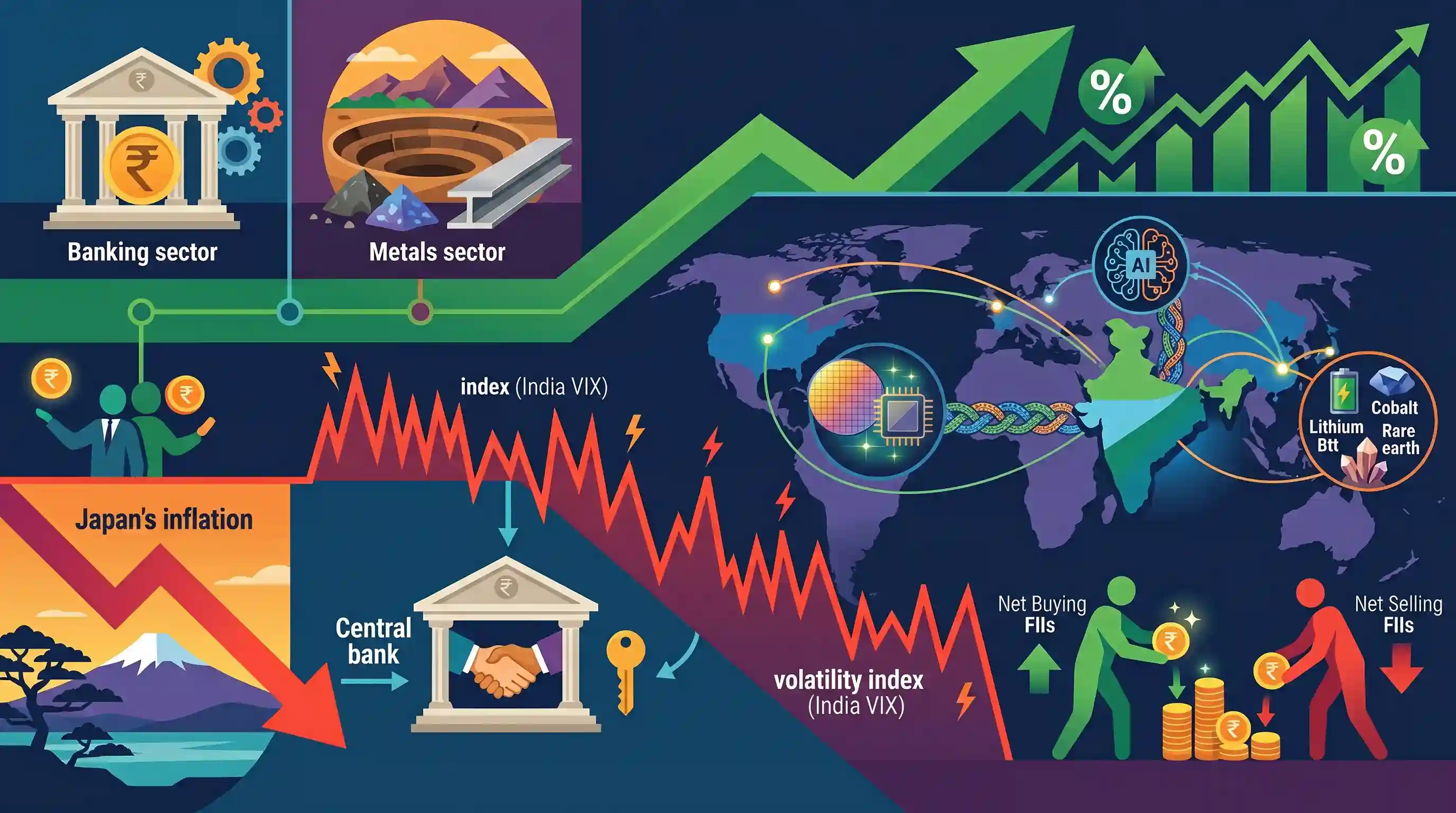
The Indian stock markets witnessed a notable recovery as the Sensex and Nifty rebounded, driven by gains in the banking and metals sectors. The rally was fueled by positive geopolitical developments, particularly the prospect of India joining 'Pax Silica', a strategic alliance designed to secure global supply chains for semiconductors, artificial intelligence, and critical minerals. Additionally, lower inflation data from Japan spurred hopes of accommodative global monetary policies. However, persistent geopolitical tensions kept the market's volatility index (India VIX) high, reflecting cautious undertones alongside mixed institutional investor activity.
Key Points
- Indian benchmark indices Sensex and Nifty rebounded significantly, led by strong buying in banking and metal sector stocks following recent geopolitical corrections.
- Market optimism was heavily driven by reports of India joining 'Pax Silica', a strategic alliance aimed at securing supply chains for semiconductors, critical minerals, and AI.
- Softer-than-expected inflation data from Japan boosted global investor sentiment by raising expectations for accommodative monetary policies globally.
- Despite the market rally, the volatility index (India VIX) remained elevated due to persistent global geopolitical tensions.
- Both Foreign Institutional Investors (FIIs) and Domestic Institutional Investors (DIIs) were recorded as net sellers in the preceding trading session, indicating underlying caution.
Important Terms
Pax Silica

A US-led strategic initiative (joined by India in 2026) to secure "trusted" supply chains for semiconductors, AI infrastructure, and critical minerals, aimed at reducing global dependency on China.
UPSC context
GS Paper II (International Relations) and GS Paper III (Science & Tech); tests understanding of geotechnological alliances and supply chain resilience.
Foreign Institutional Investors (FIIs)
Large foreign entities (e.g., pension funds, hedge funds) investing in Indian financial markets. Regulated by SEBI, they provide liquidity but are often called "hot money" due to high volatility.
UPSC context
GS Paper III (Economy); tests knowledge of capital inflows, market volatility, and the difference between FPI/FDI.
Domestic Institutional Investors (DIIs)
India-based financial institutions (e.g., LIC, mutual funds) that invest domestic pooled savings into the Indian market, typically acting as a stabilising counterweight to volatile foreign capital outflows.
UPSC context
GS Paper III (Economy); tests understanding of domestic capital formation and market stabilization mechanisms.
Critical Minerals
Metallic/non-metallic elements (e.g., lithium, cobalt, rare earths) essential for high-tech manufacturing and green energy transition, possessing high economic importance and significant supply chain risk.
UPSC context
GS Paper I (Geography) and GS Paper III (Environment/Economy); tests knowledge of resource distribution and strategic autonomy in energy.
India VIX
A volatility index computed by the NSE that measures the market's expectation of near-term volatility. Often called the "fear gauge," a higher value indicates higher perceived risk.
UPSC context
GS Paper III (Economy); tests technical understanding of financial market risk indicators and investor sentiment.
Sensex
A market-capitalization-weighted index of 30 large, liquid, and representative companies listed on the Bombay Stock Exchange (BSE), used as a primary barometer for the Indian stock market.
UPSC context
GS Paper III (Economy); tests basic knowledge of capital market indicators and economic performance metrics.
Prelims Trap
Pax Silica is a UN-backed global treaty to regulate the environmental impact of sand and silica mining.
It is actually a US-led strategic alliance focused on securing supply chains for semiconductors, AI, and critical minerals, not an environmental treaty.
Static Concepts Connected
What is the India Volatility Index (India VIX)?
- Definition: Often called the 'Fear Index', it represents the market's expectation of volatility over the next 30 calendar days.
- Calculation: It is computed by the National Stock Exchange (NSE) using the order book of NIFTY Options.
- Inverse relationship: Generally, India VIX shares an inverse relationship with benchmark indices; VIX rises when the market expects sharp downturns or uncertainty.
How do FIIs differ from Foreign Direct Investment (FDI)?
- Investment intent: FIIs invest in financial assets (stocks/bonds) without seeking management control, whereas FDI involves long-term capital investment with active management.
- Volatility: FIIs are highly liquid and often referred to as 'hot money', making them prone to sudden capital flight during global crises.
Cross-Topic Patterns
Tech alliances as Geopolitical Security Pacts
Pax Silica reflects a broader shift where technology alliances (like the Quad's Critical and Emerging Tech working group) act as quasi-security pacts to counter China's dominance in supply chains.
Domestic inflation vs Global monetary policy
How Japan's inflation impacts Indian markets highlights the 'imported monetary policy' effect, a recurring UPSC theme tested previously via US Fed tapering and its impact on FPI flows.

Expect a multi-statement Prelims question comparing 'Pax Silica', the 'Mineral Security Partnership', and 'Chip 4' in 2026.
Linked PYQs · 3
Linked PYQs · 3
- 2024PrelimsGS1
Consider the following statements : 1. In India, Non-Banking Financial Companies can access the Liquidity Adjustment Facility window of the Reserve Bank of India. 2. In India, Foreign Institutional Investors can hold the Government Securities (G-Secs). 3. In India, Stock Exchanges can offer separate trading platforms for debts. Which of the statements given above is/are correct?
- 2025MainsGS3
India aims to become a semiconductor manufacturing hub. What are the challenges faced by the semiconductor industry in India? Mention the salient features of the India Semiconductor Mission.
- 2023MainsGS3
Introduce the concept of Artificial Intelligence (AI). How does Al help clinical diagnosis? Do you perceive any threat to privacy of the individual in the use of Al in healthcare?
