Stock market volatility and economic impact of geopolitical tensions
Source:The Hindu ↗
Why It Matters
This event intersects key UPSC GS-3 themes: internal security (cross-border terrorism, border management, drone threats), and the economy (macroeconomic stability and the impact of geopolitical shocks on financial markets). 'Operation Sindoor' and the use of drones by hostile neighbors are critical case studies for modern warfare and security management.
Summary
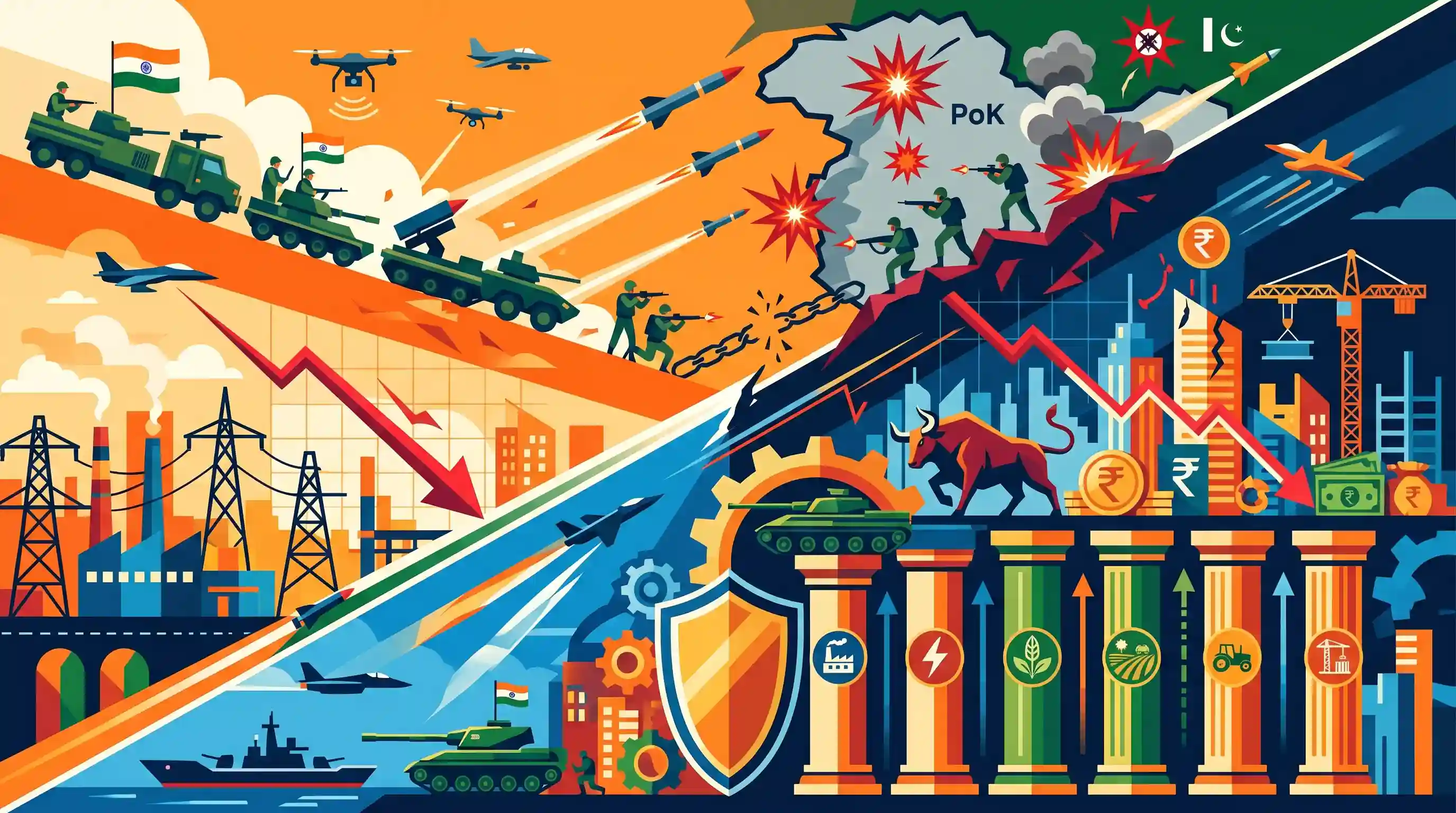
Indian equity benchmarks, Sensex and Nifty, experienced a decline in early trading sessions amid soaring geopolitical tensions between India and Pakistan. The escalation was triggered by 'Operation Sindoor', a series of precise missile strikes by the Indian armed forces against nine terror targets in Pakistan-occupied Kashmir (PoK) and Pakistan, responding to thwarted Pakistani drone and missile attacks on Indian military sites. Despite the immediate market reaction, analysts highlight the fundamental resilience of the Indian markets, underpinned by domestic macroeconomic stability and India's definitive conventional military superiority, cushioning against a severe economic fallout.
Key Points
- Indian stock indices Sensex and Nifty tumbled in early trade due to escalating military tensions and fears of a wider conflict between India and Pakistan.
- The market drop follows 'Operation Sindoor', under which Indian armed forces executed precise missile strikes on nine terror targets in Pakistan and PoK on May 7, 2025.
- Prior to India's strikes, Pakistan unsuccessfully attempted to target Indian military sites, including in Jammu and Pathankot, using drones and missiles.
- Despite short-term volatility, experts assess the Indian market as inherently resilient due to strong domestic macroeconomic fundamentals and India's clear superiority in conventional warfare.
Important Terms
Operation Sindoor

A named 2025-2026 Indian military operation involving precision missile and air strikes against terror infrastructure in Pakistan/PoK, responding to the Pahalgam terror attack.
UPSC context
GS III (Security); tests awareness of modern counter-terrorism doctrines and shifts in India's 'Zero Tolerance' military posture.
Foreign Institutional Investors (FIIs)
Large-scale international organizations (pension/mutual funds) that invest in India’s financial markets; often termed 'hot money' for their impact on market volatility.
UPSC context
GS III (Economy); relevant for topics on resource mobilization, external sector stability, and SEBI regulatory frameworks.
Sensex
The benchmark index of the Bombay Stock Exchange (BSE), tracking 30 of the largest and most liquid companies to reflect market sentiment.
UPSC context
GS III (Economy); fundamental indicator for capital market performance and domestic economic health assessment.
Nifty
The National Stock Exchange’s (NSE) flagship index, comprising 50 major stocks across 24 sectors, serving as a broad barometer of the Indian economy.
UPSC context
GS III (Economy); key for understanding financial resource mobilization and sectoral representation in the equity market.
Zero Tolerance Doctrine
A security policy treating state sponsors and non-state actors as equal threats, emphasizing proactive, calibrated retaliation over strategic restraint in response to terror.
UPSC context
GS III (Security); critical for analyzing evolution in India’s internal security strategy and border management.
Indian Armed Forces
India's unified defense wings (Army, Navy, Air Force) tasked with national defense, now increasingly employing 'theaterisation' for integrated counter-terrorism and conventional operations.
UPSC context
GS III (Security); covers roles in external aggression, internal security, and modern warfare capabilities.
Prelims Trap
Border conflicts and geopolitical shocks trigger immediate and massive outflows of Foreign Direct Investment (FDI) from India.
Short-term geopolitical shocks primarily trigger outflows of FPIs/FIIs (hot money) from equity markets. FDI is long-term capital and remains largely insulated from temporary border skirmishes.
Static Concepts Connected
What macroeconomic fundamentals cushion India against sudden geopolitical shocks?
- Forex Reserves: High reserves give the RBI a buffer to defend the Rupee against sudden depreciation caused by foreign capital flight.
- Manageable CAD: A low and manageable CAD reduces the economy's reliance on volatile short-term foreign capital to finance essential imports.
- Inflation Targeting: Strict monetary policy anchors inflation expectations, preventing severe imported inflation when global risk-aversion spikes.
How has India's doctrine evolved regarding cross-border terrorism?
- Proactive Deterrence: A shift from strictly defensive border guarding to pre-emptive neutralization of terror launchpads and infrastructure across the border.
- Precision Retaliation: Utilizing intelligence-led, precise missile and surgical strikes to target non-state actors while managing the threshold of conventional war.
- Asymmetric Threats: Hostile entities increasingly use low-cost drones for smuggling and attacks, blurring the lines between internal security and conventional war.
Cross-Topic Patterns
Asymmetric Warfare + Capital Markets
Drone attacks by non-state actors directly impact global risk sentiment, linking GS-3 Border Security with GS-3 Capital Markets and FPI flight-to-safety behavior.
Space Tech + Border Defense
Counter-terror operations increasingly rely on real-time satellite imagery and precision navigation, bridging GS-3 Science & Technology (Space) with dynamic border management.

Expect a GS-3 Mains question in 2026 linking 'proactive deterrence' in border defense with the rising asymmetric threat of drone warfare.
Linked PYQs · 4
Linked PYQs · 4
- 2023MainsGS3
The use of unmanned aerial vehicles (UAVs) by our adversaries across the borders to ferry arms/ammunitions, drugs, etc., is a serious threat to the internal security. Comment on the measures being taken to tackle this threat.
- 2021MainsGS3
Analyse the multidimensional challenges posed by external state and non-state actors, to the internal security of India. Also discuss measures required to be taken to combat these threats.
- 2018MainsGS3
How would the recent phenomena of protectionism and currency manipulations in world trade affect macroeconomic stability of India?
- 2015MainsGS2
Terrorist activities and mutual distrust have clouded India-Pakistan relations. To what extent the use of soft power like sports and cultural exchanges could help generate goodwill between the two countries? Discuss with suitable examples.
