Crude Oil Price Shocks and Macroeconomic Stability
Source:Indian Express ↗
Why It Matters
This article is highly relevant for UPSC aspirants as it provides a live case study of how geopolitical tensions in West Asia (a GS2 topic) directly impact India's macroeconomic stability, energy security, currency valuation, and RBI's monetary policy (GS3 topics). Understanding this transmission mechanism is crucial for Mains answers on inflation and external shocks.
Summary
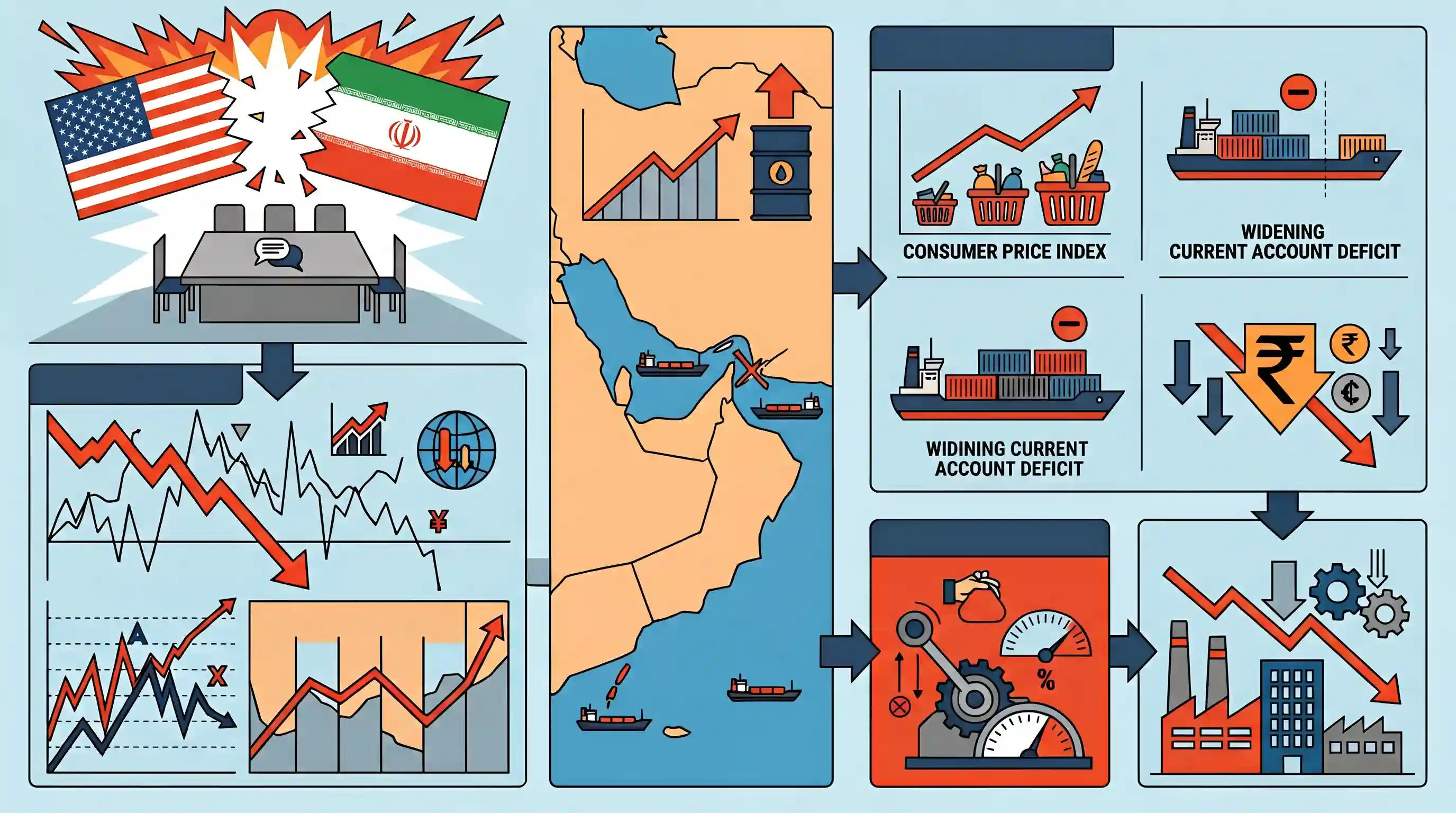
The collapse of US-Iran truce talks in Islamabad has sent shockwaves through global financial markets, with India's Sensex and Nifty preparing for extreme volatility and gap-down openings. The primary threat stems from potential disruptions in the Strait of Hormuz, which could drastically inflate Brent crude prices. For India, a net importer of oil, this translates directly into severe macroeconomic headwinds: rising imported inflation, a widening current account deficit, and a sharply depreciating rupee. The RBI is forced to maintain a tight monetary policy, recently holding the repo rate at 5.25%, to combat these external inflationary pressures, which also threaten to squeeze corporate margins across various sectors.
Key Points
- US-Iran truce talks in Islamabad have collapsed, ending hopes for a de-escalation in West Asia and threatening the recent global market 'ceasefire rally'.
- Indian equity indices (Sensex and Nifty) are bracing for a sharp gap-down opening and heightened volatility due to the geopolitical uncertainty.
- A key risk is the potential disruption of oil supplies through the Strait of Hormuz, which could push Brent crude prices to the $110-$130 per barrel range.
- Higher crude prices threaten India's macroeconomic stability by exacerbating imported inflation, pressuring corporate margins, and driving the rupee down to a projected 93-98 per US dollar.
- The RBI recently held the repo rate steady at 5.25% to manage these inflationary risks, highlighting the tightrope walk between growth and price stability amidst global shocks.
Important Terms
Strait of Hormuz

Narrow waterway between the Persian Gulf and Gulf of Oman; the world's most critical oil chokepoint. It handles approximately 20% of global oil and LNG consumption.
UPSC context
GS2: International Relations/Geopolitics. Tests knowledge of strategic chokepoints and their impact on India’s energy security and external trade.
Current Account Deficit (CAD)
Occurs when the value of a country's total imports of goods, services, and transfers exceeds its exports. High crude prices significantly widen India's CAD.
UPSC context
GS3: Indian Economy. Vital for understanding Balance of Payments, rupee stability, and macroeconomic vulnerabilities to external price shocks.
Oil Marketing Companies (OMCs)
State-run and private entities (e.g., IOCL, BPCL) that refine and retail fuel. Their margins are "squeezed" when global crude costs rise while domestic retail prices remain capped.
UPSC context
GS3: Indian Economy. Relevant for topics on energy pricing, subsidies (under-recoveries), and the health of the industrial sector.
Imported Inflation
A general rise in domestic prices driven by the increased cost of imported inputs like crude oil or a depreciating rupee making imports more expensive.
UPSC context
GS3: Indian Economy. Tests understanding of cost-push inflation and how global supply chain disruptions affect domestic price stability.
Repo Rate
The fixed interest rate at which the RBI lends short-term funds to commercial banks. It is the primary tool for regulating liquidity and controlling inflation.
UPSC context
GS3: Indian Economy. Core concept for Monetary Policy Committee (MPC) functions and the central bank's inflation-targeting mandate.
Reserve Bank of India (RBI)
India's central bank and regulatory body responsible for monetary policy. It manages the rupee’s stability and maintains the benchmark interest rates to combat inflation.
UPSC context
GS3: Indian Economy. Fundamental to topics on banking, monetary policy, and managing external economic shocks.
Brent Crude
A major global price benchmark for Atlantic basin crude oils. It is used to price two-thirds of the world's internationally traded crude oil supplies.
UPSC context
GS3: Indian Economy. Crucial for calculating India's import bill, trade deficit, and fiscal health.
Upstream Oil Companies
Companies like ONGC and Oil India involved in the exploration and production (E&P) of crude oil and natural gas, typically benefiting from higher global oil prices.
UPSC context
GS3: Indian Economy. Relevant for resource mobilization, windfall taxes, and domestic energy production strategies.
Prelims Trap
"The Strait of Hormuz connects the Persian Gulf to the Red Sea."
The Strait of Hormuz connects the Persian Gulf to the Gulf of Oman. It is the Bab el-Mandeb strait that connects the Red Sea to the Gulf of Aden.
Static Concepts Connected
How do global crude oil price shocks impact India's macroeconomic stability?
- CAD Widening: India imports over 85% of its crude oil; global price spikes directly bloat the import bill and widen the trade deficit.
- Currency Depreciation: Higher dollar demand to pay for expensive oil imports weakens the Rupee, making other imports costlier.
- Imported Inflation: Elevated fuel costs cascade into higher transport and production costs, forcing the RBI to maintain tight monetary policy.
What are the critical maritime energy chokepoints in West Asia?
- Strait of Hormuz: Located between Iran and Oman, it links the Persian Gulf to the Gulf of Oman and the Arabian Sea.
- Bab el-Mandeb: Located between Yemen and Djibouti/Eritrea, it links the Red Sea to the Gulf of Aden and the Indian Ocean.
- Suez Canal: An artificial sea-level waterway in Egypt, connecting the Mediterranean Sea to the Red Sea.
Cross-Topic Patterns
Geopolitical shocks dictating monetary policy
The RBI's inability to cut rates despite domestic growth needs highlights macroeconomic vulnerability when external supply shocks, like West Asian conflicts, drive up imported inflation.
Energy Security and Strategic Petroleum Reserves
Recurrent volatility in the Strait of Hormuz underscores India's energy vulnerability, linking GS2 Middle East diplomacy directly to GS3 Energy Security and the urgent expansion of Strategic Petroleum Reserves (SPR).

Expect a 2026 multi-statement Prelims question pairing Strait of Hormuz geography with its direct mathematical impact on India's CAD.
Linked PYQs · 5
Linked PYQs · 5
- 2024PrelimsGS1
Consider the following statements : Statement-I : Sumed pipeline is a strategic route for Persian Gulf oil and natural gas shipments to Europe. Statement-II : Sumed pipeline connects the Red Sea with the Mediterranean Sea. Which one of the following is correct in respect of the above statements?
- 2022PrelimsGS1
With reference to the Indian economy, consider the following statements: 1. If the inflation is too high, Reserve Bank of India (RBI) is likely to buy government securities. 2. If the rupee is rapidly depreciating, RBI is likely to sell dollars in the market. 3. If interest rates in the USA or European Union were to fall, that is likely to induce RBI to buy dollars. Which of the statements given above are correct?
- 2019PrelimsGS1
Which one of the following is not the most likely measure the Government/RBI takes to stop the slide of Indian rupee?
- 2018MainsGS3
How would the recent phenomena of protectionism and currency manipulations in world trade affect macroeconomic stability of India?
- 2024MainsGS3
What are the causes of persistent high food inflation in India? Comment on the effectiveness of the monetary policy of the RBI to control this type of inflation.
