Market Resilience Amid Geopolitical Shocks and Free Trade Agreements
Source:The Hindu ↗
Why It Matters
The article provides an excellent contemporary case study for GS3, showcasing how macroeconomic indicators (capital markets, FII) react to and absorb sudden geopolitical shocks (military strikes). Furthermore, the conclusion of the India-UK FTA is a highly anticipated topic for both GS2 and GS3 in understanding India's evolving bilateral trade frameworks.
Summary
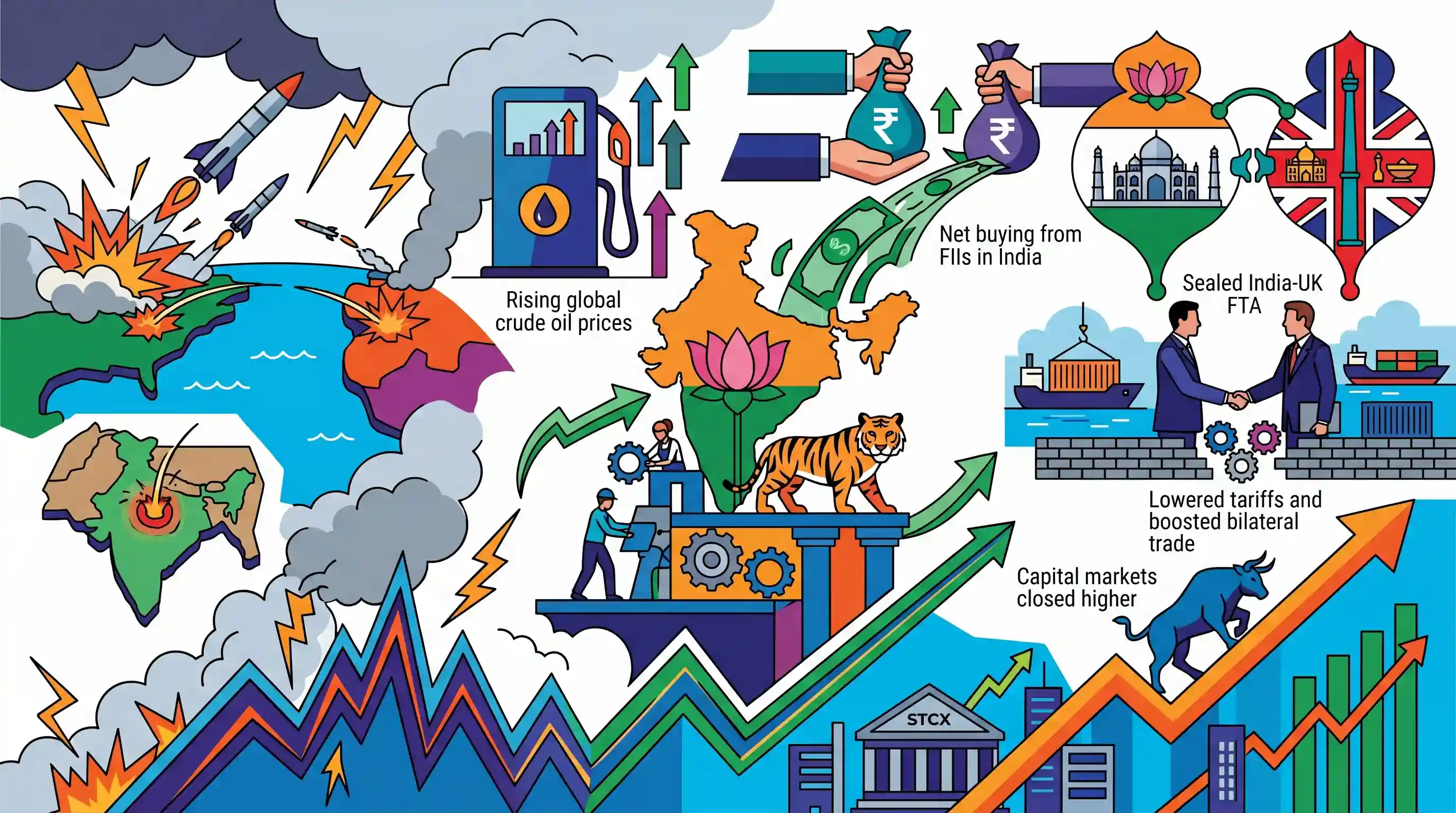
Indian equity benchmarks, Sensex and Nifty, closed higher in a highly volatile trading session influenced by escalating geopolitical tensions. The market turbulence was initially sparked by 'Operation Sindoor', India's retaliatory missile strikes on terror launchpads in Pakistan and PoK following the Pahalgam terror attack. Despite the geopolitical friction and climbing global crude oil prices, domestic markets demonstrated resilience, buoyed by net buying from Foreign Institutional Investors (FIIs). The session also coincided with the historic sealing of the India-UK Free Trade Agreement (FTA), aimed at drastically reducing tariffs and boosting bilateral trade.
Key Points
- Domestic stock indices (Sensex and Nifty) ended higher, showcasing market resilience despite early volatility triggered by geopolitical tensions.
- India executed 'Operation Sindoor', launching missile strikes on terror targets in Pakistan and PoK in retaliation for the Pahalgam terror attack.
- India and the UK sealed a landmark Free Trade Agreement (FTA) to lower tariffs on 99% of Indian exports and ease UK imports like cars and whisky.
- Foreign Institutional Investors (FIIs) remained net buyers, providing stability to Indian capital markets during the uncertainty.
- Global Brent crude prices witnessed an upward climb reflecting the geopolitical escalations in the subcontinent.
Important Terms
Operation Sindoor

India's 2025 retaliatory precision strikes against terror infrastructure in Pakistan and PoK using missiles and drones, following the Pahalgam terror attack; characterized as a 'non-contact' military response.
UPSC context
GS Paper III: Internal Security; GS Paper II: International Relations (India-Pakistan ties). Tests understanding of counter-terrorism doctrines and precision-warfare.
India-UK Free Trade Agreement (FTA)
A comprehensive 2025 trade pact between India and the UK aimed at eliminating tariffs on 90-99% of goods and enhancing professional mobility and services trade.
UPSC context
GS Paper II: International Relations; GS Paper III: Indian Economy. Tests knowledge of bilateral trade, economic diplomacy, and tariff structures.
Foreign Institutional Investors (FIIs)
Investment funds or entities (like mutual funds or insurance companies) based outside India that invest in Indian financial markets, regulated by SEBI.
UPSC context
GS Paper III: Economy. Tests understanding of capital market flows, market volatility, and their impact on macroeconomic stability.
Nifty 50
The benchmark index of the National Stock Exchange (NSE), tracking the performance of 50 large-cap Indian companies across various economic sectors.
UPSC context
GS Paper III: Economy. Essential for tracking domestic market sentiment and economic health.
Sensex
The benchmark index of the Bombay Stock Exchange (BSE), representing the weighted average of 30 well-established and financially sound companies.
UPSC context
GS Paper III: Economy. Basic indicator for capital market performance and investor confidence.
Prelims Trap
Rising geopolitical tension and spiking crude oil prices invariably lead to foreign portfolio (FII) outflows from Indian markets.
The article highlights FIIs as net buyers during the 'Operation Sindoor' volatility. FPI flows depend on relative market valuations and growth, not just geopolitical risk.
Static Concepts Connected
How does a surge in global crude oil prices impact India's macroeconomic stability?
- CAD Widening: Higher fuel import bills directly widen the Current Account Deficit (CAD) as India imports over 80% of its crude requirement.
- Currency Depreciation: Increased dollar demand to pay for expensive oil imports puts downward depreciating pressure on the Indian Rupee.
- Imported Inflation: Higher transport and production costs cascade into retail inflation, constraining the RBI from lowering interest rates.
What distinguishes a standard Free Trade Agreement (FTA) from a CEPA or CECA?
- FTA Scope: Typically focuses primarily on reducing or eliminating customs duties (tariffs) on a positive or negative list of traded goods.
- CEPA/CECA Broadness: Comprehensive Economic Partnership/Cooperation Agreements go beyond goods to include services, investments, intellectual property, and competition.
Cross-Topic Patterns
Geopolitics vs. Capital Market Resilience
Unlike the 1999 Kargil conflict, modern military strikes ('Operation Sindoor', Balakot) show diminishing marginal shock value on Indian capital markets due to stronger domestic macroeconomic fundamentals and resilient FII inflows.
FTAs vs. Domestic Protectionism
The UK FTA's phased duty cuts on automobiles and whisky highlight India's strategic balancing act between protecting domestic "Make in India" manufacturing and integrating into Global Value Chains (GVCs).

India-UK FTA tariff reductions (whisky/autos) alongside 'Rules of Origin' clauses are highly probable as a multi-statement 2026 question.
Linked PYQs · 4
Linked PYQs · 4
- 2016MainsGS3
The terms 'Hot Pursuit' and 'Surgical Strikes' are often used in connection with armed action against terrorist attacks. Discuss the strategic impact of such actions.
- 2011PrelimsGS1
Both Foreign Direct Investment (FDI) and Foreign Institutional Investor (FII) are related to investment in a country. Which one of the following statements best represents an important difference between the two?
- 2021PrelimsGS1
Consider the following : 1. Foreign currency convertible bonds 2. Foreign institutional investment with certain conditions 3. Global depository receipts 4. Non-resident external deposits Which of the above can be included in Foreign Direct Investments?
- 2018PrelimsGS1
Consider the following countries: 1. Australia 2. Canada 3. China 4. India 5. Japan 6. USA Which of the above are among the 'free-trade partners' of ASEAN?
