Sensex Decline and Macroeconomic Vulnerability to External Shocks
Source:The Hindu ↗
Why It Matters
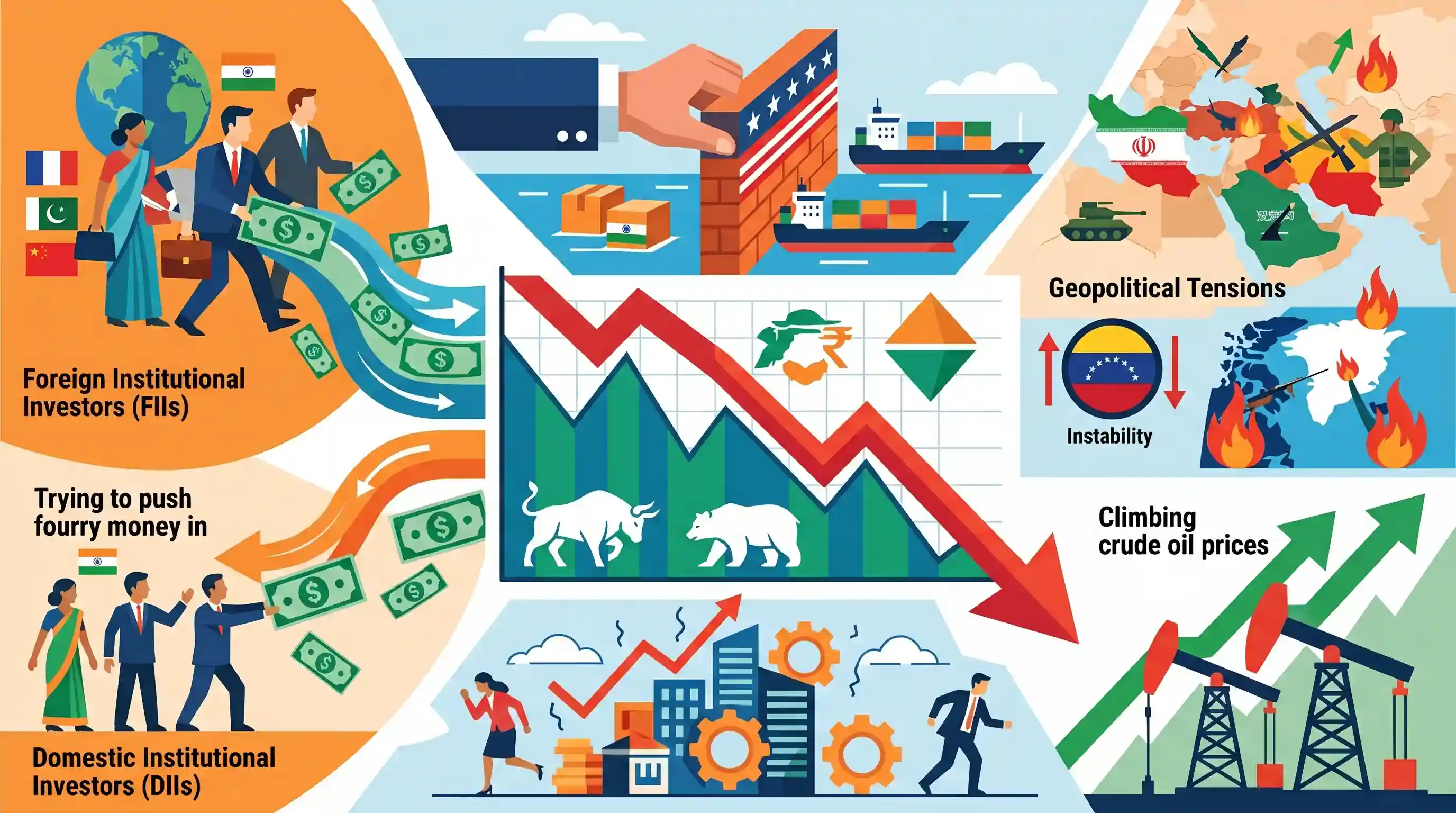
The article illustrates the vulnerability of India's macroeconomic stability to external shocks, highlighting how foreign capital flight (FII outflows), protectionist trade policies (such as US tariffs), and global geopolitical crises can heavily impact domestic financial markets and crude oil prices.
Summary
Indian equity benchmarks, Sensex and Nifty, fell by nearly 1% as investor sentiment was dampened by persistent foreign fund outflows, looming threats of U.S. tariffs on Indian exports, and mounting geopolitical tensions. Sustained selling by Foreign Institutional Investors (FIIs) counteracted buying support from Domestic Institutional Investors (DIIs). Furthermore, global geopolitical developments involving Venezuela, Iran, and U.S. rhetoric regarding Greenland contributed to a cautious market outlook and pushed Brent crude oil prices marginally higher.
Key Points
- The BSE Sensex and NSE Nifty benchmark indices declined by nearly 1% due to foreign fund outflows, threats of U.S. tariffs, and global geopolitical concerns.
- Foreign institutional investors (FIIs) offloaded equities worth ₹3,769.31 crore, which outweighed the buying support of ₹5,595.84 crore from domestic institutional investors (DIIs).
- Market sentiment was negatively impacted by international events, including the crisis in Iran, developments in Venezuela, and U.S. threats concerning Greenland.
- The geopolitical turbulence also contributed to a marginal rise in the global oil benchmark, Brent crude, which climbed to $63.49 per barrel.
Important Terms
Foreign Institutional Investors (FIIs)

Foreign entities (like pension funds or mutual funds) that invest in India's financial markets. Regulated by SEBI, they are now classified under the Foreign Portfolio Investor (FPI) framework.
UPSC context
GS Paper 3: Economy (Capital Markets). Tests understanding of external capital flows, market volatility, and SEBI regulations.
Domestic Institutional Investors (DIIs)
India-based institutional investors, such as LIC, mutual funds, and local banks, that invest in the domestic market. They often stabilize the market during foreign fund outflows.
UPSC context
GS Paper 3: Economy (Investment Models). Tests knowledge of domestic resource mobilization and financial market stability.
S&P BSE Sensex
The benchmark index of the Bombay Stock Exchange (BSE), tracking the performance of 30 large, financially sound companies across key sectors using free-float market capitalization.
UPSC context
GS Paper 3: Economy (Capital Markets). A basic indicator of Indian economic health and stock market performance.
NIFTY 50
The flagship index of the National Stock Exchange (NSE), representing 50 blue-chip companies across various sectors. It is a key barometer for the broader Indian equity market.
UPSC context
GS Paper 3: Economy (Capital Markets). Measures market trends and the impact of global/domestic policies on top companies.
Protectionism
Government policies aimed at restricting international trade to protect domestic industries, typically through tools like tariffs, quotas, and subsidies.
UPSC context
GS Paper 3: Economy (Trade/Globalization). Tests analysis of global trade dynamics and their impact on Indian exports and MSMEs.
Tariffs
A tax imposed by a government on imported goods. It increases the cost of foreign products to encourage domestic consumption and protect local manufacturers.
UPSC context
GS Paper 3: Economy (Trade). Relates to WTO issues, trade wars, and their effect on India's balance of trade.
Prelims Trap
An investment by a foreign entity of 15% in an Indian listed company's equity is classified as Foreign Portfolio Investment (FPI).
Under FEMA rules, any foreign investment of 10% or more in a listed Indian company’s post-issue paid-up equity capital is strictly classified as Foreign Direct Investment (FDI).
Static Concepts Connected
What legally distinguishes FPI from FDI under Indian regulatory norms?
- Threshold limit: Investment of less than 10% of the equity of a listed company is FPI; 10% or more automatically becomes FDI.
- Management control: FDI entails a lasting interest and potential management control; FPI is purely capital-driven without management rights.
- Volatility: FPI is considered 'hot money' prone to sudden flight during global shocks, unlike long-term, sticky FDI capital.
How does a sustained Brent crude price spike impact India's macroeconomic stability?
- Twin deficits: Since India imports ~85% of its crude, an inflated import bill directly widens the Current Account Deficit (CAD) and stresses the Fiscal Deficit.
- Imported inflation: Higher fuel prices cascade into transportation and production costs, driving systemic cost-push inflation that forces the RBI to maintain tight liquidity.
- Currency depreciation: Increased demand for US dollars to fund the ballooning oil import bill exerts downward pressure on the Indian Rupee.
Cross-Topic Patterns
DII stabilization + Financialization of Savings
DIIs consistently offsetting FPI outflows highlights India's 'financialization of savings'—the structural transition of household savings from physical assets like gold and real estate into mutual funds via SIPs.
US Protectionism + WTO Trade Barriers
US tariff threats often invoke national security or retaliatory clauses. UPSC tests this alongside the WTO's Most-Favored-Nation (MFN) exceptions and India's history of retaliatory tariffs.
Geopolitics + Brent vs WTI pricing dynamics
Instability in Iran (Strait of Hormuz) disproportionately impacts Brent crude—the global seaborne benchmark—more than landlocked US WTI, highlighting India's vulnerability to maritime chokepoints.

Expect a multi-statement Prelims question interlinking FPI outflow triggers (US yields), DII stabilization, and RBI forex moves.
Linked PYQs · 4
Linked PYQs · 4
- 2011PrelimsGS1
Both Foreign Direct Investment (FDI) and Foreign Institutional Investor (FII) are related to investment in a country. Which one of the following statements best represents an important difference between the two?
- 2021PrelimsGS1
Consider the following : 1. Foreign currency convertible bonds 2. Foreign institutional investment with certain conditions 3. Global depository receipts 4. Non-resident external deposits Which of the above can be included in Foreign Direct Investments?
- 2025MainsGS3
What are the challenges before the Indian economy when the world is moving away from free trade and multilateralism to protectionism and bilateralism? How can these challenges be met?
- 2018MainsGS3
How would the recent phenomena of protectionism and currency manipulations in world trade affect macroeconomic stability of India?
