Stock Market Crash and AI Disruption Risks for IT Sector
Source:The Hindu ↗
Why It Matters
Demonstrates the vulnerability of the Indian economy to external macroeconomic shocks (like US inflation and dollar strength) and geopolitical developments (Russian sanctions). Crucially, it highlights a structural threat to India's IT sector—a major engine for employment and forex—from AI-driven technological disruption challenging the traditional labour arbitrage business model.
Summary
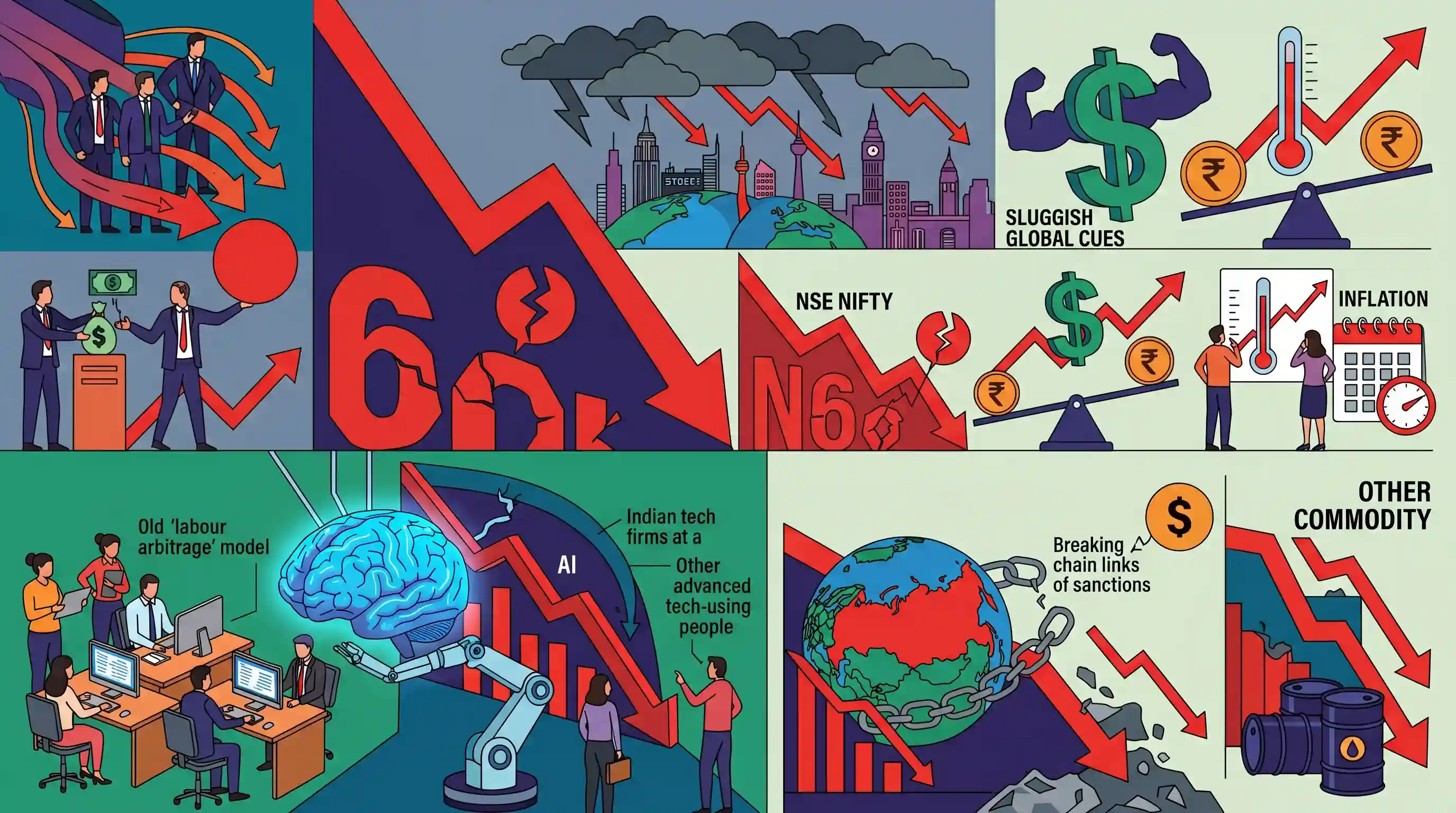
The BSE Sensex plummeted over 1,048 points and the NSE Nifty sank 336 points in a broad-based selloff led by metal, IT, and commodity stocks. The market crash was triggered by sluggish global cues, a stronger US dollar index, and caution ahead of US inflation data. The IT sector was hit particularly hard by renewed concerns that artificial intelligence (AI) will disrupt the traditional "labour arbitrage" model on which Indian tech firms rely, placing them at a competitive disadvantage against global peers. Furthermore, metal stocks declined amid reports that Russia might return to the US-dollar settlement system, which could lead to sanctions relief and subsequently lower global metal prices. Persistent selling by Foreign Institutional Investors (FIIs) further fueled the market's downward trajectory.
Key Points
- Indian stock markets (Sensex and Nifty) experienced a severe crash driven by weak global cues ahead of key US inflation data.
- IT stocks plummeted due to renewed fears that AI-driven disruption will undermine the traditional labour arbitrage model of Indian tech firms.
- Metal stocks faced heavy selling pressure amid a strengthening US dollar index.
- Reports indicating Russia's potential return to the US-dollar settlement system raised expectations of sanctions relief, leading to concerns over weaker commodity realisations for metal companies.
- Continuous selling by Foreign Institutional Investors (FIIs) exacerbated the market downturn and capital outflows.
Important Terms
BSE (Bombay Stock Exchange)

Asia's oldest stock exchange, established in 1875. It features the Sensex index, which tracks 30 prominent companies, and serves as a vital platform for capital formation and resource mobilization in the Indian economy.
UPSC context
GS Paper III (Economy); tests knowledge of capital markets and historical institutions facilitating resource mobilization.
NSE (National Stock Exchange)
India's leading modern stock exchange, founded in 1992. It introduced electronic trading and features the Nifty 50 index. It is known for high trading volumes and liquidity in the equity and derivatives segments.
UPSC context
GS Paper III (Economy); relevant for understanding market infrastructure and technological advancements in financial services.
Foreign Institutional Investors (FIIs)
Foreign entities like pension funds or mutual funds that invest in a country's financial markets. Their movements, often termed "hot money," significantly influence market volatility, exchange rates, and capital inflows.
UPSC context
GS Paper III (Investment Models/External Sector); tests ability to analyze capital flight and its impact on macroeconomic stability.
Domestic Institutional Investors (DIIs)
Indian-based institutions, such as mutual funds, insurance companies (like LIC), and banks, that invest in the domestic market. They often act as a stabilizing counterweight to volatile foreign capital outflows.
UPSC context
GS Paper III (Mobilization of Resources); important for understanding domestic investment stability and retail fund flows.
US Dollar Index (DXY)
A measure of the U.S. dollar's value against a basket of six major global currencies. A rising index typically strengthens the dollar, leading to capital outflows from emerging markets like India.
UPSC context
GS Paper III (External Sector); tests understanding of global currency dynamics and their inflationary impact on India.
Labour Arbitrage
An economic strategy where companies exploit wage differences by sourcing labor from low-cost regions. It is the foundational model for India's IT sector, now threatened by AI-driven automation and efficiency.
UPSC context
GS Paper III (Effects of Liberalization/IT Awareness); relevant for evaluating structural shifts in the services sector and employment.
Prelims Trap
The US Dollar Index evaluates the greenback against a basket of currencies including the Indian Rupee and Chinese Renminbi.
The DXY basket only contains six currencies: Euro, Japanese Yen, British Pound, Canadian Dollar, Swedish Krona, and Swiss Franc. Neither INR nor RMB is included.
Static Concepts Connected
How does a rising US Dollar Index (DXY) impact emerging markets like India?
- Capital Flight: Higher US yields attract global investors, leading to heavy selling by FIIs in Indian equity and debt markets as they repatriate funds.
- Currency Depreciation: As investors pull capital, demand for dollars rises while rupees are dumped, leading to depreciation of the domestic currency.
- Imported Inflation: A weaker rupee makes crucial dollar-denominated imports like crude oil and electronics more expensive, feeding into domestic retail inflation.
What distinguishes Foreign Portfolio Investors (FPIs) from Foreign Direct Investment (FDI)?
- Investment Horizon: FDI involves long-term commitments in physical assets or management control, whereas FPIs target short-term financial gains in stock and bond markets.
- Volatility & Liquidity: FPIs ("hot money") are highly liquid and quickly withdrawn during global macroeconomic shocks, making them vastly more volatile than sticky FDI.
Cross-Topic Patterns
AI's threat to India's Services Export
The shift from labor arbitrage to AI-native models impacts India's IT exports, directly linking GS3 tech disruption to macroeconomic stability, balance of payments, and employment generation.
BRICS de-dollarization hits a structural roadblock
Russia's potential return to the US-dollar settlement system for critical minerals threatens the recent BRICS momentum of shifting intra-bloc trade to local currencies via Special Rupee Vostro Accounts.

Expect a multi-statement question linking US Fed rates, the Dollar Index basket currencies, and FPI outflows from Indian markets in 2026.
Linked PYQs · 4
Linked PYQs · 4
- 2021PrelimsGS1
Consider the following : 1. Foreign currency convertible bonds 2. Foreign institutional investment with certain conditions 3. Global depository receipts 4. Non-resident external deposits Which of the above can be included in Foreign Direct Investments?
- 2023MainsGS3
Introduce the concept of Artificial Intelligence (AI). How does Al help clinical diagnosis? Do you perceive any threat to privacy of the individual in the use of Al in healthcare?
- 2015MainsGS3
What are the areas of prohibitive labour that can be sustainably managed by robots ? Discuss the initiatives that can propel research in premier research institutes for substantive and gainful innovation.
- 2016MainsGS3
Justify the need for FDI for the development of the Indian economy. Why there is gap between MOUs signed and actual FDIs? Suggest remedial steps to be taken for increasing actual FDIs in India.
