US Tariff Threats and Macroeconomic Pressures on Indian Equities
Source:The Hindu ↗
Why It Matters
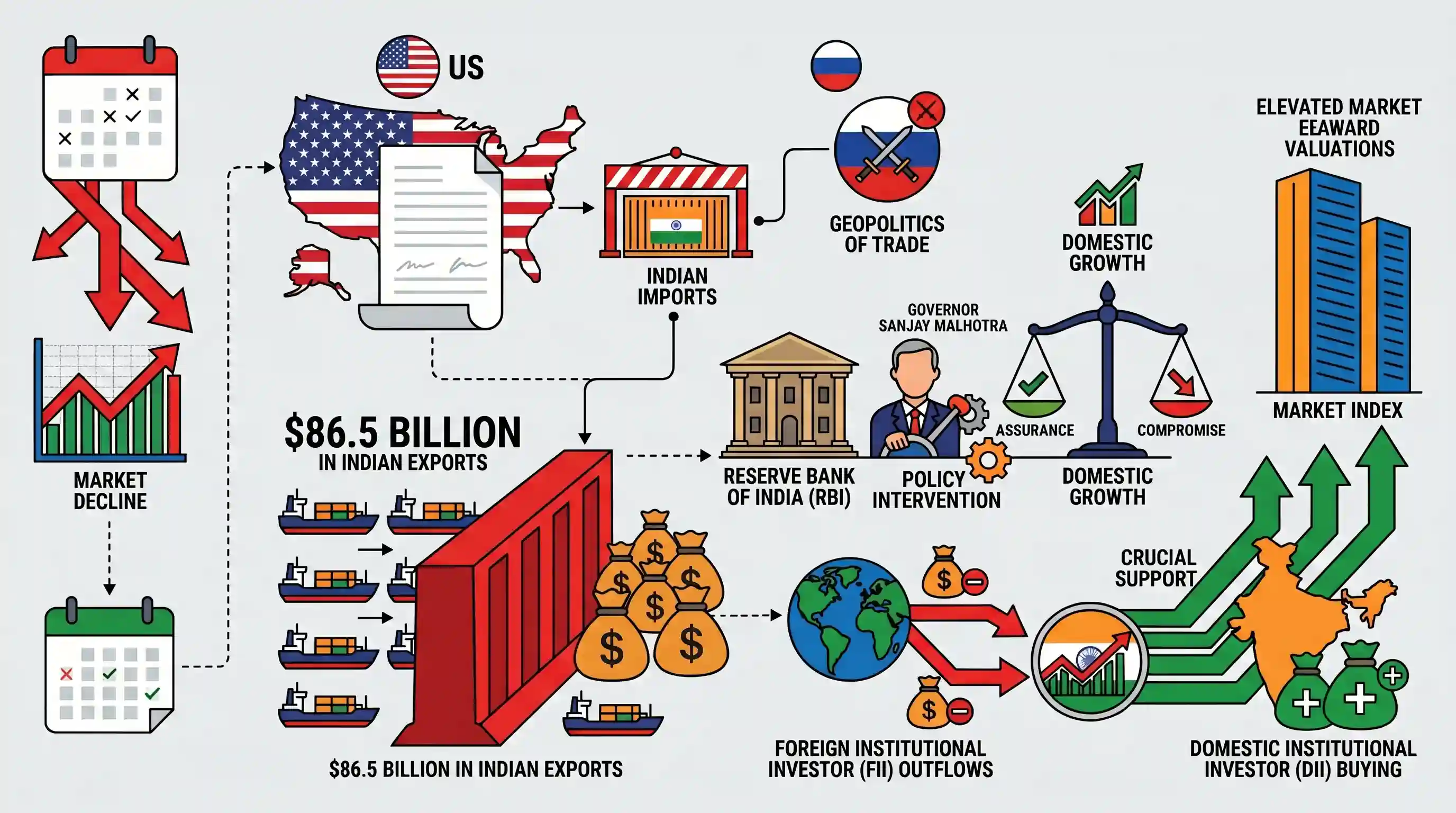
Demonstrates the direct macroeconomic impact of global trade protectionism and geopolitical tensions (US-Russia) on India's export sector and stock market. It also highlights the growing strength of domestic institutional liquidity in insulating Indian markets from FII volatility.
Summary
On August 26, 2025, Indian stock markets declined in early trade due to the US issuing a draft notice to impose an additional 25% tariff on Indian imports. The tariffs, targeting $86.5 billion in Indian exports, are linked by the US to threats from the Russian Federation. RBI Governor Sanjay Malhotra assured potential policy interventions if domestic growth is compromised. Furthermore, while the market faces headwinds from persistent Foreign Institutional Investor (FII) outflows, robust buying by Domestic Institutional Investors (DIIs) continues to provide crucial support and resilience to elevated market valuations.
Key Points
- Indian benchmark indices Sensex and Nifty declined following the US draft notice to impose an additional 25% tariff on Indian imports starting August 27, 2025.
- The tariffs threaten approximately $86.5 billion of Indian exports to the US and are strategically linked by the US to threats posed by the Russian Federation.
- RBI Governor Sanjay Malhotra assured that the central bank will initiate policy actions if the US tariffs negatively impact India's domestic economic growth.
- Despite persistent foreign fund outflows (FII selling), massive buying by Domestic Institutional Investors (DIIs) has provided substantial liquidity support to the Indian market.
Important Terms
Trade Protectionism

Economic policy of shielding domestic industries from foreign competition through measures like tariffs, quotas, and regulatory barriers. It aims to protect local jobs and promote self-reliance.
UPSC context
Relevant for GS Paper 2 (International Relations) and GS Paper 3 (Effects of Liberalization on Economy).
Tariff
A tax or duty imposed by a government on imported goods. It increases the cost of imports to protect domestic producers and can be used as a geopolitical tool.
UPSC context
GS Paper 3: Issues related to trade, balance of payments, and export competitiveness.
Foreign Institutional Investors (FIIs)
Investment funds or other institutional entities based outside a country that invest in its financial markets. Often called 'hot money' due to their potential for rapid inflow and outflow.
UPSC context
GS Paper 3: Capital markets, foreign investment flows, and their impact on market volatility.
Domestic Institutional Investors (DIIs)
Indian financial institutions, such as mutual funds, insurance companies (like LIC), and banks, that invest in the local securities market, often acting as stabilizers during foreign capital outflows.
UPSC context
GS Paper 3: Role of domestic institutions in providing financial market depth and stability.
Reserve Bank of India (RBI)
India's central bank and apex monetary authority. It regulates the banking system, manages foreign exchange, and formulates monetary policy to maintain price stability and support growth.
UPSC context
GS Paper 3: Core institution for monetary policy, inflation control, and financial regulation.
Stock Exchanges (BSE & NSE)
Regulated marketplaces for trading securities. BSE is Asia's oldest exchange (hosting the Sensex), while NSE is India's largest electronic exchange (hosting the Nifty 50).
UPSC context
GS Paper 3: Components of the Indian capital market and investment infrastructure.
Prelims Trap
WTO rules strictly prohibit member nations from imposing unilateral tariffs for geopolitical or national security reasons.
GATT Article XXI (Security Exception) allows members to breach trade obligations to protect essential security interests, a loophole increasingly weaponized for unilateral tariffs.
Static Concepts Connected
What are the key exceptions to the MFN principle under WTO rules?
- National Security: Article XXI permits members to take actions they consider necessary for the protection of their essential security interests.
- Trade Remedies: Anti-dumping duties, countervailing duties, and safeguard measures can be applied against specific countries to counter unfair trade practices.
- Regional Agreements: Article XXIV permits Free Trade Agreements and Customs Unions where members grant preferential tariff treatment to each other.
How do DIIs act as a buffer against FPI/FII capital flight?
- Structural Shift: Growing financialization of household savings via mutual fund SIPs and EPFO equity exposure provides continuous, sticky domestic liquidity.
- Counter-cyclical Force: DIIs provide a counter-cyclical force, often buying on dips when 'hot money' FIIs exit, preventing severe market crashes.
Cross-Topic Patterns
Geopolitics + Trade Weaponization
The US linking economic tariffs to India's Russian relations highlights the shift from rules-based multilateral trade (WTO) to transactional geoeconomic coercion and 'friend-shoring'.
SIPs + Macroeconomic Stability
The rise in domestic retail participation via mutual funds inherently strengthens RBI's monetary sovereignty by reducing India's reliance on volatile foreign portfolio flows during external shocks.

Expect a 2026 question testing the difference between FII 'hot money' and DII structural buffers, alongside GATT Article XXI exceptions.
Linked PYQs · 4
Linked PYQs · 4
- 2025MainsGS3
What are the challenges before the Indian economy when the world is moving away from free trade and multilateralism to protectionism and bilateralism? How can these challenges be met?
- 2018MainsGS3
How would the recent phenomena of protectionism and currency manipulations in world trade affect macroeconomic stability of India?
- 2011PrelimsGS1
Both Foreign Direct Investment (FDI) and Foreign Institutional Investor (FII) are related to investment in a country. Which one of the following statements best represents an important difference between the two?
- 2012MainsGS2
Discuss the likely negative impact of the protectionist measures proposed by the US on India's software industry.
