Israeli Airstrike in Gaza And West Asia Conflict Escalation
Source:The Hindu ↗
Why It Matters
The Israel-Palestine conflict is a highly recurrent theme in UPSC examinations. It encompasses mapping questions in Prelims (e.g., bordering nations, the Levant, Golan Heights, Gaza Strip) and analytical Mains questions on India's bilateral relations with Israel, the Palestinian cause, and broader Middle Eastern geopolitics.
Summary
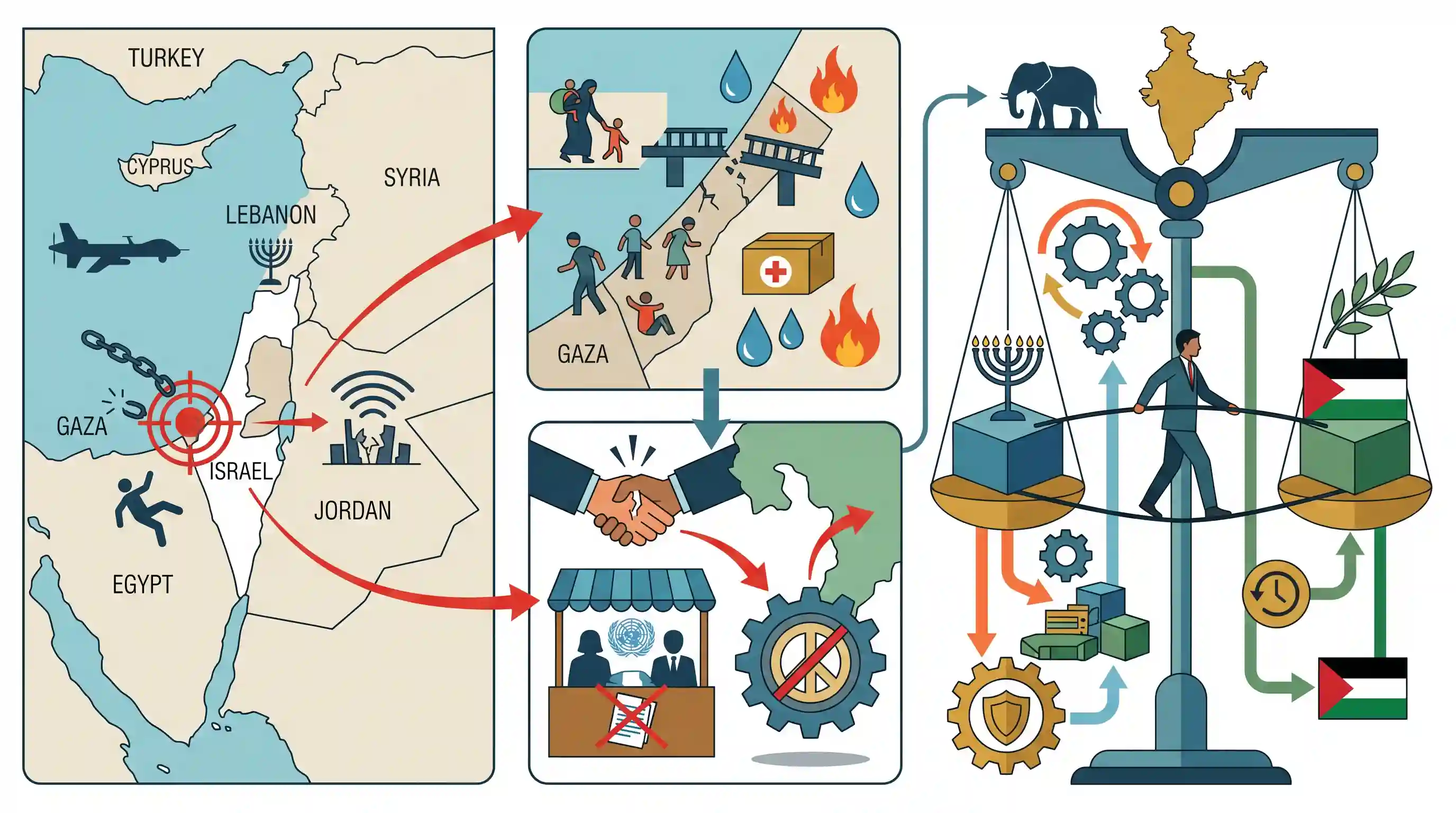
An Israeli airstrike in the Gaza Strip resulted in the death of a senior Hamas figure, underscoring the ongoing and volatile nature of the Israel-Palestine conflict. The continuous hostilities exacerbate the humanitarian crisis in Gaza and present significant hurdles to regional stability and international peace negotiations in the Middle East. For India, the evolving geopolitics of the region necessitates a careful diplomatic balance between its strategic ties with Israel and its traditional stance on the Palestinian cause.
Key Points
- A senior Hamas leader was killed in an Israeli airstrike in the Gaza Strip, reflecting continued kinetic operations in the region.
- The ongoing Israel-Hamas conflict has severely impacted civilian populations and continues to pose a major challenge to peace and stability in the Middle East.
- The incident highlights the fragility of any existing or proposed ceasefire agreements and the complexities involved in negotiating long-term peace.
- Such geopolitical flashpoints are critical for UPSC in terms of International Relations (India's balancing act between Israel and Palestine) and Places in News (mapping the Levant, Gaza, etc.).
Important Terms
Hamas

A Palestinian Sunni-Islamic fundamentalist, militant, and nationalist organization that has governed the Gaza Strip since 2007; classified as a terrorist group by several nations.
UPSC context
GS-II (International Relations): Important for understanding non-state actors, regional geopolitics in West Asia, and the drivers of the Israel-Palestine conflict.
Gaza Strip
A densely populated, narrow coastal territory on the eastern Mediterranean, bordering Israel and Egypt; it is de facto governed by Hamas and remains under a significant blockade.
UPSC context
GS-I (Geography/Places in News) and GS-II: A central flashpoint tested in mapping and international security questions regarding West Asia.
De-hyphenation Policy
India’s strategic diplomatic shift to treat its relationships with Israel and Palestine independently, pursuing national interests in defense and technology while maintaining support for the Palestinian cause.
UPSC context
GS-II (International Relations): Essential for questions on the evolution of India’s foreign policy and its pragmatic engagement in the Middle East.
Two-State Solution
A proposed diplomatic solution for the Israeli-Palestinian conflict that envisages an independent State of Palestine alongside the State of Israel, within secure and recognized borders.
UPSC context
GS-II (IR/India's Foreign Policy): India has historically supported this framework as the only viable path to long-term regional peace and stability.
West Bank
A landlocked territory in Western Asia, bordered by Jordan and Israel; captured by Israel in 1967 and central to the demand for a future Palestinian state.
UPSC context
GS-I (Geography) and GS-II: Frequently appears in mapping and international law discussions regarding settlements and territorial disputes.
Prelims Trap
UNHCR is the primary UN agency providing relief to Palestinian refugees in Gaza.
Aspirants confuse UN refugee bodies. Palestinian refugees fall exclusively under UNRWA (established 1949), not the UNHCR (1950), which handles all other global refugees.
Static Concepts Connected
What are the exact geographical borders of the Gaza Strip?
- Western boundary: Bounded entirely by the eastern Mediterranean Sea.
- Southwestern boundary: Shares a border with Egypt, controlled primarily through the Rafah crossing.
- Northern/Eastern boundary: Enclosed by Israel, with major transit points including the Erez (pedestrian) and Kerem Shalom (commercial) crossings.
What constitutes India's 'De-hyphenation' policy regarding Israel and Palestine?
- Independent tracks: India engages with Israel and Palestine on their individual merits, rather than viewing them through the lens of a zero-sum game.
- Diplomatic manifestation: Demonstrated when Indian leadership conducts standalone visits to Israel or Palestine, breaking the past tradition of combining both in one trip.
- Strategic autonomy: Allows India to expand robust defense and tech ties with Israel while continuing to officially support a negotiated Two-State Solution for Palestinians.
Cross-Topic Patterns
Gaza fallout: Red Sea maritime security
The Gaza conflict triggers asymmetric warfare by regional proxies (like Houthis in Yemen), shifting UPSC focus from land borders to maritime chokepoints like the Bab-el-Mandeb strait.
Stalling of IMEC and I2U2 initiatives
Prolonged Israel-Hamas hostility freezes normalization under the Abraham Accords, directly impeding India's strategic connectivity ambitions via the India-Middle East-Europe Economic Corridor (IMEC).

UNRWA's mandate vs UNHCR, combined with N-S mapping of Levant coastal cities, is highly likely as a 2026 Prelims multi-statement.
Linked PYQs · 5
Linked PYQs · 5
- 2018MainsGS2
“India’s relations with Israel have, of late, acquired a depth and diversity, which cannot be rolled back.” Discuss.
- 2024MainsGS2
‘Terrorism has become a significant threat to global peace and security.’ Evaluate the effectiveness of the United Nations Security Council's Counter Terrorism Committee (CTC) and its associated bodies in addressing and mitigating this threat at the international level.
- 2022PrelimsGS1
The term "Levant" often heard in the news roughly corresponds to which of the following regions?
- 2015PrelimsGS1
The area known as 'Golan Heights' sometimes appears in the news in the context of the events related to
- 2023PrelimsGS1
Consider the following pairs: Regions often mentioned in news Reason for being in news 1. North Kivu and Ituri : War between Armenia and Azerbaijan 2. Nagorno-Karabakh : Insurgency in Mozambique 3. Kherson and Zaporizhzhia : Dispute between Israel and Lebanon How many of the above pairs are correctly matched?
