Israeli Airstrike in Gaza Eliminates Senior Hamas Commander
Source:The Hindu ↗
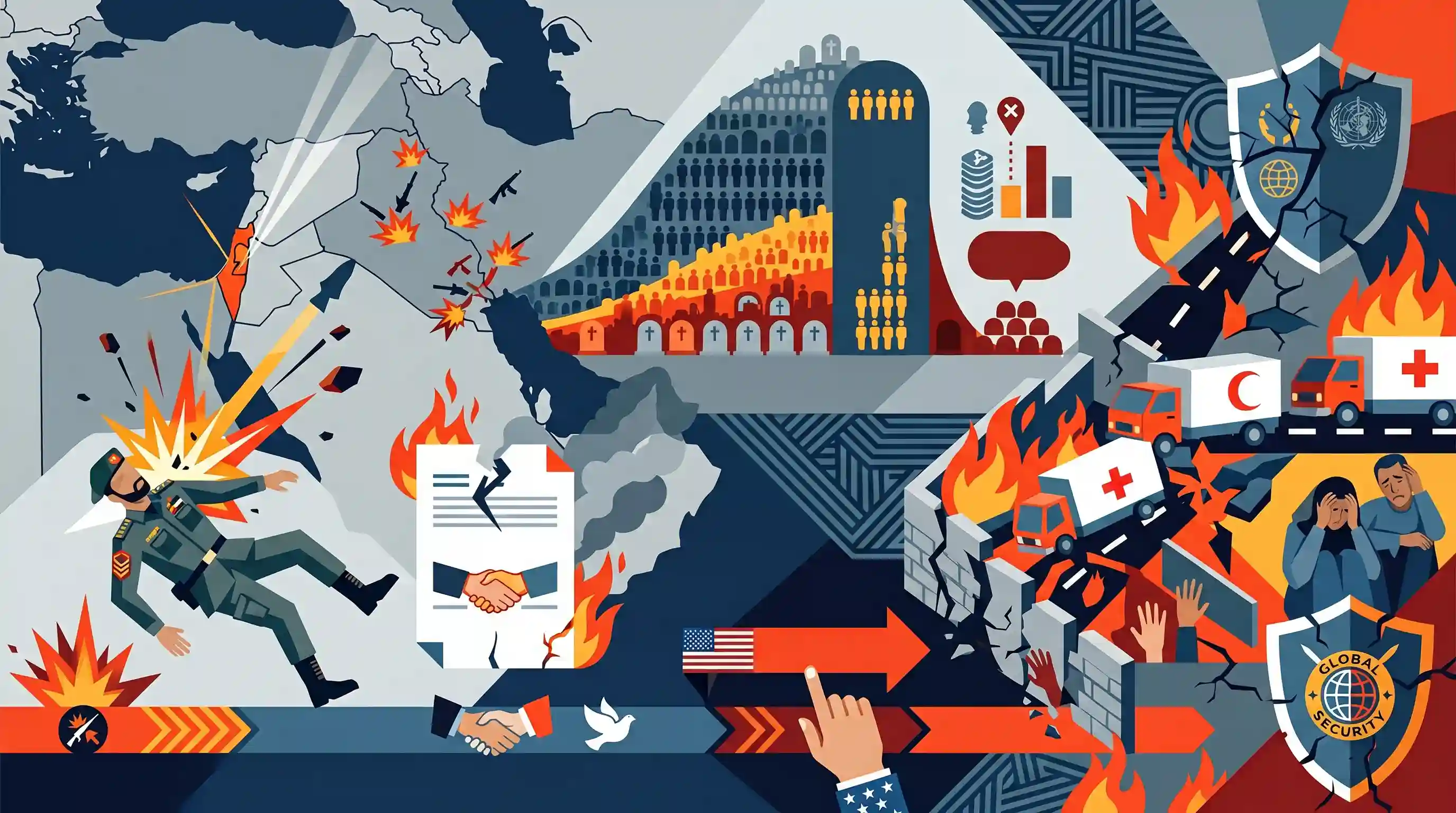
Why It Matters
The continuous breakdown of peace efforts in the Israel-Palestine conflict is critical for understanding Middle Eastern geopolitics, international mediation efforts (like those by the US and UN), and the wider implications for global security and human rights.
Summary
A senior commander of Hamas's military wing, Mohammed Al-Holy, was killed in an Israeli airstrike in central Gaza, intensifying allegations by Hamas that Israel is violating the October 2025 ceasefire agreement. The ongoing conflict has caused immense casualties, with over 400 Palestinians killed since the truce began and a total death toll surpassing 71,000 since October 2023. Despite the US announcing the second phase of the ceasefire, the humanitarian crisis and regional instability persist, highlighting the intractable nature of the Israel-Palestine conflict.
Key Points
- Senior Hamas military commander Mohammed Al-Holy was killed in an Israeli airstrike in Deir al-Balah, central Gaza Strip.
- Hamas has accused Israel of continually violating a ceasefire agreement that has been in place since October 2025.
- The United States recently announced the beginning of the second phase of the ceasefire deal, though hostilities continue.
- Since the war started in October 2023, the humanitarian crisis in Gaza has resulted in over 71,000 deaths and widespread displacement.
Important Terms
October 2025 Ceasefire deal

A US-brokered diplomatic truce effective from October 10, 2025, designed to halt the Israel-Gaza conflict, facilitate hostage releases, and allow sustained humanitarian aid into the enclave following two years of war.
UPSC context
GS Paper II (International Relations). Relevant for West Asian peace processes, the role of external mediators, and diplomatic conflict resolution frameworks.
Hamas
A Palestinian Sunni-Islamic militant and political organization that has governed Gaza since 2007. Its military wing, the Al-Qassam Brigades, led the October 2023 attacks and remains a primary combatant.
UPSC context
GS Paper II (Bilateral & Global Groupings). Focuses on non-state actors in West Asian geopolitics and their impact on regional security and India's interests.
Israeli military (IDF)
The unified military forces of Israel (IDF), responsible for national defense and operations in the Palestinian territories. It is a central actor in the regional security architecture of West Asia.
UPSC context
GS Paper II/III (Security/IR). Tests knowledge of security doctrines, regional power dynamics, and India's strategic defense partnership with Israel.
Yellow Line (Gaza Strip)
A specific military demarcation line established under the 2025 truce, separating Israeli-controlled zones from areas under Palestinian civil control; it has become a flashpoint for ongoing ceasefire violations.
UPSC context
GS Paper II (IR). Understanding territorial control, buffer zones, and practical implementation hurdles in international peace agreements.
Humanitarian Crisis
An acute emergency in Gaza involving infrastructure collapse and a death toll exceeding 71,000. It includes catastrophic food insecurity and the total breakdown of the territory's healthcare system.
UPSC context
GS Paper II/IV (Human Rights/Ethics). Relevant for the role of UN agencies, international humanitarian law, and global ethical responses to conflict.
United States (Role in West Asia)
A superpower acting as the primary mediator and guarantor of the 2025 ceasefire phases. Its regional policy significantly influences the security and diplomatic landscape of West Asia.
UPSC context
GS Paper II (IR). Tests understanding of major power involvement in regional conflicts and its implications for global stability and energy security.
Prelims Trap
"Israel controls all land border crossings and checkpoints into the Gaza Strip."
Aspirants often miss that the Rafah border crossing in the southwest is controlled by Egypt, making it the only non-Israeli land border for Gaza.
Static Concepts Connected
What are the geographical boundaries and key crossings of the Gaza Strip?
- Borders: Bounded by the Mediterranean Sea (west), Israel (north and east), and Egypt (southwest).
- Rafah Crossing: The Rafah border crossing in the southwest is the only land crossing not controlled by Israel; it is managed by Egypt.
What defines India's 'De-hyphenation' policy in West Asia?
- Independent Ties: Treating relationships with Israel and Palestine as mutually independent, avoiding a zero-sum diplomatic approach.
- Strategic Balancing: Allows India to boldly pursue defense and tech ties with Israel while continuing traditional and developmental support for Palestine.
Cross-Topic Patterns
UNESCO 'In Danger' + Gaza geography
The listing of Tell Umm Amer in Deir al-Balah connects contemporary West Asian conflict zones directly to Art & Culture and international heritage mapping.
Gaza War + IMEC disruptions
The protracted Israel-Palestine conflict directly threatens the viability of the India-Middle East-Europe Economic Corridor (IMEC), bridging hard security with geo-economics.

Gaza's borders (Rafah) paired with UNESCO's Tell Umm Amer or the stalling of IMEC will likely form a multi-statement geography/IR question.
Linked PYQs · 3
Linked PYQs · 3
- 2023PrelimsGS1
Consider the following statements: Statement-I: Israel has established diplomatic relations with some Arab States. Statement-II: The 'Arab Peace Initiative' mediated by Saudi Arabia was signed by Israel and Arab League. Which one of the following is correct in respect of the above statements?
- 2003PrelimsGS1
Israel has common borders with
- 2024MainsGS2
‘Terrorism has become a significant threat to global peace and security.’ Evaluate the effectiveness of the United Nations Security Council's Counter Terrorism Committee (CTC) and its associated bodies in addressing and mitigating this threat at the international level.
