Separation of powers and budget impasse in presidential system
Source:The Hindu ↗
Why It Matters
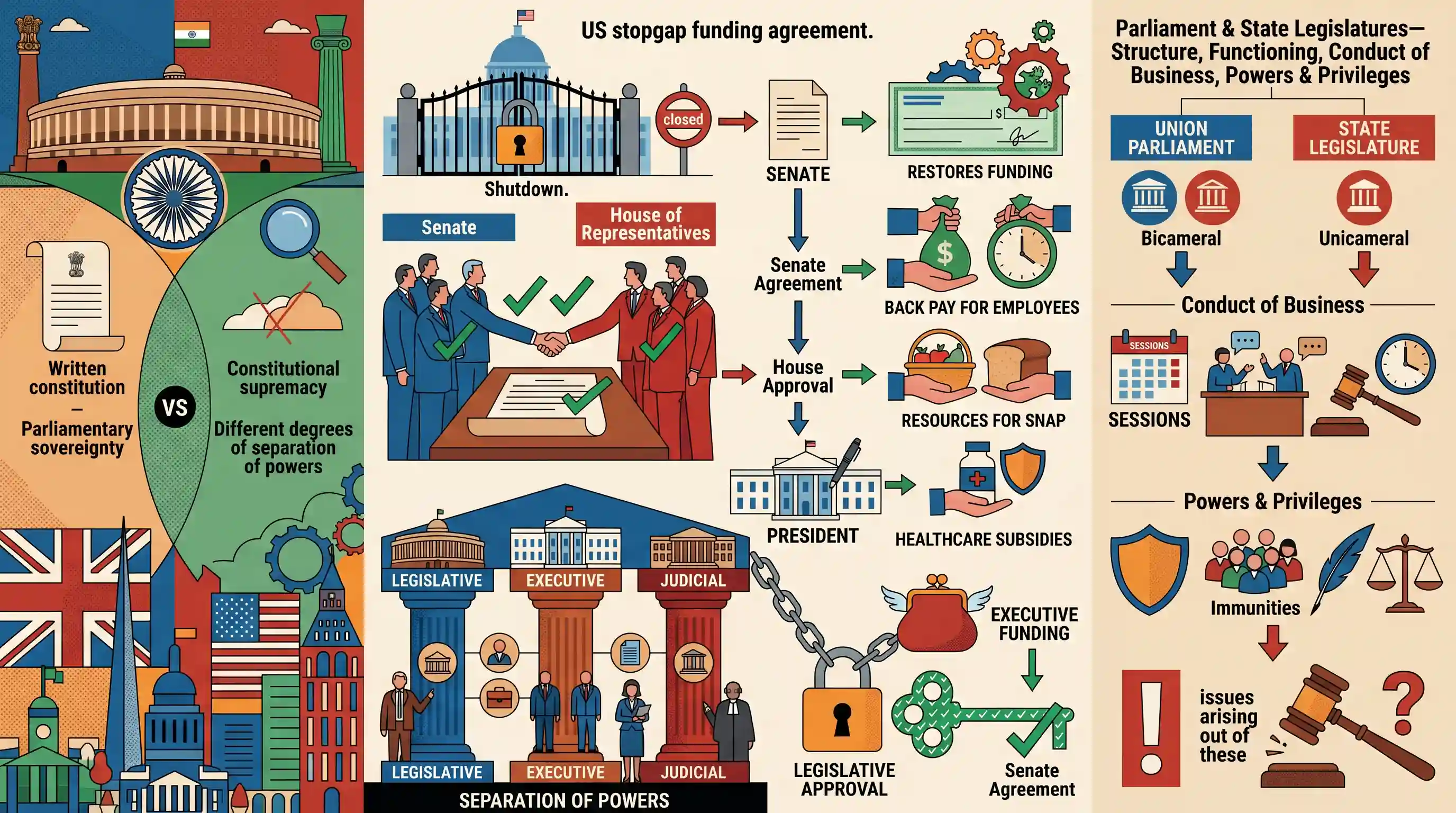
The US government shutdown provides a practical case study of the strict separation of powers in a presidential system. It contrasts sharply with India's parliamentary democracy, where the executive enjoys a built-in legislative majority, making budget impasses and government shutdowns virtually impossible. It is highly relevant for GS Paper 2 questions comparing constitutional schemes and discussing parliamentary control over the executive purse.
Summary
A bipartisan agreement was reached in the US Senate on a stopgap funding measure to end a government shutdown. The legislation restores funding to federal agencies, guarantees back pay for furloughed employees, and secures resources for essential programs like SNAP and healthcare subsidies. The deal requires further approval from the House of Representatives and the President. This event illustrates the profound impact of the separation of powers in the US system, where executive funding is strictly contingent on legislative consensus.
Key Points
- The US Senate reached a bipartisan stopgap agreement to end a prolonged government shutdown by restoring funding to shuttered federal agencies.
- The funding measure includes provisions for back pay to furloughed government employees and critical funding for the SNAP program and healthcare subsidies.
- To become law, the agreement requires passage by the Republican-controlled House of Representatives and the signature of the US President.
- The scenario highlights the operational challenges and potential impasses caused by the strict separation of powers in the US Presidential system, particularly concerning legislative approval of executive budgets.
Important Terms
US Senate

The upper chamber of the US Congress, representing state interests with two members per state; it possesses unique powers over executive appointments and treaty ratifications.
UPSC context
GS Paper 2: Comparative Constitutions. Tests the structural and functional differences between the US Senate and India’s Rajya Sabha.
US House of Representatives
The lower house of the US Congress, consisting of 435 members elected by population-based districts; it holds the specific power to initiate all revenue-related legislation.
UPSC context
GS Paper 2: Comparative Constitutions. Compares lower house roles in presidential versus parliamentary systems regarding financial control.
Separation of Powers
A constitutional doctrine where government powers are divided among independent branches (Executive, Legislative, Judicial) to ensure checks and balances and prevent authoritarianism.
UPSC context
GS Paper 2: Basic Structure. Contrasts the US 'strict separation' model with India’s 'fusion' in a parliamentary system.
Government Shutdown (US)
A cessation of non-essential US federal services occurring when Congress fails to authorize spending, highlighting the executive's total dependence on legislative funding.
UPSC context
GS Paper 2: Comparative Polity. Explains why India's parliamentary majority system avoids such governance paralysis during budget cycles.
Supplemental Nutrition Assistance Program (SNAP)
A major US social safety net program providing food-purchasing assistance to low-income families, often a central issue in federal budget negotiations.
UPSC context
GS Paper 2: Social Justice. Used to compare international welfare and subsidy models with India’s Public Distribution System.
Power of the Purse
The constitutional authority granted to the legislature to control public spending and taxation, serving as a critical check on executive power.
UPSC context
GS Paper 2: Parliament. Relates to Article 112-117 (Budget) and legislative oversight of the Consolidated Fund of India.
Stopgap Funding Measure
A temporary funding bill (Continuing Resolution) passed to maintain government operations when a full annual budget has not yet been approved.
UPSC context
GS Paper 2: Budgeting Process. Parallel to India’s ‘Vote on Account’ under Article 116 for ensuring administrative continuity.
Prelims Trap
"In India, failure to pass the Union Budget leads to a temporary government shutdown of non-essential services."
India operates on a parliamentary fusion of powers. Failing to pass the budget proves a loss of legislative majority, triggering the government's resignation, not a shutdown.
Static Concepts Connected
What happens if an Appropriation Bill is defeated in the Lok Sabha?
- Loss of Confidence: Defeat of the budget, a money bill, or an Appropriation Bill in the Lok Sabha indicates a loss of legislative majority.
- Government Resignation: The Prime Minister and the Council of Ministers must resign immediately, unlike the US system where the executive survives a budget failure.
What constitutional mechanisms prevent fiscal paralysis in India?
- Vote on Account: Article 116 empowers the Lok Sabha to grant advance funds from the Consolidated Fund of India to cover executive expenses pending budget enactment.
- Charged Expenditure: Article 112 lists non-votable expenditures (e.g., salaries of the President, CAG, SC Judges) to insulate core constitutional machinery from political deadlocks.
Cross-Topic Patterns
Bicameralism vs Power of the Purse
While the US requires Senate approval for funding, India concentrates the 'power of the purse' entirely in the Lok Sabha (Art 109), reducing the Rajya Sabha to a 14-day delaying role.
Collective Responsibility (Article 75) linkages
The US executive operates independently, whereas the Indian executive's survival is continuously contingent upon retaining the Lok Sabha's confidence, illustrating the fusion of powers under Article 75.

Expect a 2026 prelims question directly comparing the consequences of a defeated budget in Presidential vs Parliamentary systems.
Linked PYQs · 4
Linked PYQs · 4
- 2021MainsGS2
To what extent, in your view, the Parliament is able to ensure accountability of the executive in India?
- 2024MainsGS2
Discuss India as a secular state and compare with the secular principles of the US constitution.
- 2021MainsGS2
Analyze the distinguishing features of the notion of Right to Equality in the Constitutions of the USA and India.
- 2025MainsGS2
Compare and contrast the President's power to pardon in India and in the USA. Are there any limits to it in both the countries? What are 'preemptive pardons'?
