Semicon Mission Push for Domestic Chip Design Incentives
Source:Indian Express ↗
ఇది ఎందుకు ముఖ్యం
Crucial for understanding India's strategic push towards high-tech manufacturing, reducing import dependencies on critical electronic components, and fostering a domestic semiconductor ecosystem under the India Semiconductor Mission.
సారాంశం
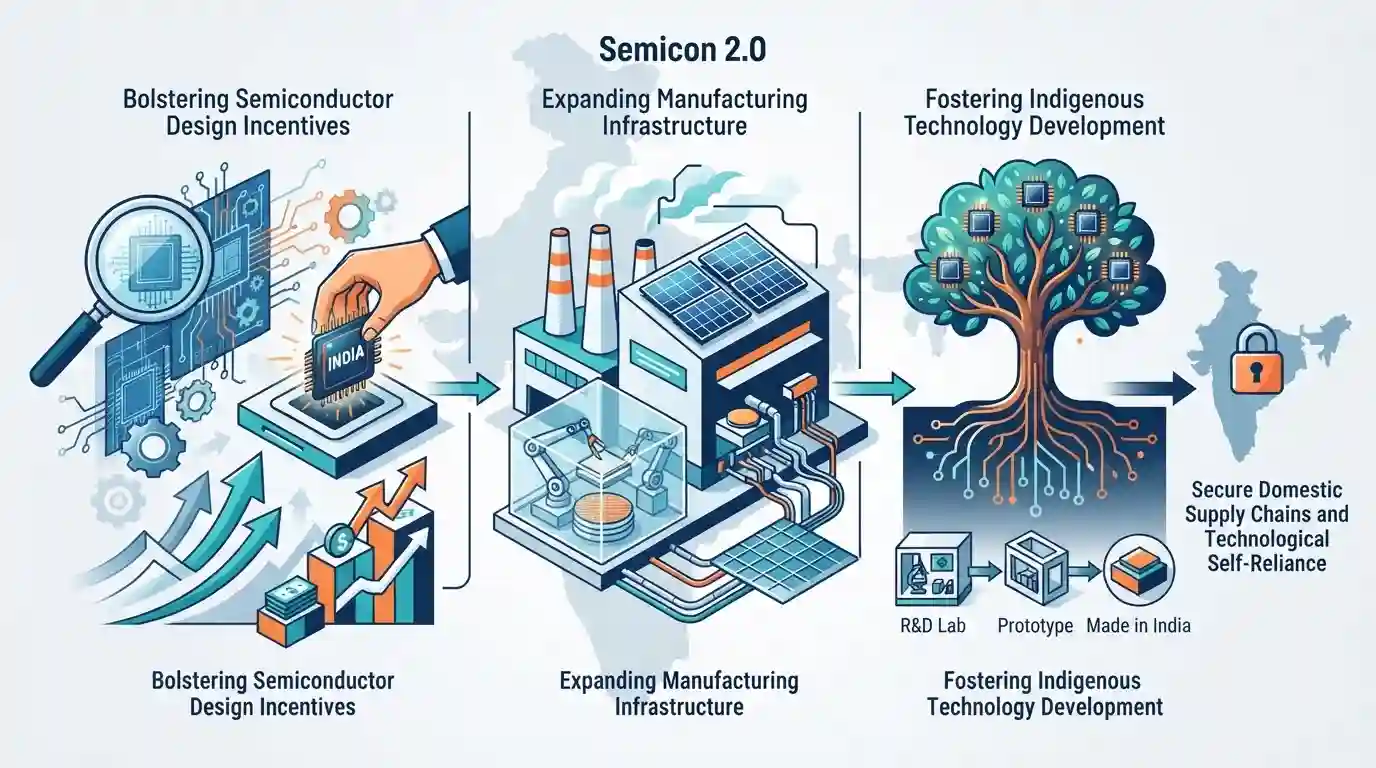
The article discusses the government's push for 'Semicon 2.0', focusing on bolstering semiconductor design incentives, expanding manufacturing infrastructure, and fostering indigenous technology development under the India Semiconductor Mission to secure domestic supply chains and technological self-reliance.
ముఖ్య అంశాలు
- The government is pushing for 'Semicon 2.0' with an intensified focus on semiconductor design, manufacturing ecosystems, and indigenous chip development.
- Key incentives include enhancements under the Design Linked Incentive (DLI) scheme to support startups and MSMEs in chip design.
- The initiative aims to build a robust domestic talent pool, reduce import dependency, and position India as a global semiconductor hub amidst geopolitical supply chain realignments.
- Challenges include massive capital requirements, complex global supply chains, water and power intensity, and the need for advanced R&D talent.
ముఖ్యమైన పదాలు
India Semiconductor Mission

A specialized institutional division under the Ministry of Electronics and Information Technology (MeitY) tasked with driving India's semiconductor and display manufacturing ecosystem.
UPSC context
GS Paper III (Technology, Indigenization): Tests knowledge of institutional frameworks for high-tech manufacturing and supply chain security in India.
Semicon India programme
A flagship government initiative providing financial incentives and infrastructure support across various stages of semiconductor manufacturing, packaging, and design to achieve self-reliance.
UPSC context
GS Paper III (Government Policies and Interventions): Assesses policies aimed at boosting indigenous electronics production and strategic self-sufficiency.
Design Linked Incentive scheme
A key scheme under the Semicon India initiative that offers financial incentives and design infrastructure support to startups and MSMEs for creating semiconductor chips and intellectual property.
UPSC context
GS Paper III (Indigenization of Technology): Evaluates policy measures designed to foster domestic R&D, innovation, and chip design capabilities.
Union Cabinet
The supreme executive body of the Union government consisting of cabinet ministers, responsible for policy formulation, major administrative decisions, and financial approvals.
UPSC context
GS Paper II (Polity and Governance): Tests understanding of executive decision-making processes, policy formulation, and administrative approvals in India.
ప్రిలిమ్స్ ఉచ్చు
Semiconductor incentives are restricted solely to capital-intensive silicon fabrication manufacturing units (fabs).
Aspirants often assume the India Semiconductor Mission only subsidizes massive fabrication plants (fabs), ignoring that Semicon 2.0 and the DLI scheme heavily incentivize fabless design startups and MSMEs.
అనుసంధానమైన స్థిర భావనలు
What are the key pillars and institutional mechanisms of the India Semiconductor Mission (ISM)?
- Nodal Agency: Nodal Body: Functioning under the Digital India Corporation, ISM drives India's long-term strategies for developing semiconductors and display manufacturing ecosystems.
- Pillars: Four Schemes: Covers 1. Semi-fabs/fabs, 2. Display fabs, 3. Compound semiconductors/ATMP/OSAT facilities, and 4. Design Linked Incentive (DLI) scheme.
- DLI Scheme: Design Support: The DLI scheme offers financial incentives and design infrastructure access (like EDA tools via C-DAC) to nurture domestic fabless startups.
అంతర-అంశ నమూనాలు
Semiconductors + Water Security Governance
Semiconductor fab requirements overlap with green energy transitions due to massive water and ultra-pure chemical dependencies, linking industrial policy with environmental governance.
Semiconductors + WTO Trade Rules
India's push for high-tech domestic manufacturing intersects with WTO rules on subsidies, particularly concerning localization and export-performance requirements.

Semicon 2.0 and DLI scheme incentives will likely feature in a multi-statement prelims question on technology missions.
అనుసంధాన PYQలు · 1
అనుసంధాన PYQలు · 1
- 2025MainsGS3
India aims to become a semiconductor manufacturing hub. What are the challenges faced by the semiconductor industry in India? Mention the salient features of the India Semiconductor Mission.
