Semicon 2.0 and India Chip Design Incentives Framework
Source:Indian Express ↗
हे का महत्त्वाचे आहे
Semiconductors are foundational for modern technology, defense systems, and economic growth. Understanding India's evolving strategy under Semicon 2.0 and design incentives is vital for analyzing India's technological self-reliance and manufacturing ambitions.
सारांश
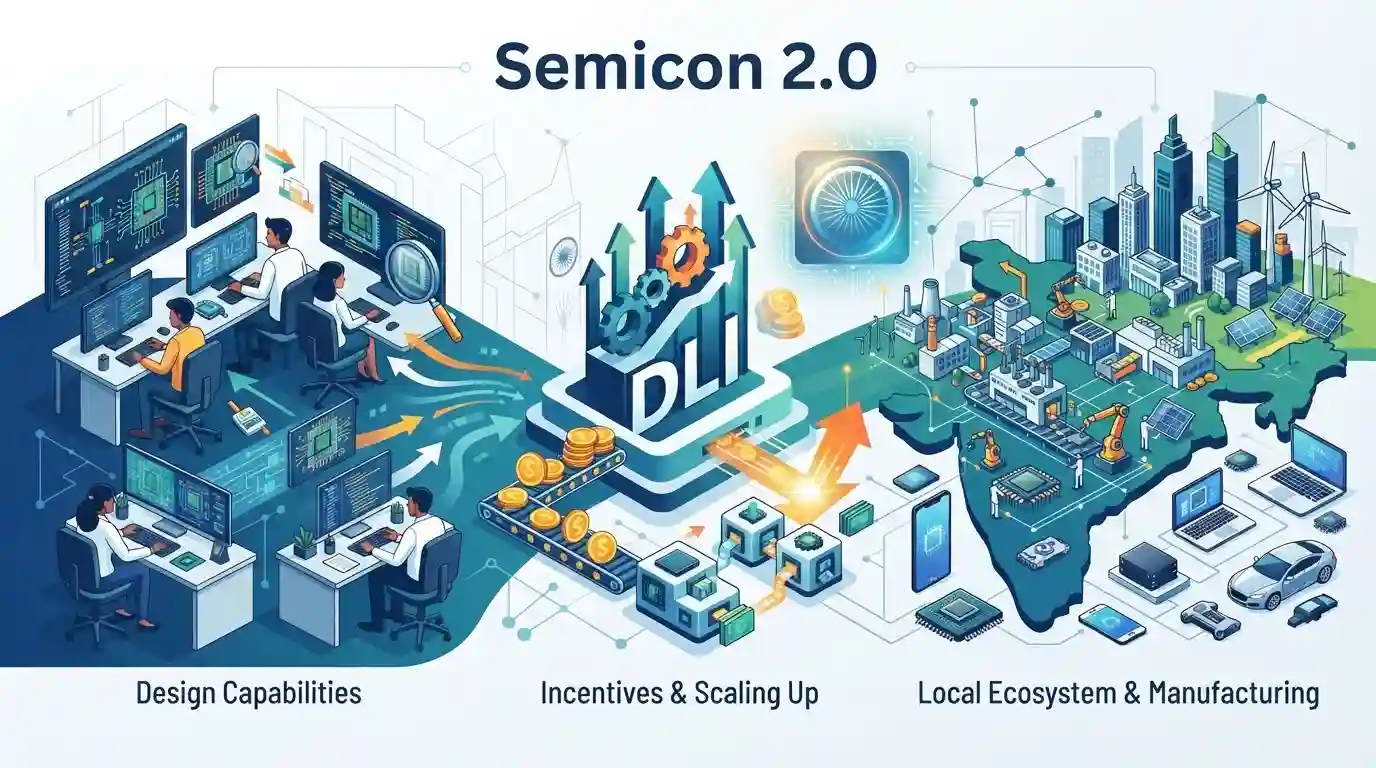
An analysis of India's push towards 'Semicon 2.0', focusing on enhancing domestic semiconductor design capabilities, scaling up incentives under the Design Linked Incentive (DLI) scheme, and strengthening the local ecosystem for chips and electronics.
मुख्य मुद्दे
- The government is pushing for "Semicon 2.0" to broaden focus from large fabrication plants to semiconductor design, packaging, and advanced components.
- The Design Linked Incentive (DLI) scheme is being revamped to encourage domestic startups and chip design companies by providing financial incentives and infrastructure support.
- India aims to capture a larger share of the global semiconductor value chain, moving beyond assembly and testing (OSAT) towards high-value intellectual property and custom silicon design.
- Key challenges include high capital intensity, complex global supply chains, and a shortage of specialized talent in VLSI (Very Large Scale Integration) and chip design.
महत्त्वाच्या संज्ञा
Semicon India Programme

An umbrella initiative launched by the Indian government to build a comprehensive semiconductor and display manufacturing ecosystem, aiming to position India as a global hub for electronics production and design.
UPSC context
Crucial for GS Paper III (Science & Technology / Industrial Policy). Tests understanding of indigenous technology development and strategic high-tech manufacturing policies.
Design Linked Incentive (DLI) scheme
A scheme under the Semicon India Programme that offers financial incentives, deployment-linked support, and infrastructure access to startups, MSMEs, and domestic companies to foster a vibrant semiconductor design ecosystem.
UPSC context
Important for GS Paper III (IT & Computers / Manufacturing). Evaluates government measures to support innovation, startups, and intellectual property creation in niche tech.
India Semiconductor Mission
A specialized, independent business division within the Digital India Corporation that acts as the nodal agency for implementing India's semiconductor and display ecosystem policies.
UPSC context
Relevant for GS Paper III (Governance / Industrial Policy). Tests knowledge of institutional mechanisms driving high-tech industrial missions and investments.
Ministry of Electronics and Information Technology
The central government ministry responsible for formulating policies, promoting e-governance, and driving digital infrastructure, IT industry growth, and semiconductor mission initiatives in India.
UPSC context
Important for GS Paper II and III (Government Policies & Interventions, IT & Computers). Evaluates the administrative framework governing technology policy.
संबंधित स्थिर संकल्पना
What are the key financial and structural components of the Design Linked Incentive (DLI) scheme in India?
- Design Support: Offers product design linked incentives of up to 50% of eligible expenditure, capped at ₹15 crore per application.
- Deployment Incentive: Provides deployment-linked incentives ranging from 4% to 6% of net sales turnover for 5 years on electronic products incorporating designed chips.
- Infrastructure Access: Facilitates access to Electronic Design Automation (EDA) tools, multi-project wafer (MPW) fabrication runs, and testing facilities for startups.
आंतर-विषय नमुने
Semiconductor Subsidies vs WTO SCM Rules
Semiconductor incentives overlap directly with WTO Agreement on Subsidies and Countervailing Measures (SCM), testing the fine line between permissible R&D support and actionable export subsidies.
Industrial Policy and Critical Minerals Nexus
High-tech manufacturing pushes require specialized inputs, linking industrial policy directly to critical mineral supply chains and QUAD mineral security dialogues.

Semicon 2.0 + DLI funding mechanisms + value-chain shift (OSAT to IP core) will anchor a multi-statement Prelims/Mains question.
संबंधित PYQ · 2
संबंधित PYQ · 2
- 2025MainsGS3
India aims to become a semiconductor manufacturing hub. What are the challenges faced by the semiconductor industry in India? Mention the salient features of the India Semiconductor Mission.
- 2026PrelimsGS1
Which one of the following pairs of semiconductor plants in India and their locations is not correctly matched ?
