Prime Minister Modi Urges Focus on Swadeshi Goods
Source:The Hindu ↗
Why It Matters
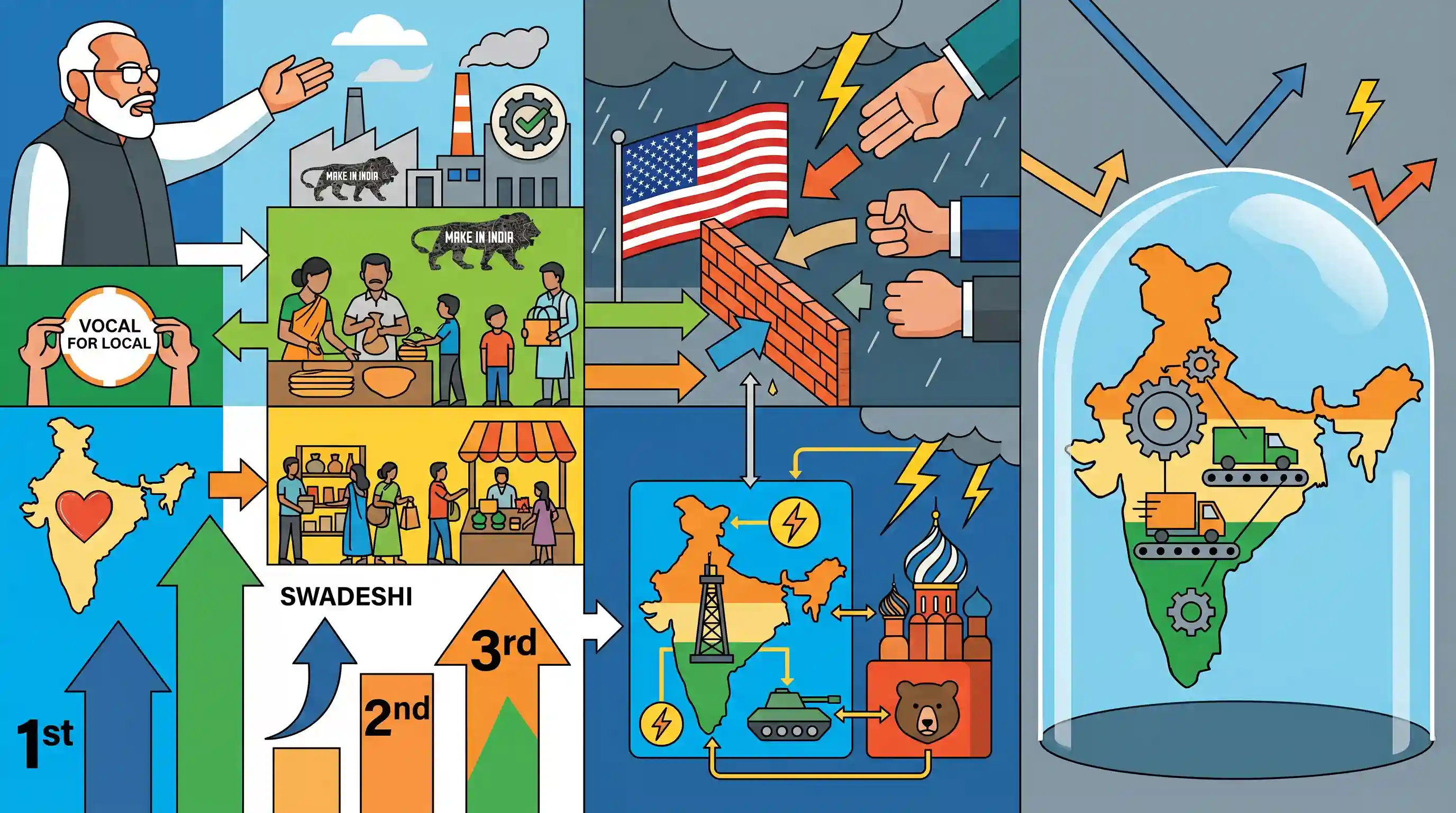
The article highlights India's strategic economic pivot toward self-reliance (Aatmanirbhar Bharat) as a defensive mechanism against rising global protectionism and external pressures on its foreign policy choices. It connects domestic industrial policies with global macroeconomic stability and trade dynamics, which are core themes in GS3.
Summary
Prime Minister Narendra Modi recently exhorted Indian traders and citizens to buy and sell only 'Swadeshi' (indigenous) goods to bolster the domestic economy against global uncertainties. The renewed push for self-reliance ('Make in India' and 'Vocal for Local') comes amid rising international protectionism, exemplified by potential U.S. tariffs on Indian imports. Highlighting India's trajectory towards becoming the world's third-largest economy, the Prime Minister underscored the necessity of robust domestic supply chains. This approach aims to insulate the nation from external geopolitical and economic shocks, including those stemming from international pressure over India's continued defence and energy ties with Russia.
Key Points
- PM Modi urged Indian citizens and traders to prioritize 'Swadeshi' (indigenous) goods to strengthen the domestic economy against global uncertainties.
- The emphasis on self-reliance acts as a strategic buffer against rising global protectionism, including potential U.S. tariffs on Indian exports.
- Strengthening the domestic market and MSME sector is framed as a crucial step for India to achieve its goal of becoming the world's third-largest economy.
- The 'Vocal for Local' initiative indirectly supports India's strategic autonomy, mitigating risks from external geopolitical pressures such as those linked to India's energy and defense ties with Russia.
Important Terms
Aatmanirbhar Bharat

A vision for a self-reliant India focusing on five pillars: Economy, Infrastructure, Technology-driven systems, Vibrant Demography, and Demand. It aims to reduce import dependence while integrating with global value chains.
UPSC context
GS Paper III (Indian Economy). Tests understanding of industrial policy, self-sufficiency vs. globalization, and economic resilience.
Vocal for Local
A campaign urging citizens and traders to prioritize locally produced goods to boost domestic industries, empower small businesses, and preserve indigenous crafts through increased consumer awareness and market access.
UPSC context
GS Paper III (Inclusive Growth). Relevant for MSMEs, rural entrepreneurship, and NITI Aayog's Aspirational Blocks Programme.
Make in India
A flagship initiative launched in 2014 to transform India into a global manufacturing hub by facilitating investment, fostering innovation, and enhancing skill development across 25 focus sectors.
UPSC context
GS Paper III (Industrial Policy). Tests knowledge of FDI, ease of doing business, and manufacturing-led growth strategies.
Swadeshi
An economic philosophy promoting the use of indigenous goods. Modern usage emphasizes national economic security and resilience against external trade shocks and protectionist policies.
UPSC context
GS Paper I (Modern History) and GS III (Economy). Connects historical anti-colonial movements with contemporary self-reliance strategies.
Protectionism
Government policies that restrict international trade to help domestic industries, often through tariffs, quotas, or subsidies, to counter external economic competition or geopolitical pressure.
UPSC context
GS Paper II (IR) and GS III (Trade). Important for understanding global trade wars and bilateral relations (e.g., India-US trade).
Prelims Trap
Aatmanirbhar Bharat advocates for a return to pre-1991 import substitution and autarky.
Aatmanirbhar Bharat aims to build domestic competitiveness for global supply chain integration, unlike the isolationist, tariff-heavy import substitution models of pre-1991 India.
Static Concepts Connected
How does Aatmanirbhar Bharat differ from pre-1991 Import Substitution?
- Global Integration: Import substitution sought isolation; Aatmanirbhar seeks to make India a competitive nodal point in global supply chains.
- Policy Tools: Pre-1991 models relied on prohibitive tariffs and quotas; modern policy prioritizes PLI schemes, infrastructure upgrades, and local consumption.
- FDI Stance: Historical policies heavily restricted foreign capital; Aatmanirbhar actively courts FDI alongside domestic capacity building.
What is the Supply Chain Resilience Initiative (SCRI)?
- Trilateral Origins: Launched by India, Japan, and Australia in 2021 to reduce Indo-Pacific dependency on singular manufacturing hubs (i.e., China).
- Core Objective: To create robust, diversified supply networks through mutual foreign direct investment and digital technology sharing.
- Strategic Alignment: It complements domestic initiatives like 'Make in India' by securing reliable external inputs and opening new export markets.
Cross-Topic Patterns
Strategic Autonomy via Manufacturing
Domestic scale-up reduces reliance on critical imports, providing India the geopolitical space to maintain independent energy and defense ties with heavily sanctioned states like Russia.
Localisation and Rupee Internationalisation
Reducing import dependency through 'Swadeshi' consumption lowers the current account deficit, structurally stabilizing the Rupee and supporting its gradual deployment as a bilateral trade currency.

Expect a GS3 question evaluating 'Vocal for Local' as a tool for strategic autonomy rather than just an economic manufacturing initiative.
Linked PYQs · 4
Linked PYQs · 4
- 2025MainsGS3
What are the challenges before the Indian economy when the world is moving away from free trade and multilateralism to protectionism and bilateralism? How can these challenges be met?
- 2018MainsGS3
How would the recent phenomena of protectionism and currency manipulations in world trade affect macroeconomic stability of India?
- 2023MainsGS3
Faster economic growth requires increased share of the manufacturing sector in GDP, particularly of MSMEs. Comment on the present policies of the Government in this regard.
- 2020MainsGS2
What is the significance of Indo-US defence deals over Indo-Russian defence deals? Discuss with reference to stability in the Indo-Pacific region.
