Civil Conflict and Humanitarian Crisis in Sudan
Source:The Hindu ↗
Why It Matters
Civil conflicts in Africa and their geopolitical spillover—especially near critical maritime chokepoints like the Red Sea—are a high-yield area for UPSC. Recent Prelims have directly tested knowledge of the Sudan conflict and the phenomenon of military coups in the Sahel and Horn of Africa regions.
Summary
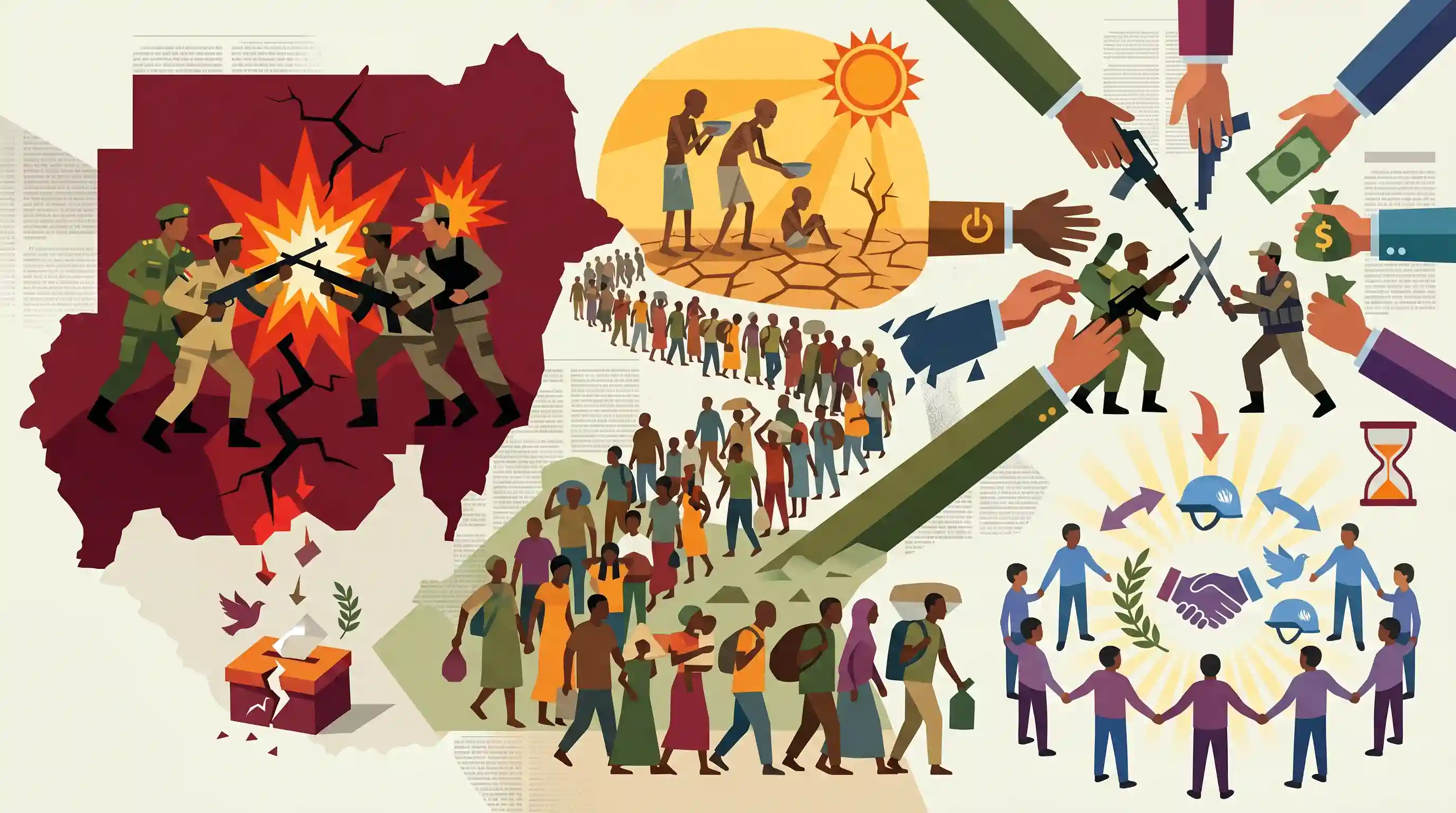
Sudan is trapped in a devastating civil war driven by a power struggle between the regular army and the paramilitary Rapid Support Forces (RSF). The conflict, which derailed the democratic transition after the fall of Omar al-Bashir, has displaced nearly 13 million people and triggered a severe famine. The crisis is compounded by foreign involvement, with different regional powers backing opposing sides, making an internationally mediated ceasefire critically urgent.
Key Points
- The power struggle in Sudan between army chief Abdel Fattah al-Burhan and RSF leader Mohamed Hamdan Dagalo has precipitated a catastrophic civil war displacing nearly 13 million people.
- The conflict arose after the military and RSF joined forces in a 2021 coup to derail the transitional civilian government that had replaced dictator Omar al-Bashir.
- The regular army currently controls eastern and northern parts of Sudan including Port Sudan (its de facto capital) and recently retook parts of Khartoum, while the RSF controls much of western Darfur.
- The war has drawn in regional and global powers; the UAE is accused of backing the RSF, while the army receives backing from nations including Russia, Turkey, Iran, and Qatar.
- The RSF's ongoing siege of El Fasher and declaration of a parallel government threatens a major humanitarian catastrophe, including widespread famine, underscoring the urgent need for international pressure to enforce a ceasefire.
Important Terms
Rapid Support Forces (RSF)

A Sudanese paramilitary force led by Mohamed Hamdan Dagalo (Hemedti), originated from Janjaweed militias; currently battling the regular army for national control.
UPSC context
GS Paper 2: International Relations; crucial for understanding civil-military conflicts and non-state actors in African geopolitics.
Sudanese Armed Forces (SAF)
The official national military of Sudan, led by General Abdel Fattah al-Burhan, representing the state in the current civil war against the RSF.
UPSC context
GS Paper 2: International Relations; tests knowledge of state institutions and their role in regional stability.
Darfur
A region in western Sudan; historically the site of genocide and currently a flashpoint for ethnic violence, mass displacement, and confirmed famine.
UPSC context
GS Paper 1: Geography (Places in News) and GS Paper 2: International Relations (Humanitarian Crises).
Horn of Africa
The strategic northeast African peninsula including Sudan, Ethiopia, and Somalia; a vital maritime corridor for global trade and India's Indian Ocean policy.
UPSC context
GS Paper 2: International Relations; important for India's strategic interests and maritime security in the Red Sea.
Integrated Food Security Phase Classification (IPC)
A multi-partner global initiative providing a standardized scale (Phases 1-5) to measure and communicate the severity of food insecurity and malnutrition.
UPSC context
GS Paper 2: International Relations/Issues related to Hunger; relevant for understanding international humanitarian standards and food security.
Omar al-Bashir
Former Sudanese dictator (1989–2019) whose ouster triggered the unstable transition that eventually collapsed into the current civil war.
UPSC context
GS Paper 2: International Relations; historical context for political transitions and military coups in Africa.
Prelims Trap
The current Sudan crisis is a religious conflict between the Muslim North and Christian South.
Aspirants often confuse the current SAF-RSF military power struggle with the historical religious/ethnic civil wars that led to South Sudan's independence in 2011.
Static Concepts Connected
Which countries and water bodies share a border with Sudan?
- North & East: Egypt to the north, Eritrea and Ethiopia to the east.
- South & West: South Sudan to the south; Central African Republic, Chad, and Libya to the west and northwest.
- Maritime Border: Sudan shares a crucial eastern coastline with the Red Sea, housing Port Sudan.
What is the strategic significance of the Red Sea for global geopolitics?
- Vital Chokepoints: It connects the Mediterranean Sea to the Indian Ocean via the Suez Canal and the Bab-el-Mandeb Strait.
- Trade Artery: Around 12% of global trade and massive volumes of Middle Eastern oil/LNG pass through this corridor daily.
Cross-Topic Patterns
Red Sea militarization & trade security
Sudan's coastal instability adds to the broader Red Sea crisis, compounding Houthi threats and directly impacting India's critical energy and trade routes through the Suez Canal.
Privatization of warfare in Africa
The RSF's evolution from the Janjaweed militia mirrors a broader Sahel trend: the growing influence of non-state actors and foreign mercenaries (like Russia's Africa Corps) destabilizing state structures.

'Match the region to the country' (e.g., Darfur-Sudan, Tigray-Ethiopia, Kivu-DRC) is highly likely in Prelims 2026.
Linked PYQs · 3
Linked PYQs · 3
- 2024PrelimsGS1
Consider the following pairs (Country — Reason for being in the news): 1. Argentina — Worst economic crisis 2. Sudan — War between the country's regular army and paramilitary forces 3. Turkey — Rescinded its membership of NATO How many of the pairs given above are correctly matched?
- 2023PrelimsGS1
In the recent years Chad, Guinea, Mali and Sudan caught the international attention for which one of the following reasons common to all of them?
- 2021MainsGS2
If the last few decades were of Asia's growth story, the next few are expected to be of Africa's.” In the light of this statement, examine India's influence in Africa in recent years.
