West Bengal begins self enumeration phase for digital census
Source:The Hindu ↗
কেন এটি গুরুত্বপূর্ণ
The 16th Census represents a landmark shift in India's demographic data collection by adopting a 100% digital format. This touches upon core GS topics including population dynamics, e-governance infrastructure, and data privacy rights.
সারসংক্ষেপ
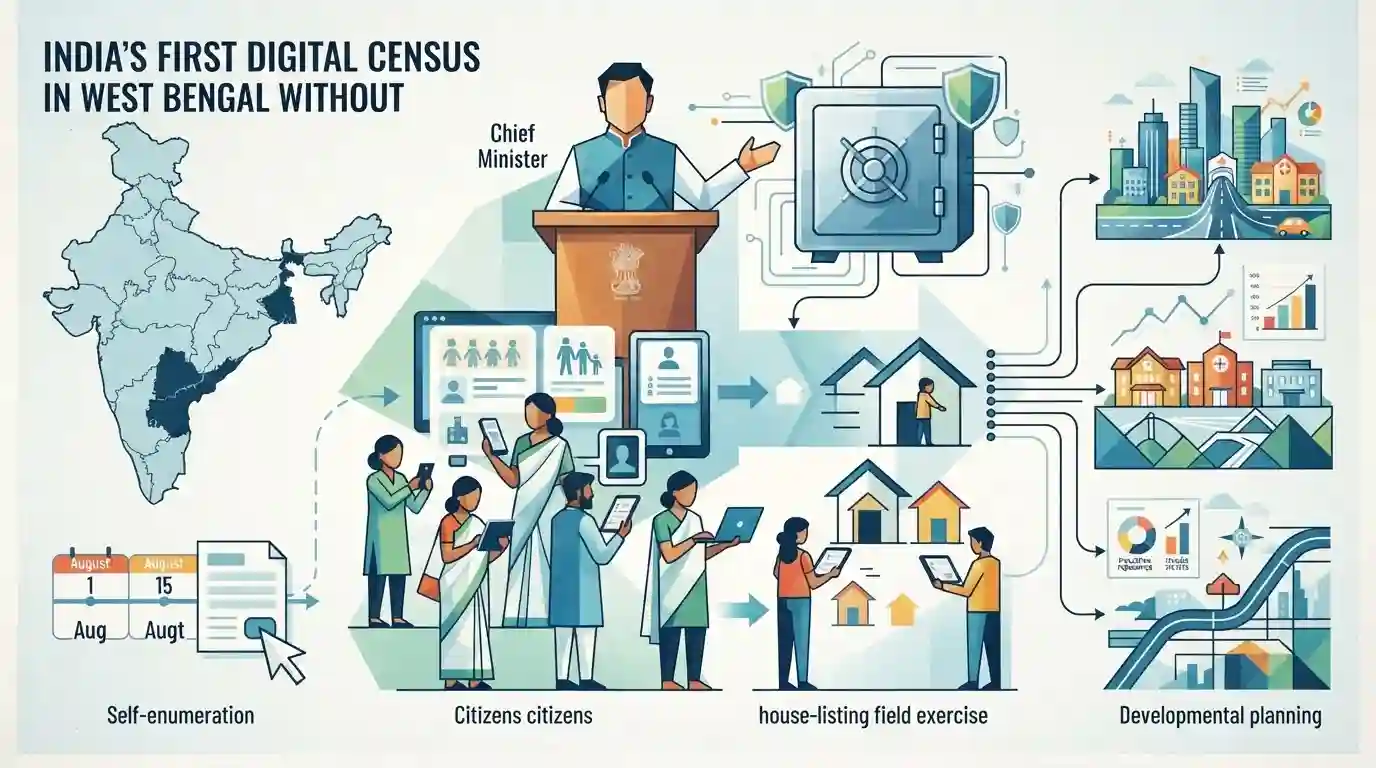
The self-enumeration phase of India's 16th Census, the country's first completely digital census, has commenced in West Bengal. Citizens can input their data online from August 1 to August 15, followed by a house-listing field exercise. The initiative was inaugurated by the state's Chief Minister with assurances regarding strict data privacy and the utilization of demographic statistics solely for developmental planning.
মূল বিষয়
- The self-enumeration phase for India's 16th Census officially began on August 1, 2026, marking the nation's transition to its first 100% digital census.
- Citizens can use a dedicated portal for self-enumeration until August 15, which will be followed by a traditional house-listing field exercise from August 16 to September 14.
- West Bengal Chief Minister Suvendu Adhikari inaugurated the exercise by registering his details digitally, emphasizing the ease of the paperless process.
- The government assured citizens of strict data privacy, noting that census data is legally protected and will be utilized strictly for statistical, developmental, and planning purposes.
গুরুত্বপূর্ণ শব্দ
16th Census of India

India's first fully digital decennial population count (Census 2027), collecting critical demographic, socio-economic, and caste data. Delayed from 2021, it features mobile-based data collection and a two-phase enumeration process.
UPSC context
Relevant for GS Paper 1 (Population) and GS 2 (Governance). Crucial for future delimitation and welfare policy planning.
Office of the Registrar General and Census Commissioner, India
A central authority under the Ministry of Home Affairs responsible for conducting the decennial population census and maintaining the Civil Registration System (births and deaths) under the Census Act, 1948.
UPSC context
Essential for GS Paper 2 (Statutory Bodies). Tests knowledge of administrative frameworks for demographic data collection and governance.
Self-enumeration
A newly introduced digital feature in the 16th Census allowing citizens to voluntarily submit their household and demographic details online via a portal before field enumerators visit for final verification.
UPSC context
Important for GS Paper 2 (E-Governance). Highlights citizen-centric administrative reforms and the digitization of India's statistical systems.
প্রিলিমস ফাঁদ
Census is a Concurrent subject as states execute it, and personal data can be summoned by courts.
Census is an exclusive Union subject (Entry 69). Under the Census Act 1948, individual data is strictly confidential, exempt from RTI, and legally inadmissible as evidence in any court.
সংযুক্ত স্থির ধারণা
What is the constitutional and statutory framework governing the Indian Census?
- Constitutional status: Mandated under Entry 69 of the Union List (Seventh Schedule), making it an exclusive Central subject.
- Statutory backing: The exercise is backed by the Census Act, 1948, providing the legal framework for data collection and penalizing non-compliance.
- Nodal Agency: Conducted by the Office of the Registrar General and Census Commissioner (ORGI), under the Union Ministry of Home Affairs.
How does the Census Act, 1948 protect the privacy of individual data?
- Court inadmissibility: Individual census data is strictly confidential and is not admissible as evidence in any civil or criminal court.
- RTI Exemption: Personal demographic data collected during the enumeration process is legally exempt from disclosure under the Right to Information (RTI) Act.
- Penalty for leaks: The Act prescribes strict penalties for enumerators or government officials who leak individual demographic information.
আন্তঃবিষয় প্যাটার্ন
Digital Census as a DPI stress-test
The shift to a 100% paperless, self-enumerated census acts as the ultimate stress-test for India's Digital Public Infrastructure (DPI) and data privacy frameworks.
Census data driving future Delimitation
Demographic data from the 16th Census will form the foundational basis for the impending delimitation of parliamentary constituencies, reigniting North-South federal debates over representation.

Expect a 2026 prelims question mixing Census data confidentiality (Census Act 1948) with its exclusive Union List (Entry 69) status.
সংযুক্ত PYQ · 3
সংযুক্ত PYQ · 3
- 2024WBCS_PRELIMSGS1
The 2026-2027 Census of India represents a significant milestone as it is the country's first
- 2020WBCS_PRELIMSGS1
Last Census of Indian Population was held in the year
- 2023WBCS_PRELIMSGS1
Population explosion took place in India during
