Opposition Demand for Parliamentary Debate on West Asia Conflict
Source:Indian Express ↗
Why It Matters
The article demonstrates how international conflicts in energy-rich regions like West Asia directly affect India's domestic economy, specifically fuel prices and inflation. It also serves as an excellent case study of the Opposition's role in demanding executive accountability in Parliament over the government's handling of interconnected foreign and economic policies.
Summary
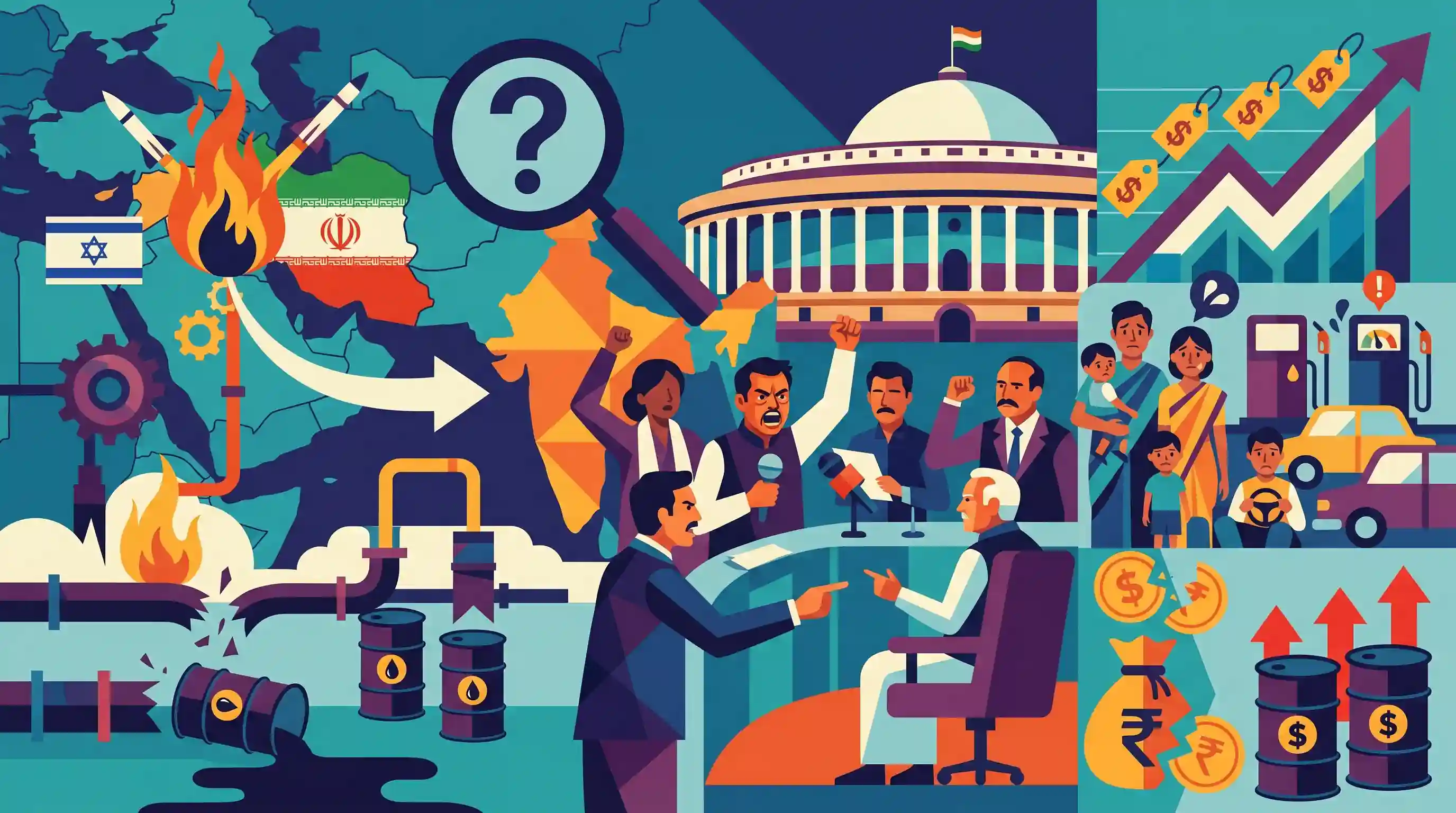
The political Opposition in India is pressing for a Parliamentary debate on the ongoing conflict in West Asia, particularly the hostilities between Israel and Iran. They contend that this geopolitical instability is the root cause of India's fuel crisis, which directly impacts citizens' daily lives. This development underscores the intersection of India's foreign policy in the Middle East with its domestic energy security, while also highlighting the vital role of the Opposition in ensuring executive accountability through parliamentary mechanisms.
Key Points
- The Opposition is demanding a Parliamentary debate on the escalating conflict in West Asia, specifically the Israel-Iran war.
- They argue that the geopolitical instability is directly responsible for an impending or ongoing fuel crisis in India, impacting household economies.
- This highlights the critical intersection of international relations and domestic economic security (energy prices and inflation).
- The issue emphasizes the role of the Opposition in leveraging parliamentary procedures to hold the executive accountable for managing foreign policy fallouts.
Important Terms
Parliamentary Accountability

The constitutional principle (Article 75) ensuring the executive remains answerable to the legislature. Mechanisms include Question Hour, Adjournment Motions, and Parliamentary Committees to ensure transparency and check arbitrary power.
UPSC context
GS Paper II: Polity. Tests the executive-legislature relationship, collective responsibility, and the effectiveness of parliamentary oversight tools.
Leader of the Opposition (LoP)
A statutory post (1977 Act) held by the leader of the largest opposition party (min. 10% seats). Acts as an 'Alternative Prime Minister,' leading scrutiny of government policies and providing alternative viewpoints.
UPSC context
GS Paper II: Polity. Relevant for questions on checks and balances and the constitutional significance of a formal opposition.
Energy Security
The uninterrupted availability of energy sources at an affordable price. India manages this through import diversification and Strategic Petroleum Reserves (SPR), given its ~85% dependence on imported crude oil.
UPSC context
GS Paper III: Economy/Energy. Tests knowledge of external vulnerabilities and strategies for self-reliance amidst geopolitical shocks.
Strategic Autonomy
A foreign policy doctrine where a nation makes independent decisions based on national interest without aligning rigidly with any power bloc. It allows India to balance ties with rivals like Israel and Iran.
UPSC context
GS Paper II: International Relations. Core concept for analyzing India’s 'multi-alignment' and response to global and regional conflicts.
Imported Inflation
General price rise driven by the increased cost of imported essentials, specifically crude oil and fertilizers. It is often triggered by global supply disruptions or the depreciation of the Indian Rupee.
UPSC context
GS Paper III: Economy. Vital for understanding cost-push inflation, its impact on the fiscal deficit, and the RBI's monetary policy.
West Asia Geopolitics
The political and security dynamics of the Middle East, a region vital for India's energy, diaspora (9 million+ citizens), and maritime trade routes like the Strait of Hormuz.
UPSC context
GS Paper II: International Relations. Focuses on India’s 'Look West' policy and regional stability's impact on national interests.
Prelims Trap
"An Adjournment Motion to discuss the fuel crisis can be moved in both Houses of Parliament."
An Adjournment Motion involves an element of censure against the government. Therefore, it can only be moved in the Lok Sabha. The Rajya Sabha uses Rule 267 for urgent discussions.
Static Concepts Connected
How do parliamentary devices for urgent public importance differ between the two Houses?
- Adjournment Motion: Requires support of 50 members, involves censure of the government, and can strictly only be introduced in the Lok Sabha.
- Rule 267: Allows suspension of pre-listed business in the Rajya Sabha to debate an urgent matter. Crucially, it does not involve censure of the government.
- Short Duration Discussion: Under Rule 193 (LS) and 176 (RS), members can raise urgent discussions without a formal motion, voting, or censuring the government.
Why is monetary policy constrained against "imported inflation" driven by global fuel crises?
- Cost-Push Nature: Fuel price shocks cause cost-push inflation by increasing input costs across logistics and manufacturing, unlike demand-pull inflation which RBI typically targets.
- Repo Rate Limits: Raising interest rates suppresses domestic demand and economic growth, but cannot resolve external supply-chain disruptions or lower global crude prices.
- CAD Exacerbation: Higher crude import bills widen the Current Account Deficit (CAD), depreciating the Rupee and ironically making imports even more expensive.
Cross-Topic Patterns
Parliamentary Devices & Energy Security
The use of Rule 267 or Adjournment motions to debate global conflicts highlights how foreign policy directly impacts domestic inflation and dictates legislative priorities.
Strategic Petroleum Reserves (SPRs) Geography
Geopolitical supply shocks continually test India's Strategic Petroleum Reserve capacity (Visakhapatnam, Mangaluru, Padur). Expanding SPRs via commercial partnerships is increasingly critical for economic resilience.

A linked multi-statement question testing Adjournment Motion vs Rule 267 alongside the macroeconomic impacts of imported inflation is likely.
Linked PYQs · 3
Linked PYQs · 3
- 2025MainsGS2
"Energy security constitutes the dominant kingpin of India's foreign policy, and is linked with India's overarching influence in Middle Eastern countries.” How would you integrate energy security with India's foreign policy trajectories in the coming years?
- 2017MainsGS2
The question of India's Energy Security constitutes the most important part of India's economic progress. Analyze India's energy policy cooperation with West Asian countries.
- 2021MainsGS2
To what extent, in your view, the Parliament is able to ensure accountability of the executive in India?
