Dravidian Model Welfare Schemes and Economic Growth Paradigm
Source:The Hindu ↗
Why It Matters
The 'Dravidian model' is a prominent case study in state-led welfare and social development. Understanding its historical success and contemporary limitations provides critical insights into the ongoing debate over welfarism versus freebies, the role of regional political parties in federalism, and the requirements for sustainable economic growth in Indian states.
Summary
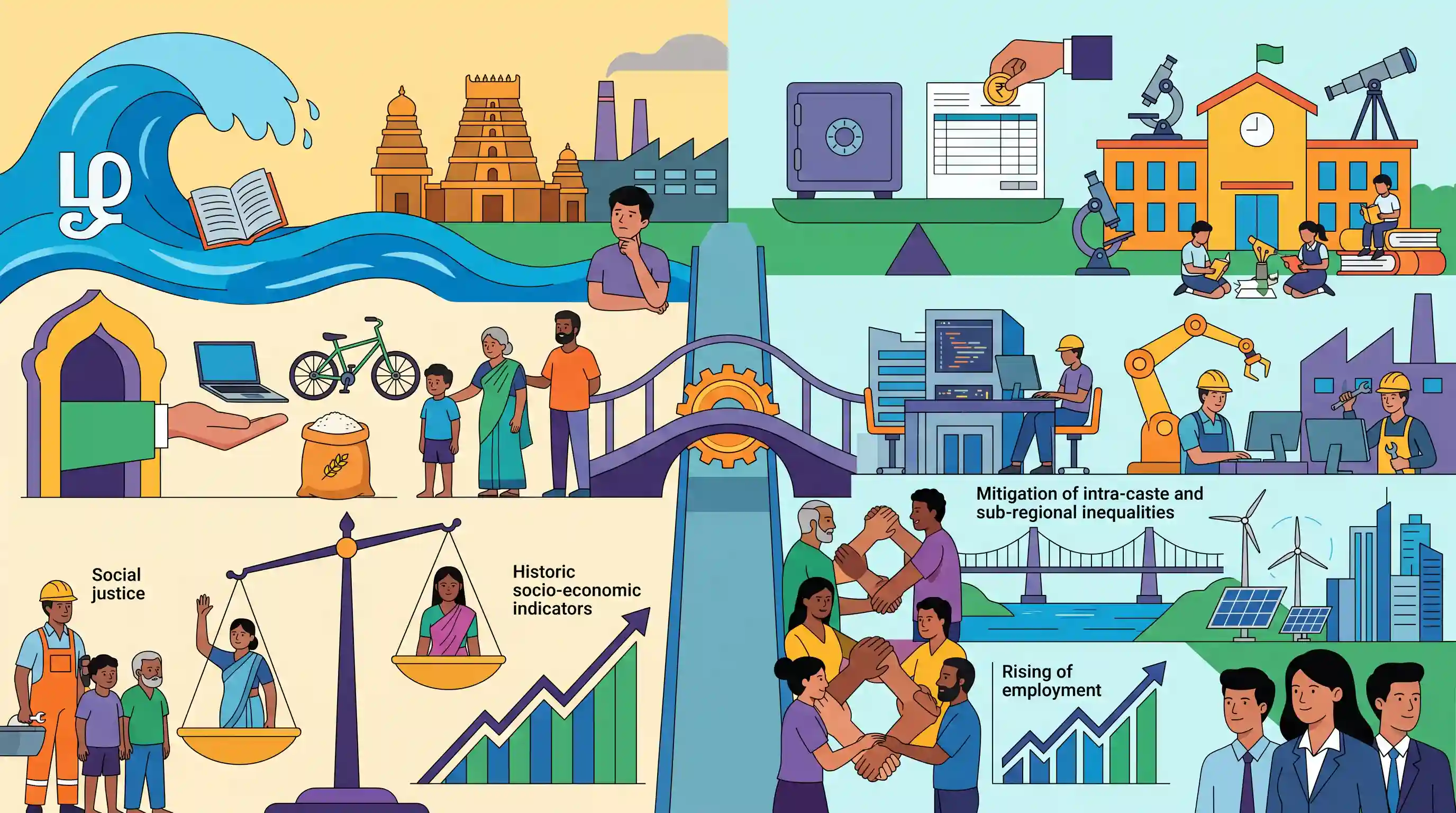
The article analyzes the concept of 'Dravidian exceptionalism,' a unique political and developmental framework in Tamil Nadu characterized by linguistic pride, anti-caste social justice, and robust state welfarism. While this model has historically yielded impressive socio-economic indicators, it requires a new paradigm to address modern challenges. The author argues that reliance on populist welfare schemes (freebies) and historical identity politics is increasingly insufficient for a younger, aspirational electorate. To sustain its exceptionalism, the state must transition toward fiscal prudence, quality education, high-skilled job creation, and mitigating intra-caste and sub-regional inequalities. Ultimately, redefining the Dravidian model entails balancing regional aspirations and foundational social justice values with the demands of sustainable economic development in the 21st century.
Key Points
- Dravidian exceptionalism is rooted in Tamil Nadu's unique combination of linguistic identity, anti-caste social justice, and extensive welfare schemes, leading to high socio-economic development.
- The traditional Dravidian model faces contemporary challenges, including fiscal strain from populist measures (freebies), changing youth aspirations, and persistent sub-regional or intra-caste inequalities.
- There is a pressing need for a new paradigm that shifts focus from historical identity politics to sustainable economic growth, quality education, and high-skilled job creation.
- Redefining the model requires balancing its foundational social justice values with fiscal prudence and the demands of governance in a modern, knowledge-driven economy.
Important Terms
Dravidian Model

A socio-economic framework in Tamil Nadu emphasizing social justice, inclusive growth, and high human development through targeted welfare and anti-caste mobilization.
UPSC context
GS Paper 2: Governance and Social Justice; tests understanding of regional developmental models and inclusive growth.
Social Justice
The fair distribution of resources and opportunities, focusing on uplifting marginalized sections to ensure equitable participation in societal and economic progress.
UPSC context
GS Paper 2: Welfare schemes for vulnerable sections; a core constitutional value and recurring theme in Mains.
State Reservation Policies
Quotas in education and employment for disadvantaged groups; Tamil Nadu’s unique 69% policy is legally shielded via the Constitution's Ninth Schedule.
UPSC context
GS Paper 2: Indian Constitution and its features; specifically Ninth Schedule protections and the Indra Sawhney 50% ceiling.
Fiscal Prudence
Managing public finances by maintaining sustainable debt levels and budget deficits, ensuring that short-term welfare spending does not compromise long-term stability.
UPSC context
GS Paper 3: Indian Economy (Fiscal Policy); tests the balance between populism and sustainable economic development.
Dravida Munnetra Kazhagam (DMK)
A prominent Tamil Nadu regional party rooted in Dravidian ideology, advocating for social reform, state autonomy, and linguistic identity.
UPSC context
GS Paper 2: Federalism and regional parties; tests the evolution and impact of regionalism on Indian politics.
Regionalism
A political ideology that prioritizes the interests, cultural identity, and autonomy of a specific region within the broader federal structure.
UPSC context
GS Paper 1: Social issues and GS Paper 2: Federalism; tests the tension between regional aspirations and national unity.
Affirmative action policies
Policies providing preferential treatment or quotas to historically disadvantaged groups to address systemic inequality and lack of representation in public life.
UPSC context
GS Paper 2: Social Justice; tests mechanisms for ensuring substantive equality under Articles 15 and 16.
Welfare State
A system where the government protects and promotes the economic and social well-being of citizens through healthcare, education, and financial assistance.
UPSC context
GS Paper 2: Governance; distinguishes between essential welfare (merit goods) and electoral populism (non-merit goods).
Prelims Trap
"The Supreme Court has constitutionally banned state governments from distributing non-merit freebies to ensure fiscal prudence."
The SC has not banned "freebies." In the Subramaniam Balaji case, it ruled that distributing consumer goods aligns with DPSPs and isn't a corrupt practice under RPA, though it directed the ECI to frame guidelines.
Static Concepts Connected
How does the Constitution regulate state government borrowing and fiscal discipline?
- Article 293: States cannot borrow externally. They need the Centre's consent to borrow domestically if they owe any outstanding debt to the Centre or against prior guarantees.
- FRBM Act: Mandates states to legislate their own fiscal responsibility laws, typically capping their fiscal deficit at 3% of the Gross State Domestic Product (GSDP).
- Finance Commission: Often ties additional state borrowing space (e.g., an extra 0.5% of GSDP) to specific sectoral reforms like power sector efficiency or 'One Nation One Ration Card'.
What is the constitutional protection for Tamil Nadu's 69% reservation policy?
- Indra Sawhney (1992): Set a 50% ceiling on vertical reservations, ruling that this limit can only be breached in extraordinary and exceptional situations.
- Ninth Schedule: Tamil Nadu placed its 1993 Reservation Act into the 9th Schedule via the 76th Constitutional Amendment to shield it from judicial review regarding the 50% cap.
- I.R. Coelho Case: The Supreme Court ruled that laws placed in the 9th Schedule after April 24, 1973, remain open to judicial review if they violate the basic structure.
Cross-Topic Patterns
Regional demographic success vs. delimitation
The Dravidian model's success in stabilizing population and human development fuels the southern states' anxiety over losing political representation in post-2026 Lok Sabha delimitations.
Fiscal federalism vs. regional autonomy
Welfare exceptionalism often clashes with the Centre's macroeconomic directives, reflecting the tension between state autonomy (regionalism) and national fiscal consolidation (Article 293).

SC rulings on freebies (Subramaniam Balaji case) + Article 293 state borrowing limits likely form a multi-statement Prelims Q in 2026.
Linked PYQs · 5
Linked PYQs · 5
- 2022MainsGS2
“While the national political parties in India favour centralisation, the regional parties are in favour of State autonomy.” Comment.
- 2023MainsGS2
“Development and welfare schemes for the vulnerable, by its nature, are discriminatory in approach.” Do you agree? Give reasons for your answer.
- 2024MainsGS1
Despite comprehensive policies for equity and social justice, underprivileged sections are not yet getting the full benefits of affirmative action envisaged by the Constitution. Comment.
- 2021MainsGS2
“Besides being a moral imperative of a Welfare State, primary health structure is a necessary precondition for sustainable development.” Analyze.
- 2013MainsGS1
Growing feeling of regionalism is an important factor in generation of demand for a separate State. Discuss.
