Uttar Pradesh tops PM VIKAS scheme allocation for minority skilling
Source:timesofindia ↗
Why It Matters
UPPSC frequently tests candidates on central sector welfare schemes, including specific eligibility criteria (age brackets, minority status), physical and gender targets (33% female reservation), and UP-specific highlights (UP securing the highest state allocation).
Summary
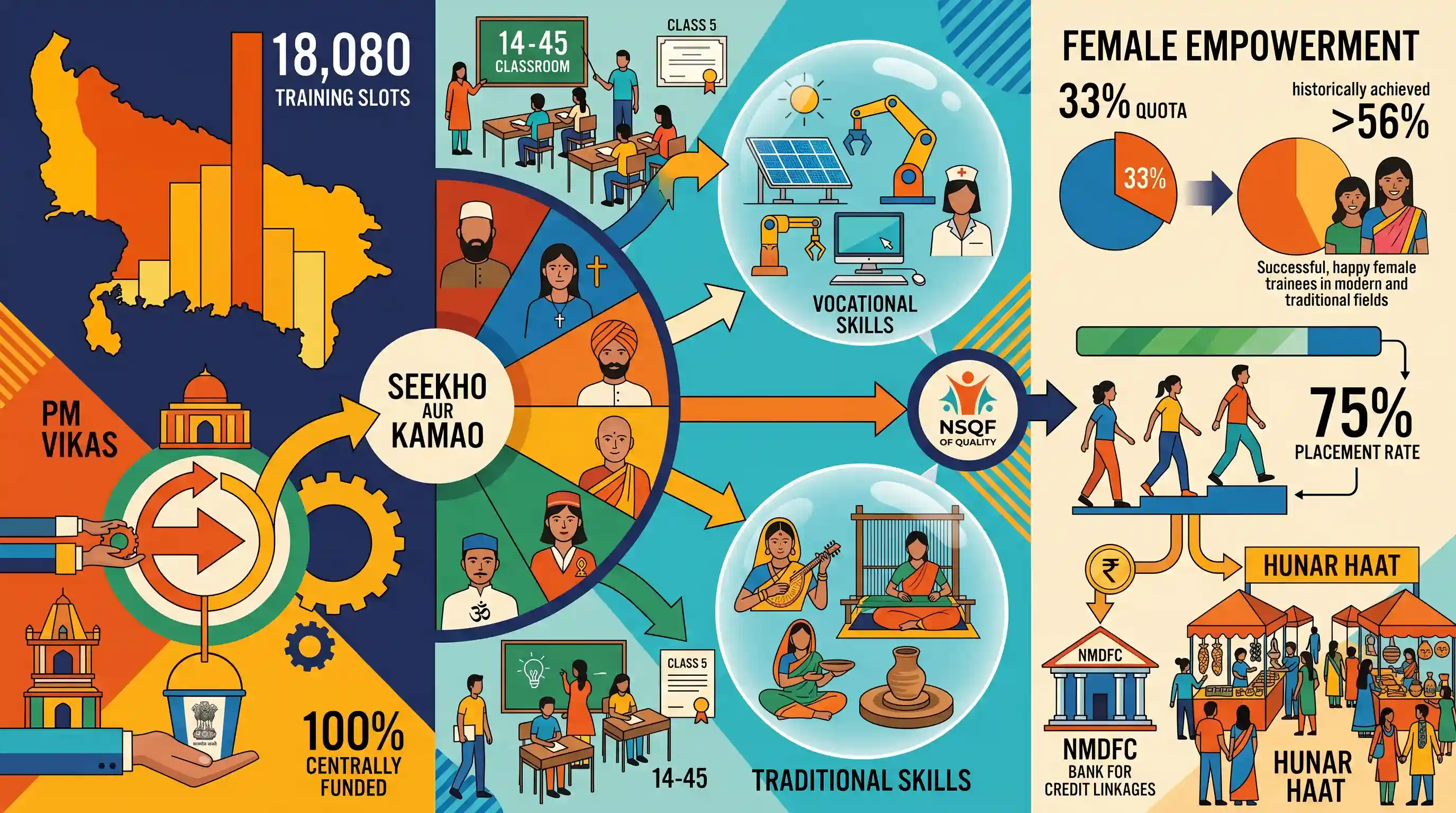
Uttar Pradesh has received the highest allocation under the Pradhan Mantri Virasat Ka Samvardhan (PM VIKAS) scheme with 18,080 training slots, leading all other states. Its core skilling component, 'Seekho aur Kamao' (Learn and Earn), is a 100% centrally funded Central Sector Scheme by the Ministry of Minority Affairs. The program targets youth aged 14 to 45 from India's six notified minority communities who have completed at least Class 5, offering them free, NSQF-aligned vocational and traditional skill training. It emphasizes female empowerment with a 33% quota (historically achieving over 56% female participation) and mandates a 75% placement rate for trainees, coupled with credit linkages via NMDFC and market access via Hunar Haat.
Key Points
- Uttar Pradesh has secured the highest allocation in the country with 18,080 training slots in the current cycle of PM VIKAS.
- Seekho aur Kamao (Learn and Earn) serves as the core skilling component of the umbrella scheme Pradhan Mantri Virasat Ka Samvardhan (PM VIKAS).
- It is a Central Sector Scheme funded 100% by the Union Ministry of Minority Affairs, which allocates training slots to empanelled Project Implementing Agencies (PIAs) and state agencies based on proposals.
- Eligible candidates must belong to the six notified minority communities (Muslims, Christians, Sikhs, Buddhists, Jains, and Parsis) and be aged between 14 and 45 years, with a minimum qualification of Class 5.
- The scheme mandates a minimum of 33% reservation for women. Nationally, women have accounted for over 56% of all trainees under the program. Successful women completing leadership training can become 'Biz Sakhis' (business mentors).
- At least 75% of trained candidates must be placed, with at least 50% of those placed in the organized sector. Credit linkages are provided through the NMDFC, and market access is facilitated through Hunar Haat.
- Over the last decade, the scheme has trained 4.68 lakh beneficiaries nationally, with over 2.28 lakh placed. The overall national target under PM VIKAS is 9 lakh beneficiaries, with 1.51 lakh designated for the current cycle.
Important Terms
Pradhan Mantri Virasat Ka Samvardhan (PM VIKAS)

A Central Sector Scheme under the Ministry of Minority Affairs that consolidates five earlier schemes (including Seekho aur Kamao and USTTAD) to provide comprehensive skilling, entrepreneurship, leadership, and education support to India's minority and artisan communities.
UPSC context
GS Paper II (Welfare Schemes) and GS Paper III (Employment/Skill Development). Tests policies for marginalized sections, economic inclusion, and skill preservation.
Seekho aur Kamao
A skill development initiative of the Ministry of Minority Affairs, now a component of PM VIKAS, aimed at upgrading the modern and traditional skills of minority youth aged 14–45 to ensure sustainable employment.
UPSC context
GS Paper II (Social Justice/Welfare Schemes) and GS Paper III (Employment). Tests strategies for minority skill-building, gender empowerment, and demographic dividend.
National Minorities Development and Finance Corporation (NMDFC)
A not-for-profit apex body under the Ministry of Minority Affairs incorporated in 1994 to provide concessional credit and financial assistance to notified minority communities for self-employment and income-generating activities.
UPSC context
GS Paper II (Welfare Institutions) and GS Paper III (Inclusive Growth/Financial Inclusion). Tests knowledge of apex bodies providing microfinance and credit to weaker sections.
Hunar Haat
An exhibition platform organized by the Ministry of Minority Affairs to display and market traditional handicrafts, handlooms, and cuisines of master artisans and craftsmen from minority communities, promoting direct-to-buyer market access.
UPSC context
GS Paper II (Social Empowerment) and GS Paper III (MSMEs/Growth). Tests awareness of marketing linkages, vocal-for-local initiatives, and cultural heritage preservation.
Ministry of Minority Affairs
The nodal Ministry of the Government of India, established in 2006, responsible for the formulation of policy, planning, coordination, evaluation, and implementation of development and regulatory programs for notified minority communities.
UPSC context
GS Paper II (Governance/Welfare Policies). Tests understanding of the executive machinery, administrative structures, and targeted interventions for vulnerable and minority communities.
Prelims Trap
PM VIKAS is a Centrally Sponsored Scheme where funds are devolved directly to State governments based on their minority population.
PM VIKAS is a 100% Central Sector Scheme. Funds are allocated directly to Project Implementing Agencies (PIAs) based on proposals, not via direct state-level fiscal devolution.
Static Concepts Connected
What is the statutory and constitutional framework for identifying minorities in India?
- Statutory basis: Under Section 2(c) of the National Commission for Minorities Act, 1992, the Central Government officially notifies minority communities.
- Notified groups: Six communities are currently notified: Muslims, Christians, Sikhs, Buddhists, Zoroastrians (Parsis), and Jains (notified in 2014).
- Constitutional articles: Articles 29 and 30 safeguard minority interests, though the Constitution does not explicitly define the term 'minority'.
How do Central Sector and Centrally Sponsored schemes differ?
- Funding pattern: Central Sector Schemes are 100% Union-funded, whereas Centrally Sponsored Schemes involve cost-sharing (e.g., 60:40) with State governments.
- Implementation mechanism: Central Sector Schemes are executed directly by Central Ministries/PIAs; Centrally Sponsored Schemes are implemented via State executive machinery.
Cross-Topic Patterns
Minority welfare + Federal devolution
Schemes like PM VIKAS use central sector routing through PIAs, highlighting operational differences between centralized target funding and state-level cooperative federalism.
Traditional crafts + IPR protection
Promoting traditional minority arts (e.g., USTTAD component) directly intersects with intellectual property rights under TRIPS and GI tag protection for local artisans.

Multi-statement questions on the five merged schemes under PM VIKAS and the statutory basis of minority notification likely in Prelims 2026.
Linked PYQs · 3
Linked PYQs · 3
- 2014UPPSC_PRELIMSGS1
The 'Nalanda Project' is a programme of which of the following Ministries?
- 2023UPPSC_PRELIMSGS1
Which of the following scheme/s is/are related to Uttar Pradesh? (1) Anuthee Uphar Scheme (2) Matra Shakti Udyamita Scheme (3) Kaushalya Matritva Scheme (4) Stree Nidhi Scheme Select the 'correct' answer using the code given below -
- 2025UPPSC_PRELIMSGS1
Match List-I (Committee): (A) Union Constitution Committee (B) Rules of Procedure Committee (C) Drafting Committee (D) Advisory Committee on Fundamental Rights, Minorities and Tribal and Excluded Areas List-II (Chairman): 1. Dr. B.R. Ambedkar 2. Sardar Vallabhbhai Patel 3. Jawaharlal Nehru 4. Dr. Rajendra Prasad
