Iran Economic Crisis Triggers Deadly Protests and Rial Collapse
Source:The Hindu ↗
Why It Matters
Understanding the interplay between international sanctions, regional conflict, and severe domestic economic crises (like hyperinflation and currency collapse) is crucial for analyzing the geopolitical stability of West Asia and its broader implications for global energy security and bilateral relations.
Summary
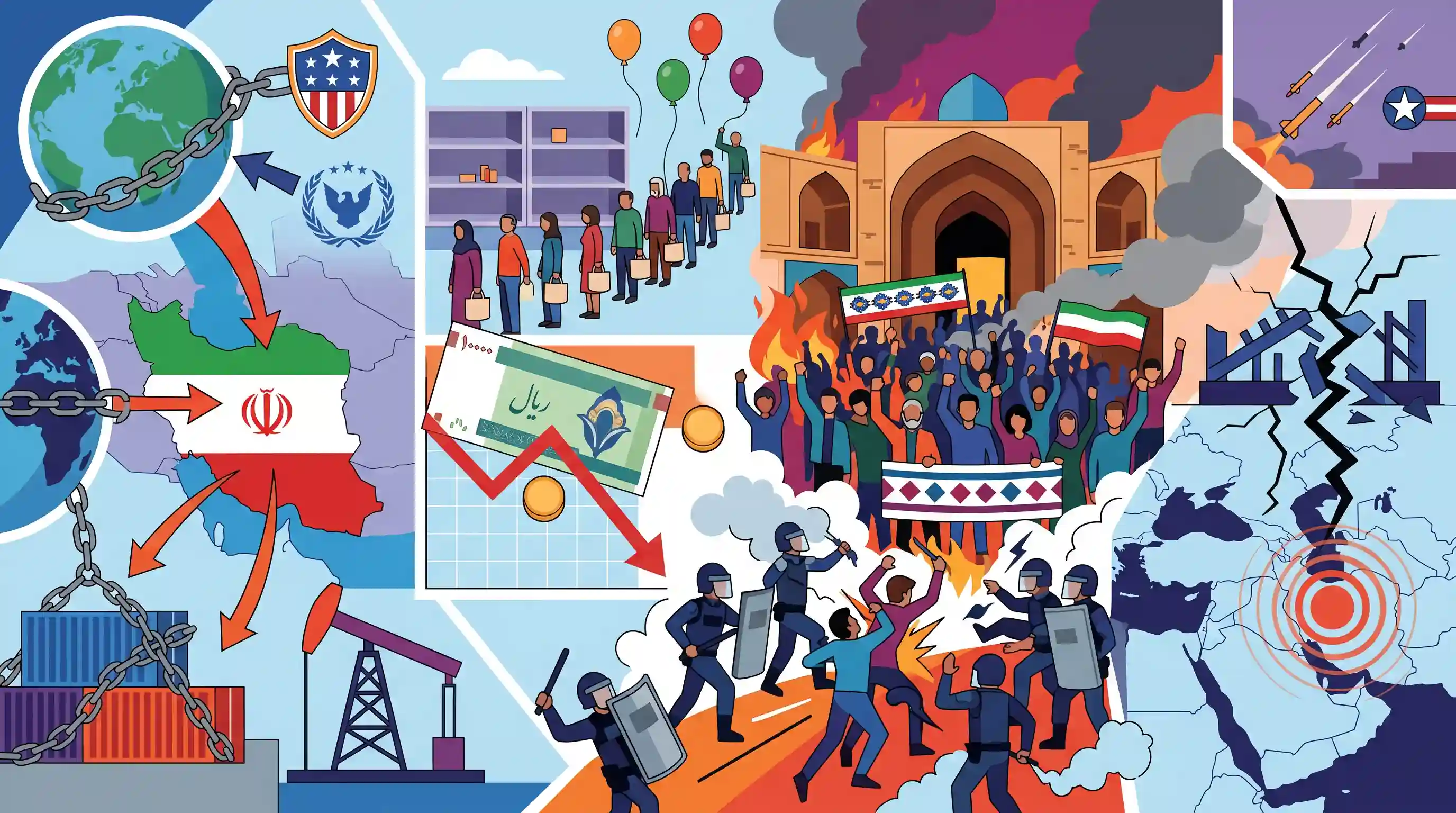
Massive protests erupted in Iran, particularly at Tehran's Grand Bazaar, over the country's severe economic crisis, leading to clashes with security forces that left at least 35 dead. The unrest is fueled by a collapsing rial, hyperinflation, and shortages of essential goods, exacerbated by ongoing international sanctions and the economic fallout from a recent conflict with Israel. The situation highlights the profound domestic impact of geopolitical isolation and currency devaluation on regional stability in West Asia.
Key Points
- At least 35 people were killed in Tehran's Grand Bazaar as security forces clashed with protesters decrying the failing economy.
- Iran's currency, the rial, collapsed to a record low of 1.46 million to the US dollar, driving severe hyperinflation and shortages of basic goods.
- The economic turmoil is largely driven by the aftermath of a recent 12-day war with Israel and compounding international sanctions.
- Protests have spread beyond the capital to regions like Ilam, prompting reformist President Masoud Pezeshkian to acknowledge the spiraling crisis.
Important Terms
Economic Sanctions

Commercial and financial penalties applied by countries or international organizations against states or entities to influence their behavior or security decisions.
UPSC context
GS II: International Relations. Relevant for analyzing non-military foreign policy tools and their impacts on India's strategic and economic interests.
Hyperinflation
A state of rapid, out-of-control price increases, typically exceeding 50% per month, which causes a currency to lose its value as a medium of exchange.
UPSC context
GS III: Indian Economy. Tests understanding of extreme inflationary pressures, monetary instability, and the resulting socio-political unrest.
Currency Devaluation
The deliberate downward adjustment of a country's official exchange rate relative to another currency or basket of currencies, usually enacted by the central bank.
UPSC context
GS III: Indian Economy. Tests concepts of exchange rate management, Balance of Payments (BoP), and trade competitiveness.
West Asia
A strategically vital region for India's energy security and diaspora, comprising countries such as Iran, Israel, Saudi Arabia, and the UAE.
UPSC context
GS II: International Relations. Key for India’s ‘Look West’ policy, energy diplomacy, and the welfare of over 9 million Indian expatriates.
Bazaaris
The traditional merchant and shopkeeper class in Iran, centered in historic marketplaces like Tehran’s Grand Bazaar, who exert significant socio-political and economic influence.
UPSC context
GS II: International Relations. Important for understanding internal socio-economic actors that drive political change and domestic stability in West Asian powers.
Central Bank (of Iran)
The national institution responsible for monetary policy, managing the national currency, and overseeing the banking sector, especially under international financial isolation.
UPSC context
GS III: Indian Economy. Relates to institutional roles in crisis management, inflation targeting, and the effects of global financial sanctions.
Prelims Trap
The collapse of the Iranian rial is primarily driven by comprehensive UN Security Council sanctions.
The most crippling measures are unilateral US/Western sanctions imposed after the 2018 US withdrawal from the JCPOA, not active UN Security Council mandates.
Static Concepts Connected
What are the macroeconomic impacts of severe currency devaluation in import-dependent economies?
- Imported Inflation: The cost of imported essential goods and raw materials skyrockets, often triggering a hyperinflationary spiral if unmanaged.
- Capital Flight: Loss of economic confidence prompts citizens to convert local currency into foreign assets or gold, worsening the depreciation cycle.
- Eroded Purchasing Power: Real incomes and living standards drastically fall, frequently sparking civil unrest and political instability.
What is the strategic and geographic significance of Iran for India?
- Chabahar Port: Located on the Gulf of Oman, it allows India to bypass Pakistan for direct transit access to Afghanistan and Central Asia.
- INSTC Node: Iran acts as a pivotal transit corridor in the International North-South Transport Corridor (INSTC) linking India to Russia and Europe.
- Strait of Hormuz: Iran borders the Strait of Hormuz, a critical maritime route that facilitates a massive share of India's hydrocarbon imports.
Cross-Topic Patterns
Currency crisis + Geopolitical sanctions
Demonstrates how unilateral US sanctions and regional conflicts directly translate into hyperinflation and domestic instability, presenting a classic political-economy linkage.
Iran unrest + Connectivity projects
Prolonged domestic instability in Iran threatens the timely execution and operational security of India's strategic connectivity investments, including Chabahar Port and the INSTC.

Map-based matching questions linking West Asian crisis regions (e.g., Ilam) and strategic ports (Gulf of Oman) are highly likely in 2026.
Linked PYQs · 3
Linked PYQs · 3
- 2012MainsGS2
How have the US sanctions against Iran affected India's bilateral relations with Iran?
- 2018MainsGS3
How would the recent phenomena of protectionism and currency manipulations in world trade affect macroeconomic stability of India?
- 2022PrelimsGS1
The term "Levant" often heard in the news roughly corresponds to which of the following regions?
