India Japan Summit Focuses On Economic Security And Defence Pacts
Source:The Hindu ↗
Why It Matters
The article is crucial for UPSC aspirants as it highlights the evolution of the India-Japan partnership from traditional security and infrastructure (ODA, bullet trains) to emerging domains like economic security, critical minerals, and AI. It also underscores their joint role in shaping the Indo-Pacific architecture through the Quad.
Summary
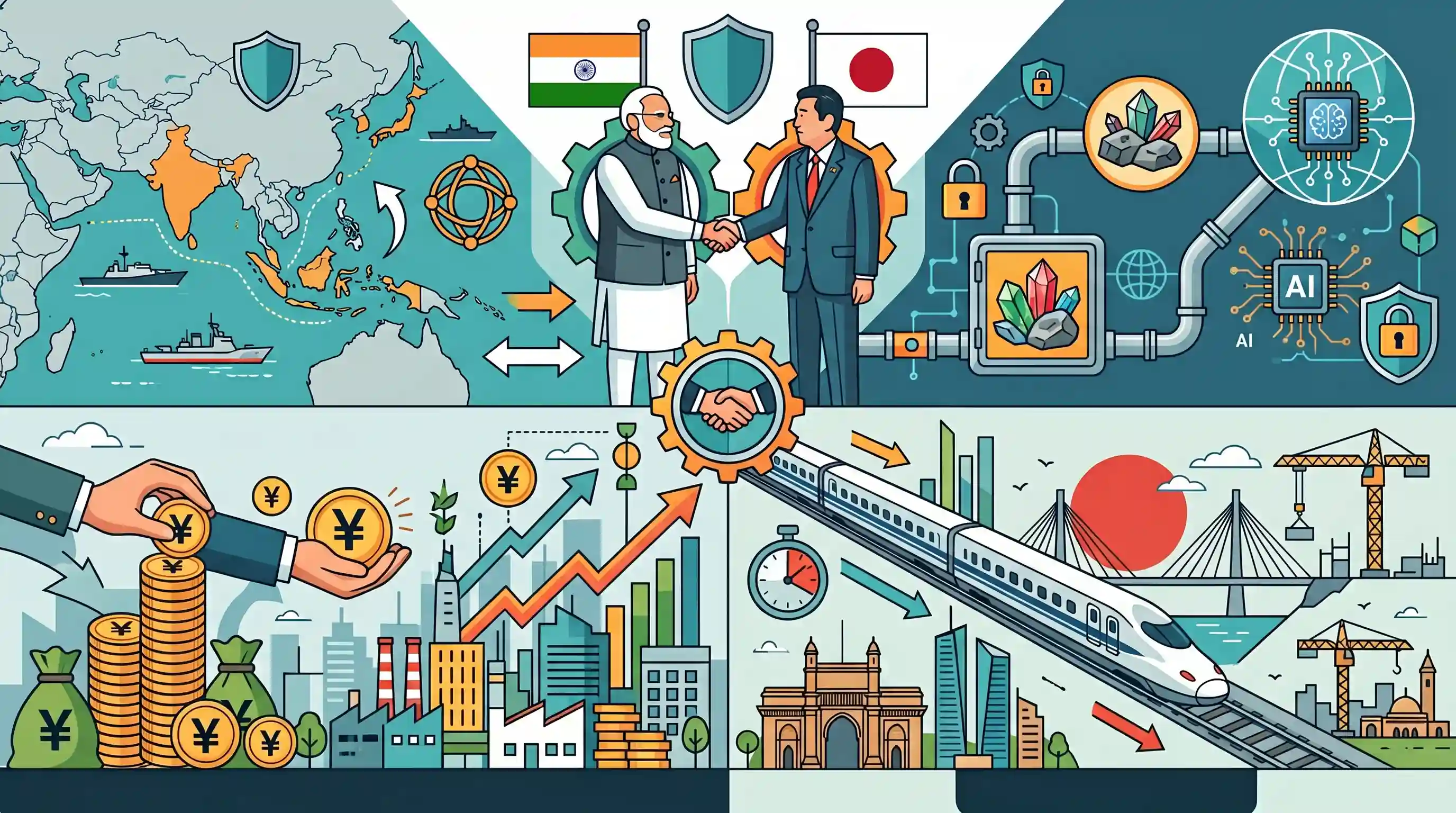
Prime Minister Narendra Modi's visit to Japan for the 15th annual summit with Prime Minister Shigeru Ishiba marks a significant step in the India-Japan Special Strategic and Global Partnership. The visit is expected to yield an upgraded security cooperation declaration and a new 'Economic Security' initiative aimed at securing supply chains for critical minerals and AI. Bilateral economic ties will be strengthened by a higher Japanese investment target of approximately $68 billion. Furthermore, the leaders will discuss the delayed but crucial Mumbai-Ahmedabad bullet train project—funded by Japanese ODA—and coordinate their Indo-Pacific strategies ahead of the upcoming Quad summit hosted by India.
Key Points
- PM Modi and Japanese PM Shigeru Ishiba are set to hold the 15th annual India-Japan summit, aiming to upgrade the 2008 Declaration on Security Cooperation.
- A new 'Economic Security' initiative will be launched, focusing on building resilient supply chains for critical minerals, semiconductors, and Artificial Intelligence (AI).
- Japan plans to increase its investment target in India to roughly $68 billion, solidifying its position as a major source of Foreign Direct Investment (FDI) and Official Development Assistance (ODA).
- The leaders will review the progress of the Mumbai-Ahmedabad bullet train project and discuss regional geopolitics in preparation for the upcoming Quad summit in India.
Important Terms
2008 Declaration on Security Cooperation

The foundational 2008 agreement between India and Japan establishing a framework for defense cooperation, maritime security, and information sharing on regional and global strategic issues.
UPSC context
GS Paper II: International Relations. Tests knowledge of the historical evolution of strategic partnerships with major powers like Japan.
Joint Vision for the Next Decade
A strategic roadmap adopted during the 2025 summit outlining eight pillars of cooperation—including technology, health, and mobility—to steer the India-Japan partnership through 2035.
UPSC context
GS Paper II: Bilateral Relations. Important for understanding future trajectories and specific areas of multifaceted global partnerships.
Economic Security initiative
A bilateral framework focused on securing resilient supply chains for critical minerals, semiconductors, and AI, aimed at de-risking economies from global geoeconomic vulnerabilities.
UPSC context
GS Paper III: Economy and Security. Tests understanding of how international diplomacy addresses supply chain resilience and technological sovereignty.
Mumbai-Ahmedabad High-Speed Rail (MAHSR)
India's flagship high-speed rail project using Japanese Shinkansen technology, largely funded by JICA, designed to connect major economic hubs in Gujarat and Maharashtra.
UPSC context
GS Paper III: Infrastructure. Relevant for studying Foreign Direct Investment, technology transfer, and mega-infrastructure financing through ODA.
Quad
A strategic forum comprising India, Japan, USA, and Australia committed to a "Free and Open Indo-Pacific," focusing on maritime security and rules-based order.
UPSC context
GS Paper II: International Relations. Essential for questions on regional groupings and Indo-Pacific geopolitics affecting India's strategic interests.
Japan International Cooperation Agency (JICA)
Japan's principal agency for implementing Official Development Assistance (ODA), providing technical expertise and low-interest loans for major Indian infrastructure like Metros and the Dedicated Freight Corridor.
UPSC context
GS Paper II: Bilateral Relations. Tests knowledge of the role of international development agencies in India’s domestic growth.
Prelims Trap
Japan is the largest source of Foreign Direct Investment (FDI) in India.
While Japan is India's largest bilateral donor of Official Development Assistance (ODA), it is not the top source of FDI (which is traditionally Singapore or Mauritius).
Static Concepts Connected
What characterizes Official Development Assistance (ODA) like the JICA bullet train loan?
- Concessional terms: Loans feature lower interest rates, longer repayment tenures, and extended grace periods compared to commercial market rates.
- Development focus: Primarily aimed at promoting the economic development and welfare of developing nations rather than commercial profit.
- Tied vs. Untied: Loans can be 'tied' (requiring procurement of goods/tech from the donor, like Shinkansen technology) or 'untied'.
What is the Supply Chain Resilience Initiative (SCRI)?
- Trilateral launch: Initiated by India, Japan, and Australia in 2021 to reduce dependence on China and ensure predictable supply chains.
- FDI promotion: Aims to enhance investment and trade networks to turn the Indo-Pacific region into a stable economic powerhouse.
- Digital integration: Focuses on sharing best practices in supply chain management and accelerating digital technology adoption.
Cross-Topic Patterns
ODA as strategic infrastructure diplomacy
Japan utilizes JICA's concessional loans to cement long-term strategic partnerships, offering a transparent, low-interest alternative to China's commercial Belt and Road Initiative (BRI) in the Indo-Pacific.
Critical minerals and Quad integration
The evolution from maritime security to 'Economic Security' reflects a broader Quad strategy to de-risk critical mineral and semiconductor supply chains from Chinese dominance.

Expect a 2026 Prelims multi-statement question blurring the lines between Japan's ODA, the SCRI, and commercial FDI.
Linked PYQs · 3
Linked PYQs · 3
- 2019MainsGS2
‘The time has come for India and Japan to build a strong contemporary relationship, one involving global and strategic partnership that will have a great significance for Asia and the world as a whole.’ Comment.
- 2021MainsGS3
“Investment in infrastructure is essential for more rapid and inclusive economic growth.” Discuss in the light of India's experience.
- 2016MainsGS3
Justify the need for FDI for the development of the Indian economy. Why there is gap between MOUs signed and actual FDIs? Suggest remedial steps to be taken for increasing actual FDIs in India.
