Section 163 BNSS Invoked During Delhi Protest March
Source:Indian Express ↗
આ શા માટે મહત્વનું છે
Understanding the practical application and frequent misuse of emergency police powers is crucial for aspirants. It highlights the friction between state authority (public order) and fundamental rights (freedom of assembly under Article 19), a recurring theme in GS Paper 2 governance and polity questions.
સારાંશ
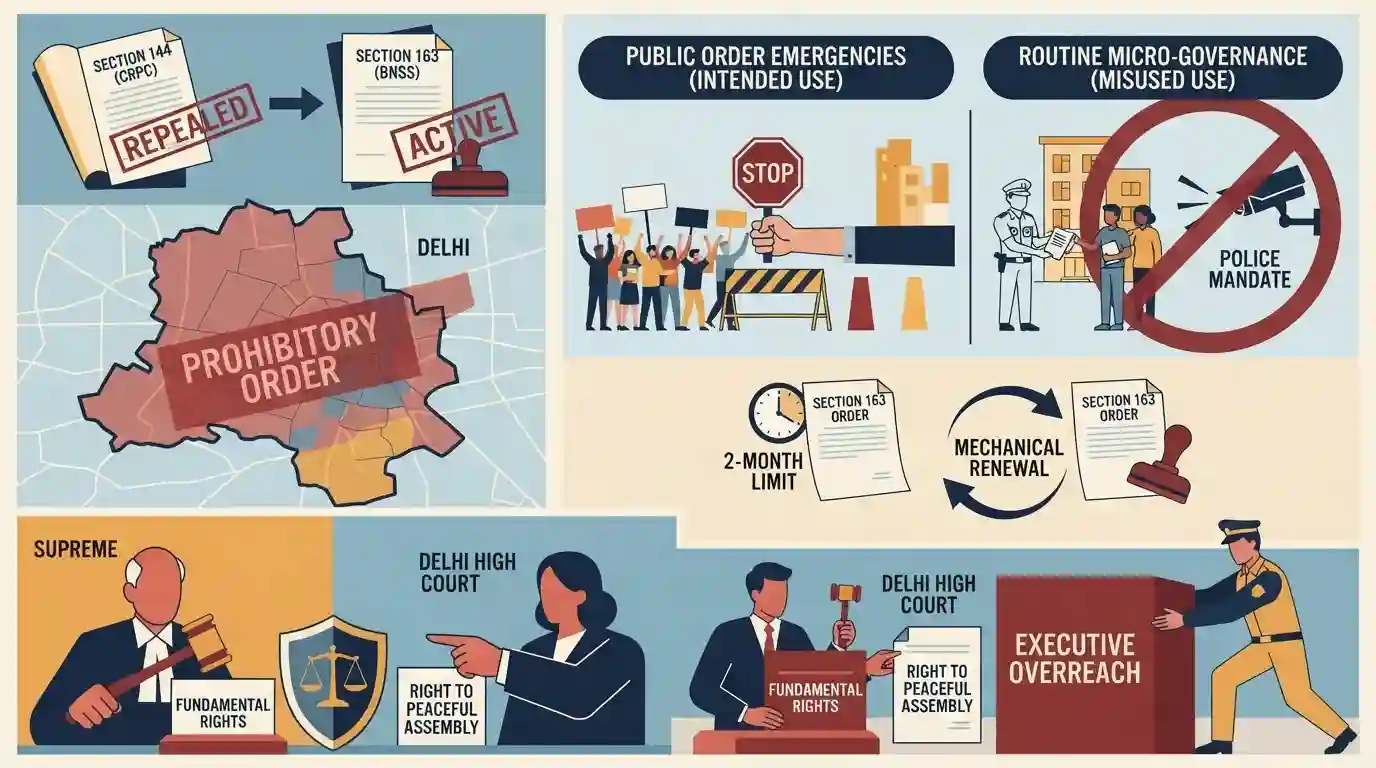
The article examines the application of Section 163 of the Bharatiya Nagarik Suraksha Sanhita (BNSS), which has replaced Section 144 of the CrPC. The provision was recently invoked by the Delhi Police to ban a protest march by the Cockroach Janta Party regarding the NEET-UG examination controversy. Highlighting an empirical study on the usage of Section 144, the article reveals that rather than managing true public order emergencies, the vast majority of these prohibitory orders in Delhi are misused for routine micro-governance tasks—such as tenant verification and CCTV mandates. By continuously renewing these orders every two months in a mechanical fashion, authorities effectively bypass statutory time limits and judicial precedents. Rulings by the Supreme Court and Delhi High Court have consistently warned against such blanket bans and executive overreach, stating that the right to peaceful assembly must not be trampled under the guise of procedure.
મુખ્ય મુદ્દા
- Section 163 of the newly enacted BNSS retains the emergency provisions of Section 144 of the CrPC, empowering Executive Magistrates to issue prohibitory orders to prevent apprehended danger or public nuisance.
- Delhi Police recently invoked Section 163 BNSS to prevent a protest march by the Cockroach Janta Party (CJP) demanding the resignation of the Union Education Minister over NEET-UG irregularities.
- An empirical study on the use of Section 144 CrPC in Delhi revealed that only 1.5% of the orders are related to protests or public order emergencies, while 98.5% are used for routine micro-governance (e.g., mandating CCTVs, tenant verifications, and banning synthetic kite strings).
- The study flags the systematic misuse of these powers through continuous, mechanical re-issuance of 'cyclostyled' orders every two months, which circumvents the statutory limit on their duration and amounts to legislation by executive fiat.
- Key Supreme Court judgments, including Babulal Parate (1961) and Mazdoor Kisan Shakti Sangathan (2018), have ruled that such emergency powers are not absolute and cannot be used to impose blanket bans on protests, emphasizing the need to balance public order with civil liberties.
સંલગ્ન PYQ · 1
સંલગ્ન PYQ · 1
- 2023MainsGS2
“The Constitution of India is a living instrument with capabilities of enormous dynamism. It is a constitution made for a progressive society.” Illustrate with special reference to the expanding horizons of the right to life and personal liberty.
