Madhya Pradesh High Court Ruling on Section 125 CrPC Maintenance
Source:lawbeat ↗
Why It Matters
Understanding the judicial framework for maintenance (Section 125 CrPC) is critical for MPPSC aspirants. It underscores the protection of women's rights while ensuring that legal processes (Family Courts) function objectively based on evidence rather than assumption, illustrating the everyday operation of the judiciary.
Summary
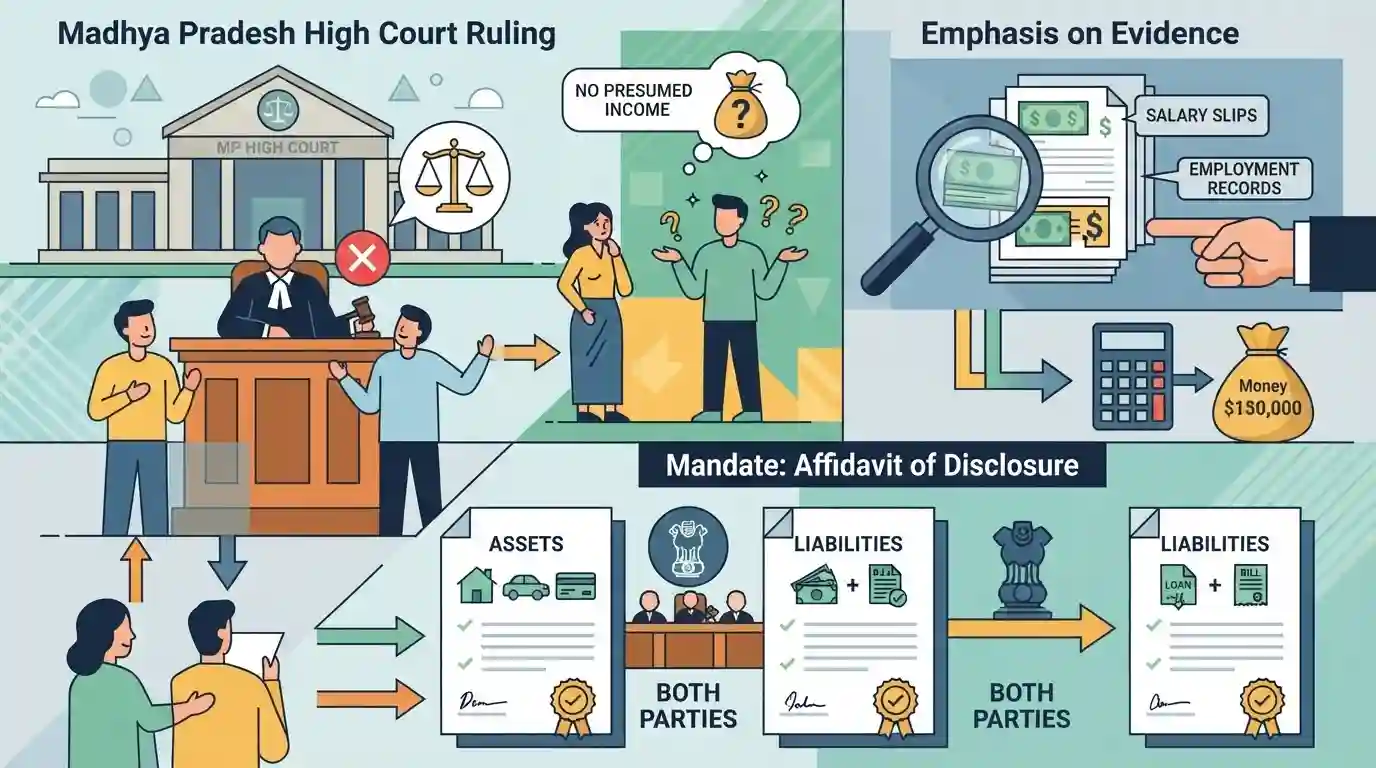
The Madhya Pradesh High Court ruled that family courts cannot decide maintenance amounts under Section 125 of the Code of Criminal Procedure (CrPC) based on presumed or assumed income. Justice Prem Narayan Singh emphasized that authenticated salary slips or concrete evidence of earnings must be presented before fixing maintenance. The High Court further highlighted the mandate from the Supreme Court in Rajnesh v. Neha, requiring both parties to file an Affidavit of Disclosure of Assets and Liabilities in such cases.
Key Points
- The Madhya Pradesh High Court ruled that family courts must calculate maintenance under Section 125 of the CrPC based on concrete evidence, such as authenticated salary slips, rather than assumptions.
- Justice Prem Narayan Singh noted that determining a spouse's income merely on guesswork or unverified claims leads to arbitrary maintenance orders.
- The court reiterated the Supreme Court's mandate in Rajnesh v. Neha, which requires both parties in a maintenance dispute to submit an Affidavit of Disclosure of Assets and Liabilities.
- The ruling overturned a Family Court order that had granted a Rs. 60,000 monthly maintenance based on the wife's unsubstantiated claim regarding the husband's salary.
Important Terms
Section 125 of Code of Criminal Procedure (CrPC)

A key provision providing summary remedy for dependent wives, children, and parents to claim maintenance from a person with sufficient means who neglects or refuses to maintain them.
UPSC context
GS Paper 2 (Social Justice/Judiciary). Tests knowledge of legal mechanisms ensuring financial security for destitute family members.
Affidavit of Disclosure of Assets and Liabilities
A mandatory legal document mandated by the Supreme Court in Rajnesh v. Neha, requiring disputing spouses to declare all income, assets, and liabilities transparently to determine fair maintenance.
UPSC context
GS Paper 2 (Judiciary/Women's Issues). Relevant for evaluating judicial reforms aimed at streamlining matrimonial dispute resolution.
Family Court
A specialized lower court established to handle family-related legal matters like divorce, child custody, and maintenance, aiming for conciliation and speedy resolution.
UPSC context
GS Paper 2 (Statutory Bodies/Judiciary). Tests understanding of institutional mechanisms for specialized, alternative dispute resolution.
High Court
The highest judicial court in a state in India, possessing appellate and original jurisdiction, and holding supervisory powers over subordinate courts, including Family Courts.
UPSC context
GS Paper 2 (Judiciary). Tests basic knowledge of the Indian judicial hierarchy and appellate powers.
Prelims Trap
"Parties appearing before a Family Court have a statutory right to be represented by a legal practitioner."
Section 13 of the Family Courts Act, 1984 explicitly denies the automatic right to legal representation to encourage conciliation over adversarial litigation.
Static Concepts Connected
What are the key statutory features of the Family Courts Act, 1984?
- Mandatory Setup: State Governments, consulting High Courts, must establish these courts in cities with a population over 1 million.
- Legal Representation: Parties have no absolute right to a lawyer. The court may permit one or appoint an amicus curiae to assist.
- Appeals & Revisions: Appeals lie directly to a High Court division bench. However, maintenance orders are challenged via revision petitions, not standard appeals.
How does maintenance under CrPC (now BNSS) interact with personal laws?
- Secular Nature: It provides a speedy, secular remedy to wives, children, and parents to prevent destitution, regardless of their religion.
- Overriding Effect: It offers immediate, independent relief that overrides personal laws, operating parallel to slower civil family disputes.
- Statutory Transition: Section 125 of the 1973 CrPC has been structurally retained and replaced by Section 144 of the new Bharatiya Nagarik Suraksha Sanhita (BNSS), 2023.
Cross-Topic Patterns
Secular Maintenance & BNSS Transition
The transition of Section 125 CrPC to Section 144 BNSS bridges criminal justice reforms with gender justice, maintaining a secular safety net against vagrancy regardless of personal laws.
Article 142 & Standardized Guidelines
The Supreme Court's mandate in Rajnesh v. Neha mirrors the Vishaka judgment by using Article 142 to fill legislative vacuums with standardized, nationwide procedural guidelines.

Expect a multi-statement Prelims question on the Family Courts Act, testing its unique barring of automatic legal representation.
Linked PYQs · 3
Linked PYQs · 3
- 2023MPPSC_PRELIMSGS1
What is the maximum age limit of a High Court Judge?
- 2021MPPSC_PRELIMSGS1
The power of Supreme Court of India to decide the disputes between Centre and States falls under which Jurisdiction ?
- 2023MPPSC_PRELIMSGS1
The functions of the National Commission for Women are Specified in:
