Finance Ministry Warns Of Secondary Impacts From US Tariffs On Exports
Source:The Hindu ↗
Why It Matters
Understanding the implications of global trade wars and protectionist policies on India's economy is crucial for the UPSC syllabus. It links external sector vulnerabilities (tariffs, FTAs) with domestic macroeconomic stability (sovereign ratings, inflation, employment schemes).
Summary
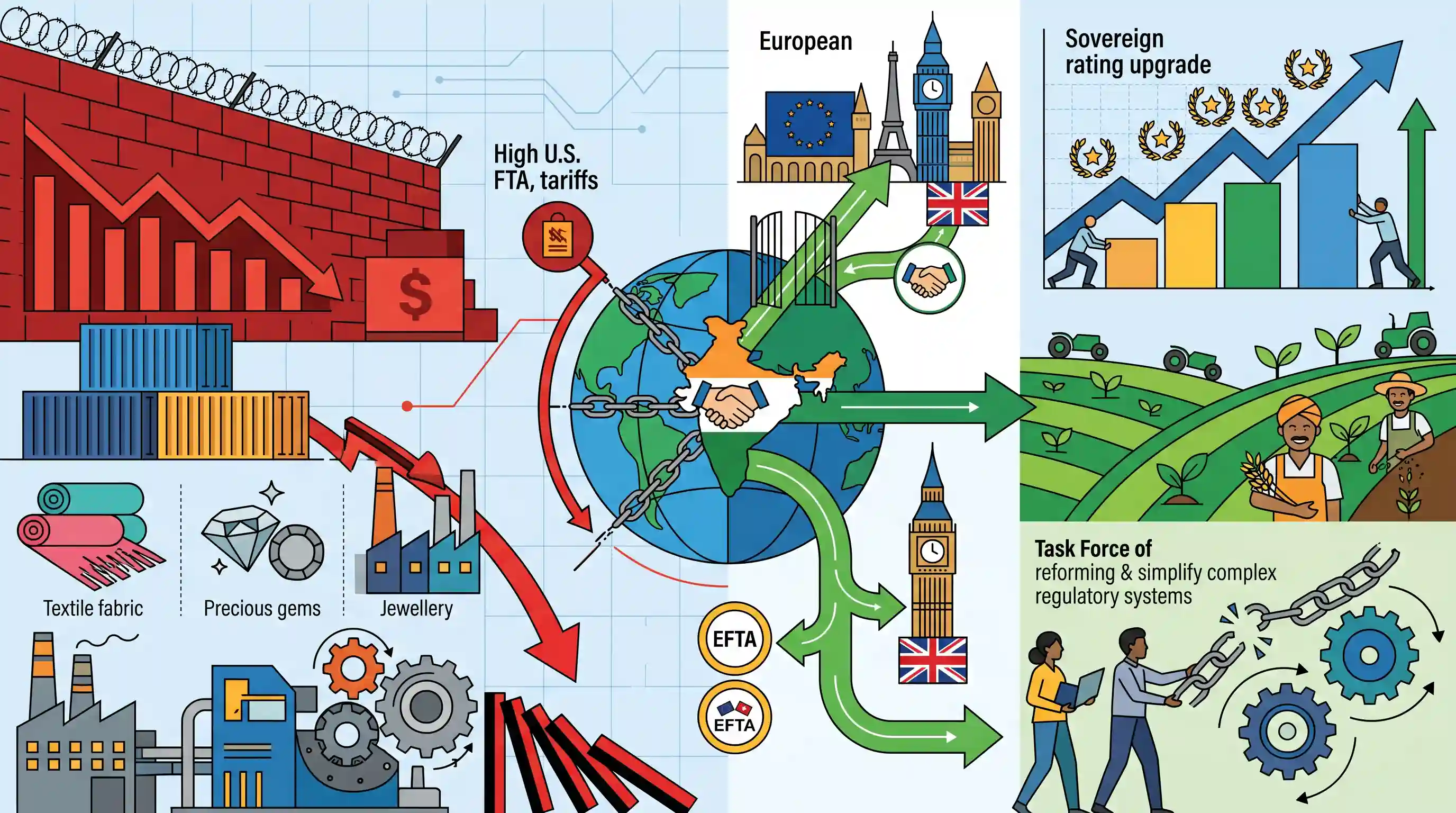
A recent Finance Ministry report highlights the economic challenges posed by the secondary and tertiary effects of widespread 50% U.S. tariffs imposed on Indian exports. These tariffs directly impact over $48 billion in shipments across key sectors like textiles, gems and jewellery, and machinery. To counter rising global protectionism, India is actively pursuing new Free Trade Agreements (FTAs) with the EU and others, following recent successful pacts with the UK and EFTA. Domestically, the economy shows resilience with an S&P sovereign rating upgrade to 'BBB', strong agricultural sowing, and ongoing regulatory reforms driven by a dedicated Task Force.
Key Points
- The Finance Ministry's latest report cautions that the secondary and tertiary effects of the sweeping 50% U.S. tariffs will pose significant challenges to the Indian economy.
- The U.S. tariffs affect diverse Indian exports worth over $48 billion, spanning labor-intensive sectors like textiles, gems and jewellery, leather, and shrimp, as well as chemicals and machinery.
- To navigate global protectionism, India is accelerating Free Trade Agreement (FTA) negotiations with partners like the EU, New Zealand, Chile, and Peru, having recently concluded pacts with the UK and EFTA.
- Despite external headwinds, domestic macroeconomic stability was reaffirmed by S&P upgrading India's sovereign rating to BBB, citing robust infrastructure spending and controlled inflation.
- The government aims to sustain growth through the Task Force for Next-Generation Reforms targeting regulatory simplification and employment schemes like PM Viksit Bharat Rozgar Yojana.
Important Terms
PM Viksit Bharat Rozgar Yojana

An employment-linked incentive scheme launched in August 2025 to create 3.5 crore jobs. It provides a ₹15,000 one-time incentive to first-time workers and EPFO-linked benefits to employers.
UPSC context
GS Paper II: Welfare schemes; GS Paper III: Employment and growth. Tests knowledge of labor-market interventions and social security.
India-EFTA Trade Agreement (TEPA)
A landmark trade deal signed in March 2024 between India and Iceland, Liechtenstein, Norway, and Switzerland. It includes a unique $100 billion investment commitment to India over 15 years.
UPSC context
GS Paper II: Bilateral agreements. Tests understanding of 'new-generation' FTAs involving non-EU European states and FDI commitments.
India-UK FTA
Officially known as the Comprehensive Economic and Trade Agreement (CETA), this 2025 pact targets doubling bilateral trade by 2030, granting 99% of Indian exports duty-free access to British markets.
UPSC context
GS Paper II: International Relations. Tests knowledge of post-Brexit economic diplomacy and sectoral impacts on Indian textiles/IT.
European Free Trade Association (EFTA)
An intergovernmental organization of four non-EU European states (Switzerland, Norway, Iceland, Liechtenstein) focused on free trade. It is the first European bloc to formalize a trade pact with India.
UPSC context
GS Paper II: International institutions. Essential for differentiating between EU and non-EU trade dynamics in Europe.
S&P Global Ratings
A global credit rating agency that upgraded India’s sovereign rating to ‘BBB’ (investment grade) in 2025, citing fiscal consolidation and infrastructure-led growth after an 18-year hiatus.
UPSC context
GS Paper III: Indian Economy. Tests understanding of sovereign creditworthiness, borrowing costs, and global investor confidence.
European Union (EU)
A political and economic union of 27 member states. India signed a landmark FTA with the EU in January 2026 to reduce tariffs and address carbon-border taxes.
UPSC context
GS Paper II: Regional groupings. Crucial for understanding global trade standards, IPR, and environmental trade barriers (e.g., CBAM).
Prelims Trap
"The recently signed India-EFTA trade agreement provides Indian exporters tariff-free access to the European Union (EU) market."
The EFTA consists of Switzerland, Norway, Iceland, and Liechtenstein. None of these are EU members. Aspirants often erroneously conflate EFTA with the broader EU bloc.
Static Concepts Connected
What is the macroeconomic impact of a Sovereign Credit Rating upgrade?
- Investment grade: A 'BBB' rating signifies investment grade, contrasting with speculative or 'junk' status, indicating a strong capacity to meet financial commitments.
- Borrowing costs: Upgrades lower the sovereign risk premium, reducing the interest rates Indian government and corporate borrowers face in international capital markets.
- Capital inflows: A higher rating signals macroeconomic stability to global investors, widening the pool of institutional funds willing to deploy FDI and FPI into India.
What are the secondary and tertiary effects of high export tariffs?
- Secondary effects: Immediate supply chain bottlenecks, cancelled orders, and inventory pile-ups for domestic industries that produce intermediate goods for the targeted exports.
- Tertiary effects: Broader macroeconomic shocks like a widened current account deficit, structural job losses in labor-intensive sectors (e.g., textiles), and subsequent currency volatility.
Cross-Topic Patterns
Tariffs + Current Account Deficit
Sharp drops in export earnings due to protectionist U.S. tariffs strain India's Current Account Deficit (CAD), creating downward pressure on the Rupee and complicating the RBI's inflation management.
Welfare via EPFO Formalization
The PM-VBRY scheme exemplifies a shift from traditional welfare to Employment Linked Incentives (ELI), using EPFO enrollment to simultaneously drive job creation and formalize the unorganized labor market.

Expect a 2026 prelims question contrasting the EFTA TEPA's $100B FDI commitment and non-EU members against the pending India-EU FTA.
Linked PYQs · 3
Linked PYQs · 3
- 2018MainsGS3
How would the recent phenomena of protectionism and currency manipulations in world trade affect macroeconomic stability of India?
- 2025MainsGS3
What are the challenges before the Indian economy when the world is moving away from free trade and multilateralism to protectionism and bilateralism? How can these challenges be met?
- 2016MainsGS2
The broader aims and objectives of WTO are to manage and promote international trade in the era of globalization. But the Doha round of negotiations seem doomed due to differences between the developed and the developing countries." Discuss in the Indian perspective.
