Secondary pollutants form significant share of PM2.5 pollution
Source:The Hindu ↗
Why It Matters
Highlights the critical distinction between primary and secondary pollutants for air quality management, emphasizing the role of thermal power plant emissions and the lack of FGD compliance as a major roadblock to achieving NCAP goals. Crucial for GS-3 Environment and Pollution topics.
Summary
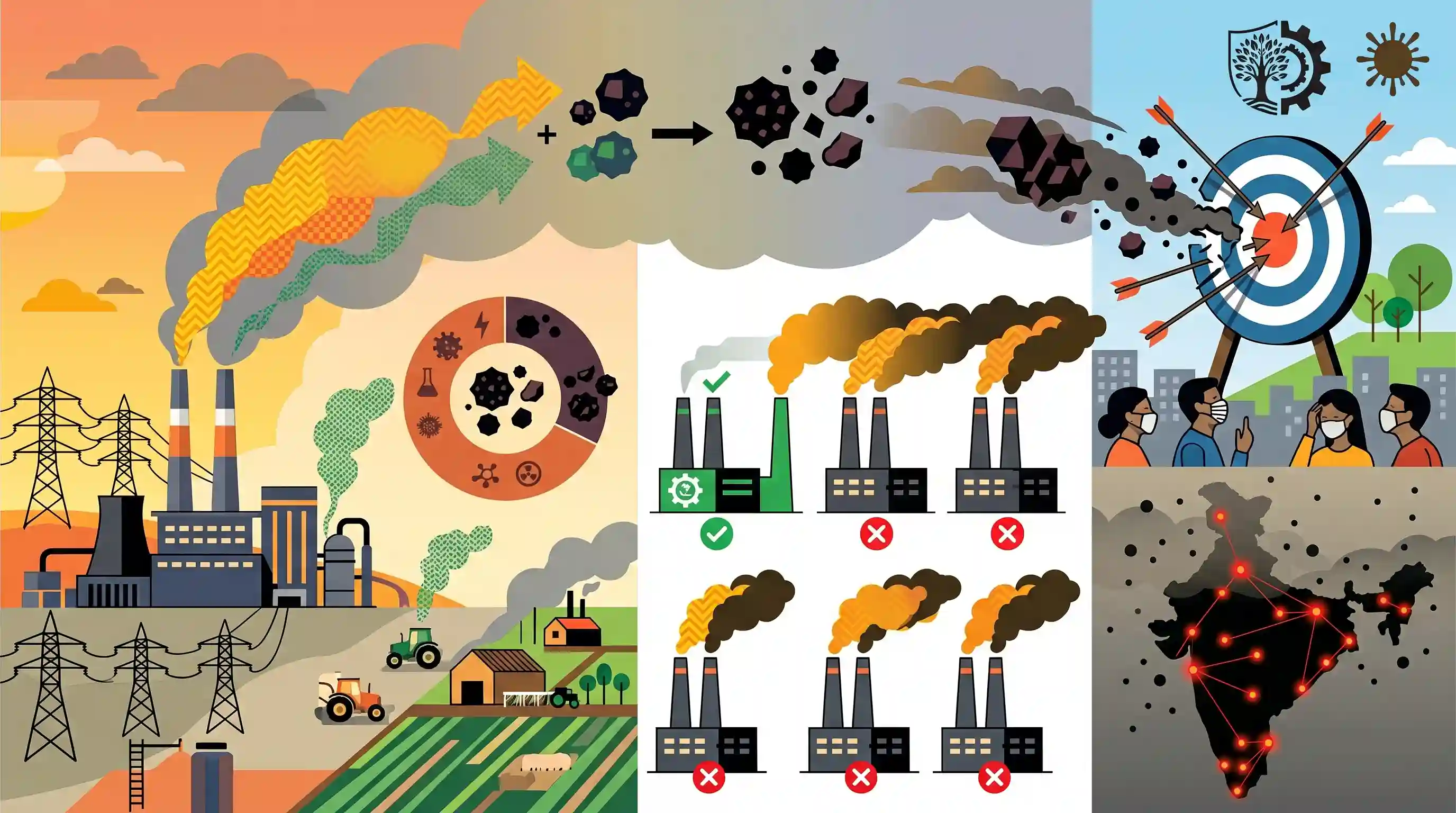
A study by the Centre for Research on Energy and Clean Air (CREA) reveals that secondary pollutants, particularly ammonium sulphate formed from the reaction of sulphur dioxide (SO2) and ammonia, constitute nearly one-third of India's PM2.5 pollution. While primary pollutants are directly emitted by sources like burning fossil fuels, secondary pollutants form via atmospheric reactions. The study highlights that coal-fired thermal power plants are the primary source of SO2 emissions in India, yet only about 8% of these plants have installed flue gas desulphurisation (FGD) systems. This massive contribution of secondary pollutants severely undermines the National Clean Air Programme (NCAP), which seeks to reduce PM2.5 levels across 130 non-attainment cities.
Key Points
- Secondary pollutants, specifically ammonium sulphate, make up nearly a third of India's PM2.5 pollution according to a CREA study.
- Secondary pollutants form in the atmosphere when primary pollutants like sulphur dioxide (SO2) and ammonia react, unlike primary pollutants which are emitted directly.
- Coal-fired thermal power plants are the largest driver of SO2 emissions in India.
- Only 8% of coal thermal plants have installed required flue gas desulphurisation (FGD) systems to mitigate SO2 emissions.
- The National Clean Air Programme (NCAP) covers 130 cities, and ammonium sulphate accounted for over 30% of PM2.5 in 114 of these cities, threatening NCAP air quality targets.
Important Terms
National Clean Air Programme (NCAP)

Launched in 2019 by MoEFCC, it is India's first national framework for time-bound air quality improvement. It targets a 40% reduction in particulate matter concentration by 2026 across 131 non-attainment cities.
UPSC context
GS III (Environment); crucial for questions on government pollution-control strategies and sustainable urban development.
PM2.5
Fine particulate matter $\le$ 2.5 micrometres in diameter. These particles penetrate deep into the lungs and bloodstream, causing severe respiratory and cardiovascular issues. WHO's safe limit is 5 $\mu$g/m³.
UPSC context
GS III (Pollution/Health); tests knowledge of air quality standards and public health impacts.
Secondary Pollutants
Pollutants not emitted directly but formed in the atmosphere through chemical reactions between primary pollutants (like $SO_2$, $NO_x$, Ammonia) and environmental factors like moisture and sunlight. Examples include ammonium sulphate and ozone.
UPSC context
GS III (Environment); tests conceptual understanding of atmospheric chemistry and complex pollution sources.
Flue Gas Desulphurisation (FGD)
A technology used to remove sulphur dioxide ($SO_2$) from the exhaust gases of coal-fired power plants. It involves scrubbing systems that convert $SO_2$ into neutral compounds like gypsum.
UPSC context
GS III (Infrastructure/Pollution); relevant for thermal energy regulations and industrial emission control.
Non-attainment Cities
Cities that consistently fail to meet the National Ambient Air Quality Standards (NAAQS) for five consecutive years. Under NCAP, 131 such cities are prioritized for air quality management.
UPSC context
GS III (Environment); essential for understanding targeted environmental governance and regional pollution disparities.
Centre for Research on Energy and Clean Air (CREA)
An independent, non-profit research organization (headquartered in Helsinki) that uses scientific data to track air pollution trends, health impacts, and energy transition solutions globally and in India.
UPSC context
GS III (Reports/Environment); source of critical data for policy evaluation and scientific evidence in environmental debates.
Prelims Trap
Ammonium sulphate is directly emitted into the atmosphere by coal-fired thermal power plants.
It is a secondary pollutant. Thermal plants emit SO2 (primary), which later reacts with atmospheric ammonia to form ammonium sulphate.
Static Concepts Connected
What is Flue Gas Desulphurisation (FGD) technology?
- Mechanism: Passes exhaust gases through an alkaline reagent (like limestone slurry) to scrub sulphur dioxide (SO2).
- By-product: Produces synthetic gypsum, which can be commercially reused in the cement and fertilizer industries.
- Efficiency: Removes up to 95% of SO2 emissions, significantly curbing the precursors that form secondary particulate matter (PM2.5).
What is the difference between Primary and Secondary pollutants?
- Primary Pollutants: Emitted directly into the air from a specific source (e.g., SO2, Carbon Monoxide, Ammonia, direct PM10).
- Secondary Pollutants: Not directly emitted; formed when primary pollutants react in the atmosphere (e.g., Ground-level Ozone, Peroxyacetyl Nitrate (PAN), Ammonium Sulphate).
Cross-Topic Patterns
Agriculture-Energy Pollution Nexus
Coal plants emit SO2, while agriculture (fertilizers/livestock) emits ammonia. Their atmospheric combination forms secondary PM2.5, bridging energy emissions with farming practices.
NCAP vs Regulatory Enforcement
NCAP aims to reduce PM across 130 non-attainment cities, but its success is structurally blocked by repeated deadline extensions for FGD installation in coal power plants.

Expect a pair-matching question on primary vs. secondary pollutants, or the exact commercial by-products of FGD (like gypsum) in 2026.
Linked PYQs · 4
Linked PYQs · 4
- 2020PrelimsGS1
Consider the following statements: 1. Coal ash contains arsenic, lead and mercury. 2. Coal-fired power plants release sulphur dioxide and oxides of nitrogen into the environment. 3. High ash content is observed in Indian coal. Which of the statements given above is/are correct?
- 2024PrelimsGS1
According to the Environmental Protection Agency (EPA), which one of the following is the largest source of sulphur dioxide emissions?
- 2020MainsGS3
What are the key features of the National Clean Air Programme (NCAP) initiated by the Government of India?
- 2022PrelimsGS1
In the context of WHO Air Quality Guidelines, consider the following statements: 1. The 24-hour mean of PM2.5 should not exceed 15 µg/m³ and annual mean of PM2.5 should not exceed 5 µg/m³. 2. In a year, the highest levels of ozone pollution occur during the periods of inclement weather. 3. PM10 can penetrate the lung barrier and enter the bloodstream. 4. Excessive ozone in the air can trigger asthma. Which of the statements given above are correct?
