High Court rules on family pension eligibility for second spouse
Source:etvbharat ↗
Why It Matters
The ruling highlights the intersection of statutory administrative rules (like CCS Pension Rules) and personal laws. Understanding the legal interpretation of marital validity and bigamy is essential for analyzing issues of women's rights, succession, and state welfare policies.
Summary
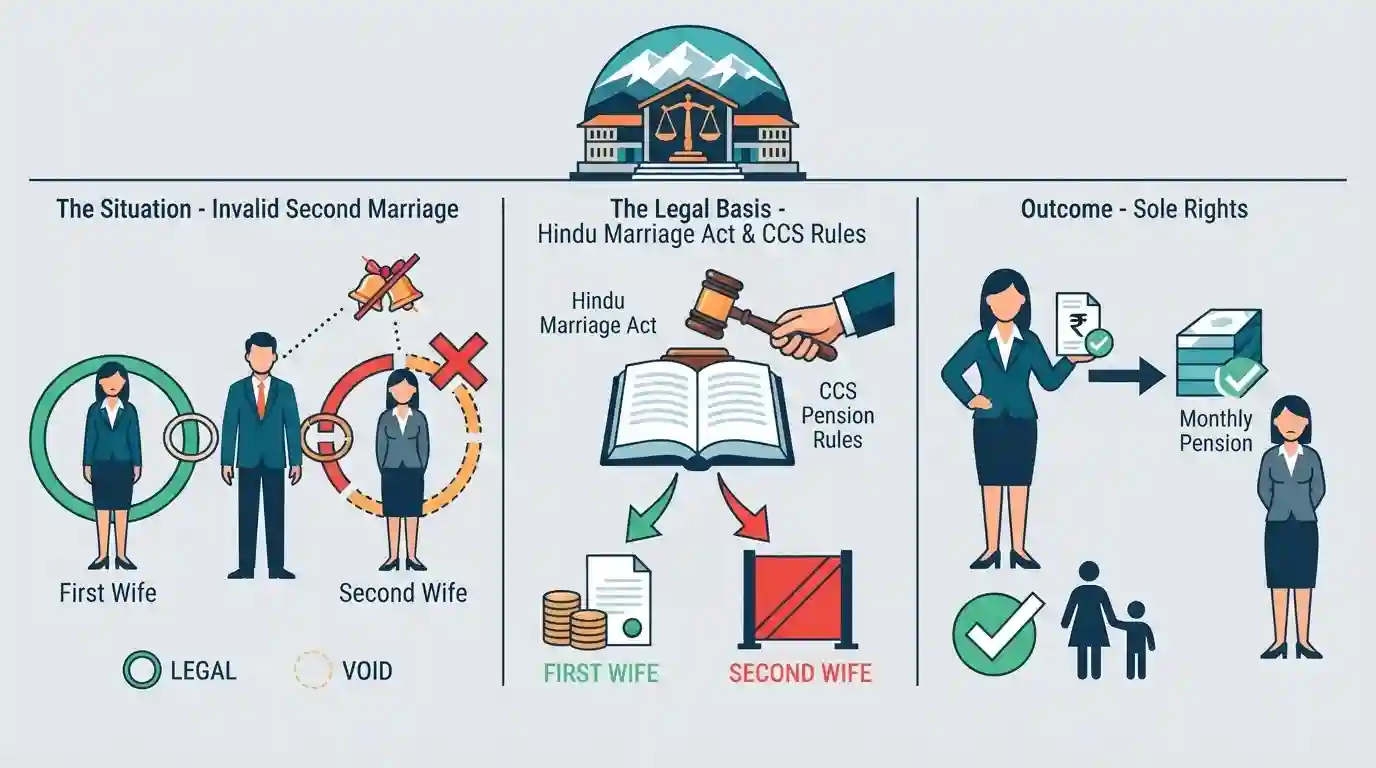
The Himachal Pradesh High Court has held that a second wife is not entitled to a family pension if her marriage was solemnized during the lifetime of the first wife. Dismissing the petition of Damyanti Devi, the court noted that under the Hindu Marriage Act, a second marriage contracted while the first spouse is living is void. Consequently, such a marriage does not confer any legal rights to the 'second wife' under the Central Civil Services (Pension) Rules, thereby affirming that the first legally wedded wife retains sole rights to the family pension.
Key Points
- The Himachal Pradesh High Court ruled that a second wife cannot claim family pension if the marriage took place while the first wife was alive.
- Under Hindu personal law, a second marriage solemnized during the subsistence of the first marriage is legally invalid (void ab initio).
- The Central Civil Services (Pension) Rules do not recognize rights, including pension claims, arising from a void marriage.
- The judgment reinforces the strict application of legal monogamy and the priority of the legally wedded first spouse in matters of government benefits and succession.
Important Terms
Hindu Marriage Act, 1955

A 1955 law governing Hindu marriages. It explicitly prohibits bigamy; under Section 11, any second marriage contracted while the first spouse is still living is declared legally void from its inception.
UPSC context
Tests GS Paper I (Society) and GS II (Polity). Highlights statutory personal laws, social justice, and women's legal rights.
Central Civil Services (Pension) Rules, 1972
Statutory rules governing pension benefits for government employees. Under Rule 54, family pensions are granted to legally wedded spouses, meaning partners in void second marriages have no legal claim to these funds.
UPSC context
Vital for GS Paper II (Governance). Evaluates understanding of administrative regulations, welfare distribution rules, and dependents' legal rights.
Himachal Pradesh High Court
The highest judicial authority in Himachal Pradesh, located in Shimla. It adjudicates on constitutional, civil, and criminal matters within the state, interpreting legislation like marriage validity for administrative claims.
UPSC context
Relevant for GS Paper II (Polity). Assesses knowledge of the state judiciary's role in enforcing governance rules and civil rights.
Prelims Trap
"A second wife from a void marriage has absolutely no legal claims, including maintenance or alimony."
While she is strictly barred from claiming family pension under CCS Rules, Indian courts allow her to claim maintenance under Section 25 of HMA to prevent destitution.
Static Concepts Connected
What are the grounds for a "Void Marriage" under the Hindu Marriage Act, 1955?
- Bigamy: Either party has a living spouse at the time of marriage (Section 5(i)), making the marriage void ab initio.
- Prohibited Relationship: The parties fall within the degrees of prohibited relationship, rendering the union void unless a valid custom permits it.
- Sapinda Relationship: The parties are sapindas of each other, which strictly nullifies the marriage without recognized customary exceptions.
Cross-Topic Patterns
Pension Rights vs. Children's Legitimacy
While a second wife is denied family pension, Section 16 of the HMA protects children of void marriages, granting them legitimacy and inheritance rights in their parents' property.
Service Rules and the UCC Discourse
Discrepancies in bigamy rules across different personal laws and their intersection with uniform state service rules (like CCS) frequently anchor Uniform Civil Code (UCC) debates in Mains.

Expect a multi-statement question contrasting a second wife's right to maintenance (allowed) vs. family pension (barred) under HMA & CCS.
Linked PYQs · 1
Linked PYQs · 1
- 2017HPAS_PRELIMSGS1
Which of the following Bills was drafted by Dr. B.R. Ambedkar as the first Law Minister of India?
