Abu Dhabi Peace Talks and UAE Role in Conflict Mediation
Source:Indian Express ↗
Why It Matters
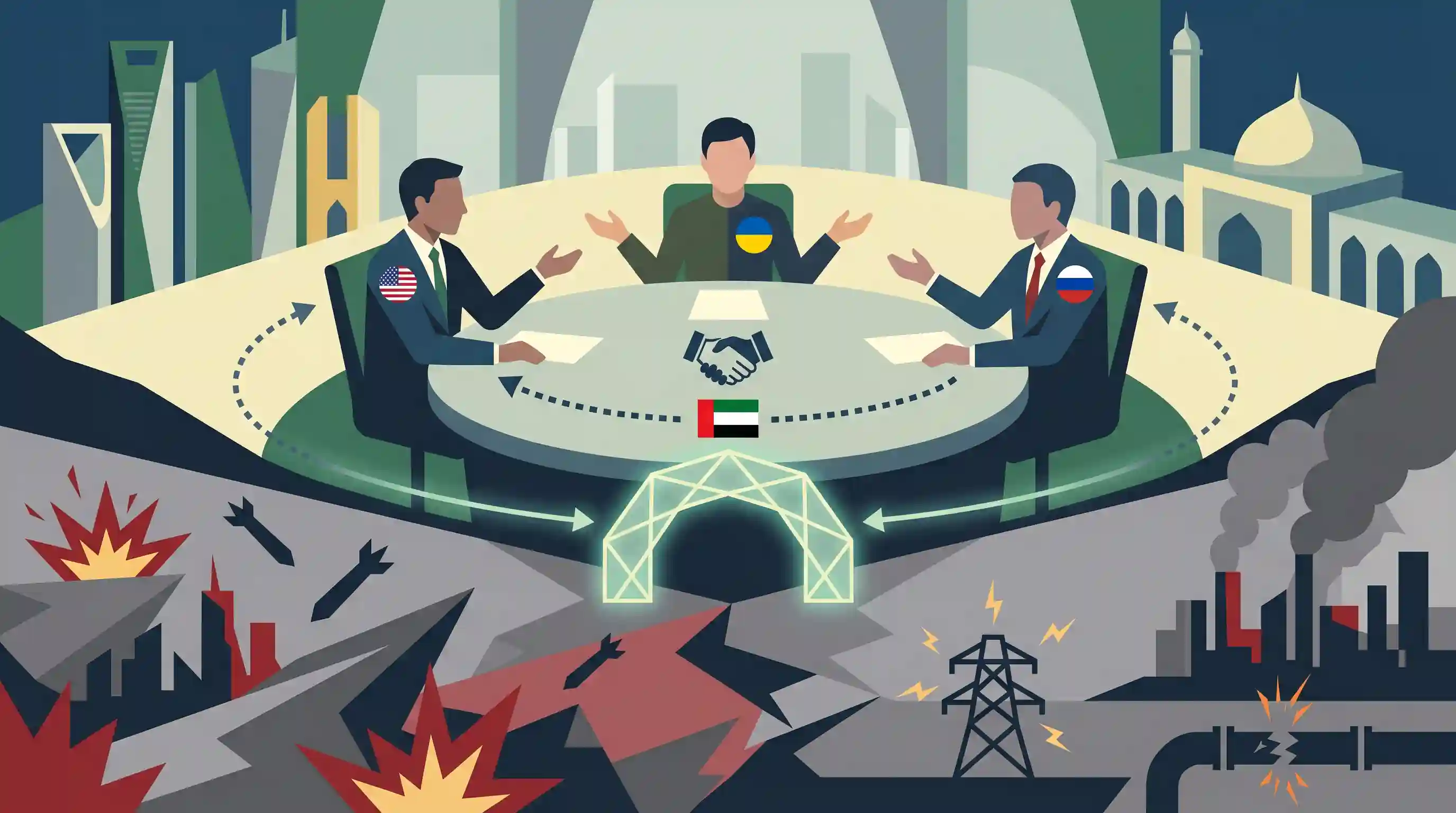
Illustrates the dual-track nature of modern conflicts where severe military escalation coincides with back-channel diplomatic negotiations. It also highlights the rising strategic profile of Gulf nations like the UAE in facilitating dialogue between conflicting great powers, which is highly relevant for GS-2 International Relations and mapping for Prelims.
Summary
A second round of trilateral peace talks involving Ukraine, Russia, and the United States has resumed in Abu Dhabi. These negotiations are taking place despite a significant escalation in hostilities, characterized by record Russian military strikes and the breakdown of a prior 'energy truce'. The meeting underscores the persistence of back-channel diplomacy amidst active conflict and highlights the United Arab Emirates' growing strategic role as a neutral mediator in global geopolitical disputes.
Key Points
- A second round of trilateral peace talks involving Ukraine, Russia, and the US has commenced in Abu Dhabi.
- Negotiations are occurring against the backdrop of record-high Russian military strikes against Ukraine.
- An earlier 'energy truce' intended to protect critical infrastructure has collapsed.
- The UAE is increasingly positioning itself as a pivotal neutral venue for global conflict mediation and back-channel diplomacy.
Important Terms
Trilateral talks

Formal or informal negotiations involving three distinct parties (e.g., Ukraine, Russia, and the US) to resolve conflicts or coordinate strategic interests.
UPSC context
GS II: International Relations. Tests understanding of diplomatic formats used in multi-party conflict resolution and global geopolitics.
Energy truce
A negotiated moratorium or informal agreement between warring parties to cease attacks on energy infrastructure, such as power plants and refineries, during active conflict.
UPSC context
GS II & GS III: International Relations and Security. Tests knowledge of infrastructure protection and humanitarian constraints in modern warfare.
Back-channel diplomacy
Secret or unofficial communication between adversaries that bypasses formal protocols to explore sensitive compromises away from public or political pressure.
UPSC context
GS II: International Relations. Crucial for understanding conflict management and "Track" diplomacy in sensitive geopolitical crises.
Neutral mediator
A state or entity that facilitates dialogue between conflicting parties while maintaining an impartial stance to build trust and ensure fairness.
UPSC context
GS II: International Relations. Tests knowledge of the role of middle powers (like UAE) in global conflict resolution.
Energy security
The reliable availability and protection of energy sources, often compromised during war through targeted strikes on civilian and military power grids.
UPSC context
GS III: Economy and Environment. A major strategic objective for nations to ensure economic stability and survival during geopolitical crises.
Prelims Trap
"An 'Energy Truce' is a formal mechanism monitored by the IAEA to prevent strikes on nuclear facilities."
An 'energy truce' is an informal agreement to halt strikes on general civilian power grids and oil facilities, not a formal IAEA-monitored protocol strictly for nuclear plants.
Static Concepts Connected
What are the different "Tracks" of diplomacy in International Relations?
- Track I: Official, formal government-to-government diplomatic negotiations and interactions.
- Track II: Unofficial, informal interactions involving non-state actors, NGOs, or retired officials to build mutual trust.
- Back-channel: Secret, informal negotiations—often facilitated by a neutral third party—to bypass rigid public stances and explore compromises.
What is the geographical location and border configuration of the UAE?
- Land Borders: The UAE shares land borders only with Saudi Arabia (to the west and south) and Oman (to the east and northeast).
- Water Bodies: It overlooks the Persian Gulf to the north and the Gulf of Oman to the east.
- Qatar Exception: It does not share a land border with Qatar; the two are separated by a stretch of Saudi Arabian territory.
Cross-Topic Patterns
Gulf's strategic autonomy & BRICS
The UAE's role as a neutral mediator highlights its shift from a US security dependent to a multi-aligned middle power, parallel to its recent entry into the BRICS grouping.
Weaponisation of civilian infrastructure
The concept of an 'energy truce' ties into the broader Geneva Conventions, testing the limits of international humanitarian law against targeting civilian power grids in modern warfare.

Expect a 'Places in News' pairing question linking mediation venues (Abu Dhabi) or conflict zones (Donbas) with their respective borders.
Linked PYQs · 4
Linked PYQs · 4
- 2023PrelimsGS1
Consider the following pairs: Regions often mentioned in news Reason for being in news 1. North Kivu and Ituri : War between Armenia and Azerbaijan 2. Nagorno-Karabakh : Insurgency in Mozambique 3. Kherson and Zaporizhzhia : Dispute between Israel and Lebanon How many of the above pairs are correctly matched?
- 2023PrelimsGS1
Consider the following pairs: Area of conflict mentioned in news Country where it is located 1. Donbas : Syria 2. Kachin : Ethiopia 3. Tigray : North Yemen How many of the above pairs are correctly matched?
- 2023PrelimsGS1
Consider the following countries: 1. Bulgaria 2. Czech Republic 3. Hungary 4. Latvia 5. Lithuania 6. Romania How many of the above-mentioned countries share a land border with Ukraine?
- 2025MainsGS2
"Energy security constitutes the dominant kingpin of India's foreign policy, and is linked with India's overarching influence in Middle Eastern countries.” How would you integrate energy security with India's foreign policy trajectories in the coming years?
