Cheetah Reintroduction Program Yields New Births at Kuno National Park
Source:Indian Express ↗
Why It Matters
Project Cheetah is a landmark intercontinental wildlife translocation initiative. Updates on the survival, breeding, and acclimatization of the cheetahs are highly relevant for the Environment and Ecology section of UPSC Prelims and Mains (GS3).
Summary
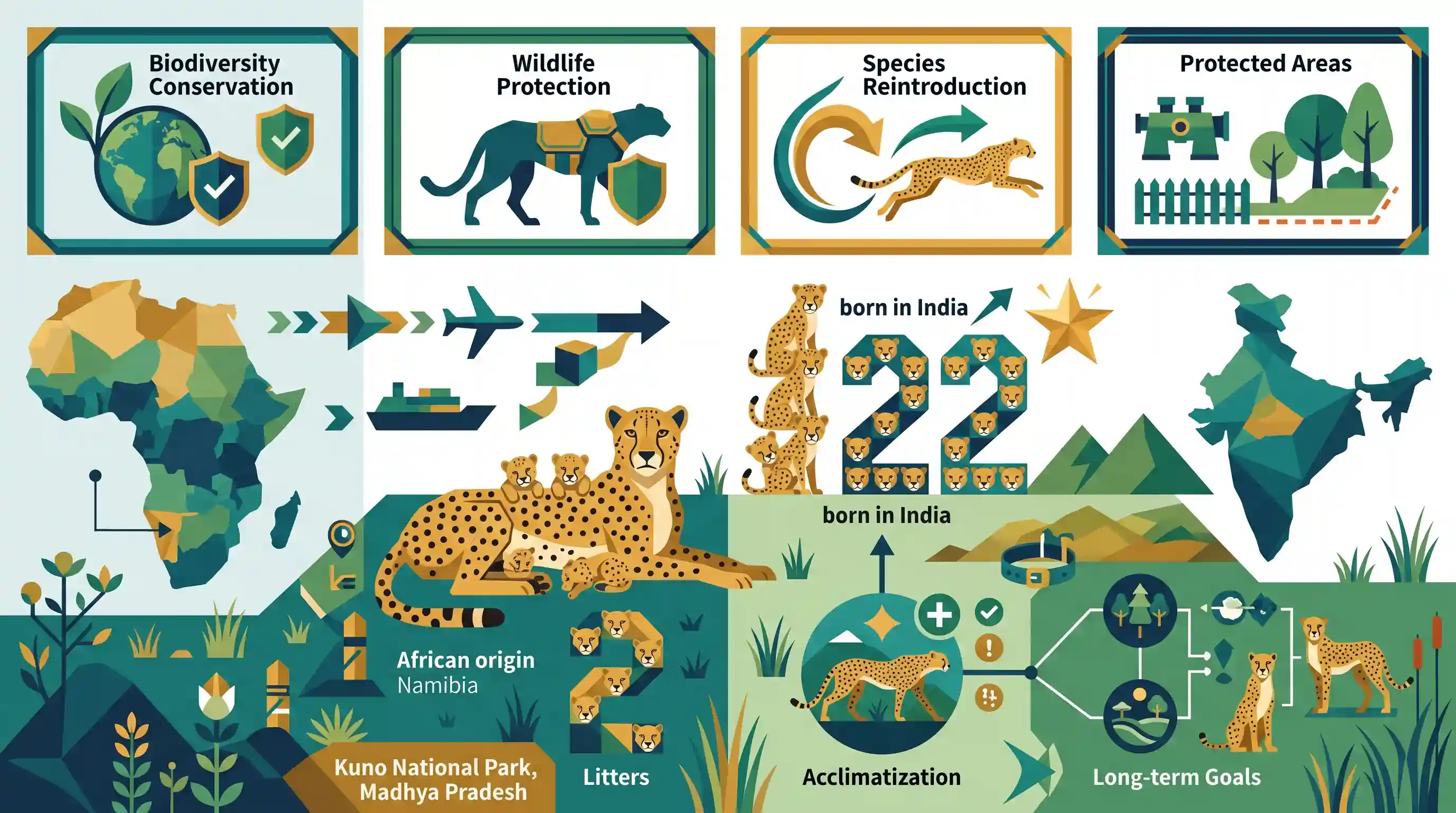
Aasha, a cheetah translocated from Namibia to India under Project Cheetah, has successfully given birth to five cubs at Kuno National Park in Madhya Pradesh. This marks her second litter and brings the total number of cubs born on Indian soil since the project's inception to 22. The continued successful breeding of these apex predators is a significant indicator that the African cheetahs are acclimatizing well to their new habitat, bolstering the long-term goals of India's ambitious cheetah reintroduction program.
Key Points
- Namibian cheetah 'Aasha' gave birth to five cubs at Madhya Pradesh's Kuno National Park.
- This is Aasha's second litter; she previously delivered three cubs in early 2024.
- The birth brings the total number of cheetah cubs born in India under Project Cheetah to 22, and the total population at Kuno to 37 (13 adults and 24 cubs).
- The successful reproduction of translocated cheetahs indicates positive acclimatization to the Indian environment, marking a milestone for the world's first intercontinental large carnivore translocation project.
Important Terms
Project Cheetah

India's initiative to reintroduce cheetahs, officially extinct since 1952, using African subspecies. It represents the world's first intercontinental large carnivore translocation project.
UPSC context
GS III (Environment). Tests knowledge of species recovery programs, ecological restoration, and challenges of intercontinental animal translocations.
Kuno National Park
A protected area in Madhya Pradesh's Sheopur district selected as the primary reintroduction site for cheetahs due to its grassland-savanna habitat and prey availability.
UPSC context
GS III (Biodiversity). Relevant for maps, habitat types (dry deciduous), and its role as a potential second home for Asiatic lions.
Species Reintroduction
The deliberate release of a species into the wild to establish a self-sustaining population in a habitat where it has been extirpated or made extinct.
UPSC context
GS III (Conservation). Tests understanding of in-situ vs ex-situ conservation and the ecological impacts of returning vanished species to an ecosystem.
African Cheetah
The subspecies (Acinonyx jubatus jubatus) sourced from Namibia and South Africa. Unlike the critically endangered Asiatic cheetah, it is listed as 'Vulnerable' on the IUCN Red List.
UPSC context
GS III (Environment). Important for Prelims to distinguish subspecies differences (IUCN status, size, habitat) and source countries like Namibia/South Africa.
National Tiger Conservation Authority (NTCA)
A statutory body under the Ministry of Environment, Forest and Climate Change (MoEFCC) that oversees the implementation of both Project Tiger and Project Cheetah.
UPSC context
GS II (Governance) & GS III (Wildlife). Tests knowledge of statutory bodies, their legal backing (WPA 1972), and roles in flagship conservation projects.
Apex Predator
A high-level carnivore at the top of the food chain with no natural predators. Their presence helps regulate prey populations and maintains ecological balance.
UPSC context
GS III (Ecology). Relevant for food web dynamics, trophic cascades, and the biological justification for reintroducing large carnivores into degraded habitats.
Prelims Trap
India's Project Cheetah involves the reintroduction of the Critically Endangered Asiatic Cheetah.
The reintroduced cheetahs are African (IUCN: Vulnerable). The Asiatic cheetah (IUCN: Critically Endangered) went extinct in India in 1952 and now only survives in Iran. Aspirants frequently confuse the two.
Static Concepts Connected
How do African and Asiatic Cheetahs differ in conservation status?
- African Cheetah: Classified as Vulnerable on the IUCN Red List. They are found across various habitats in Africa and have a slightly larger build.
- Asiatic Cheetah: Classified as Critically Endangered. It went extinct in India in 1952 and is now restricted exclusively to a small pocket in Iran.
What are the core geographical and ecological features of Kuno National Park?
- Vegetation Type: Falls under the Kathiawar-Gir dry deciduous forest eco-region, characterized by open woodlands and expansive savanna grasslands ideal for cheetahs.
- Hydrology: The park is bisected by the Kuno River, which is a major tributary of the Chambal River system.
- Original Purpose: Before Project Cheetah, Kuno was thoroughly prepared to serve as a second home for the Asiatic Lion to prevent epidemic wipeouts at Gir.
Cross-Topic Patterns
Grassland ecology & flagship species
Cheetah reintroduction acts as a catalyst to conserve India's neglected dry-deciduous savanna ecosystems, drawing a parallel to how Project Tiger preserved dense forest habitats.
Asiatic Lion vs Cheetah governance
Kuno highlights a wildlife governance paradox: intercontinental cheetah translocation succeeded rapidly, while the Supreme Court-mandated inter-state transfer of Gir lions remains stalled.

Expect a 2026 prelims question merging Cheetah subspecies IUCN differences with the geography of Kuno National Park and the Chambal basin.
Linked PYQs · 3
Linked PYQs · 3
- 2017PrelimsGS1
Recently there was a proposal to translocate some of the lions from their natural habitat in Gujarat to which one of the following sites?
- 2020PrelimsGS1
Which one of the following protected areas is well-known for the conservation of a sub-species of the Indian swamp deer (Barasingha) that thrives well on hard ground and is exclusively graminivorous?
- 2017PrelimsGS1
The term 'M-STRIPES' is sometimes seen in the news in the context of
