Karnataka Socio Educational Survey and E Governance Integration
Source:The Hindu ↗
Why It Matters
This article provides an excellent case study on the practical application of e-governance (Aadhaar, geo-tagging, online portals) to solve logistical challenges in large-scale socio-economic enumerations. It is highly relevant for GS2 questions concerning the effectiveness of public service delivery, data-driven policymaking for backward classes, and the administrative hurdles of conducting censuses in urban areas.
Summary
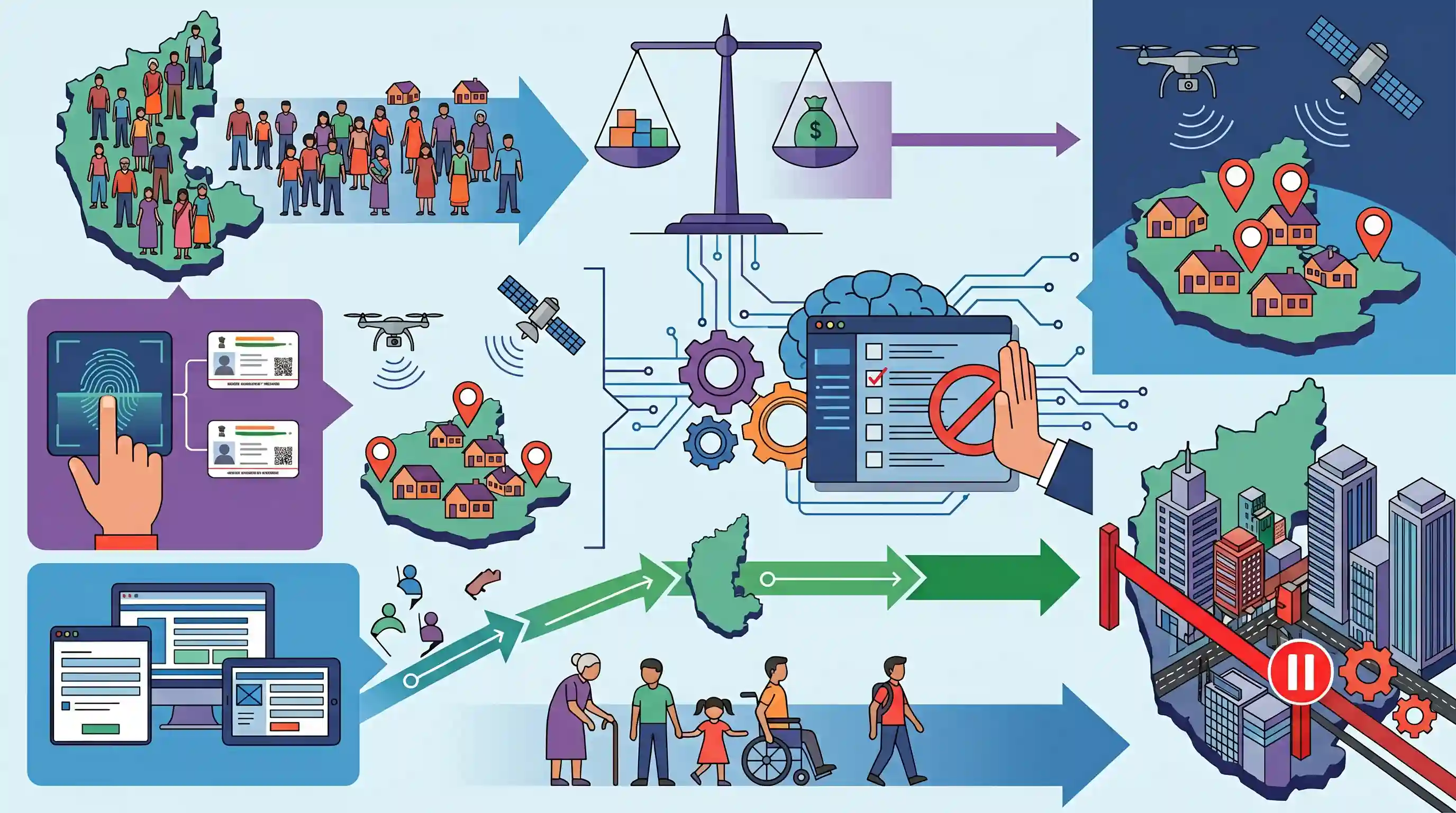
Karnataka is initiating its second large-scale socio-educational survey led by the State Commission for Backward Classes, designed to map the socio-economic status of a 7-crore population. To ensure accuracy and prevent duplication, the exercise integrates robust e-governance mechanisms such as Aadhaar authentication, geo-tagging of households, and an online participation portal. While the statewide rollout is proceeding, enumeration in the Greater Bengaluru Authority area is temporarily delayed to address urban administrative challenges that have historically hampered coverage in previous commission surveys.
Key Points
- The Karnataka State Commission for Backward Classes is launching its second socio-educational survey to enumerate a population of 7 crores across the state.
- The survey prominently integrates e-governance tools, utilizing Aadhaar authentication to prevent duplication, ration card linkages for auto-fetching data, and geo-tagging to track enumerator visits.
- An online participation option has been introduced to improve coverage, particularly aimed at urban areas where earlier surveys struggled to reach gated communities and working couples.
- The survey faces a brief delay in the Greater Bengaluru Authority (GBA) area due to administrative complexities, reflecting historical challenges in urban census exercises like those faced by the H. Kantharaj and H.N. Nagamohan Das commissions.
Important Terms
Karnataka State Commission for Backward Classes (KSCBC)

A statutory body in Karnataka responsible for identifying and recommending welfare measures for Backward Classes; it is currently executing the 2025 socio-educational survey.
UPSC context
GS-II: Social Justice. Tests knowledge of statutory mechanisms protecting and identifying vulnerable sections of society.
Greater Bengaluru Authority (GBA)
A unified urban governance framework proposed for Bengaluru to replace BBMP, currently facing administrative delays in implementing statewide surveys due to urban complexity.
UPSC context
GS-II: Governance. Relevant for urban administration reforms and the challenges of metropolitan governance in India.
H.N. Nagamohan Das Commission
A judicial commission task with recommending internal reservation within the Scheduled Caste quota; it submitted a major report in August 2025 based on empirical data.
UPSC context
GS-II: Vulnerable Sections. Tests understanding of the "internal reservation" debate and sub-classification within reserved categories.
H. Kantharaj Commission
The commission that conducted Karnataka's first socio-educational survey in 2015, the report of which was officially set aside before the 2025 exercise.
UPSC context
GS-II: Social Justice. Essential for historical context of caste-based surveys and their political-legal implementation hurdles.
Geo-tagging
The addition of geographical identification metadata to digital media; used in the Karnataka survey to precisely map households via electricity meters.
UPSC context
GS-II: E-governance. Tests the integration of modern technology in streamlining large-scale administrative data collection and planning.
Prelims Trap
State socio-educational surveys and caste enumerations are conducted under the statutory mandate of the Census Act, 1948.
The Census Act of 1948 strictly governs the Union's decennial population census. State socio-educational surveys are separate administrative exercises led by state-level commissions.
Static Concepts Connected
How does the 105th Constitutional Amendment empower State Backward Class Commissions?
- Restored State Power: It amended Articles 338B, 342A, and 366, expressly restoring the power of State Governments to identify and maintain their own localized lists of SEBCs.
- NCBC Bypass: It bypassed the Supreme Court's Maratha quota ruling, ensuring states do not need to consult the National Commission for Backward Classes (NCBC) for state-level lists.
- Empirical Basis: State Backward Class Commissions can now actively conduct localized surveys to form the empirical basis for state affirmative action and reservations.
How does a Socio-Economic Census differ from the regular Decennial Census?
- Statutory Backing & Confidentiality: The decennial Census is strictly governed by the Census Act, 1948, making individual demographic data confidential. Socio-economic census data is often open for beneficiary targeting.
- Nodal Agencies: The regular Census is conducted solely by the Registrar General of India (MHA). SECC exercises involve multi-agency coordination (MoRD, MoHUA, State Commissions).
- Core Objective: While the regular Census captures demographic aggregates, socio-economic surveys specifically map multi-dimensional poverty, caste, and educational backwardness to direct state welfare.
Cross-Topic Patterns
Federalism and affirmative action data
State-led socio-economic enumerations assert federal autonomy in social justice, effectively bypassing the Union government's reluctance to conduct a comprehensive nationwide caste census.
E-governance bridging urban administrative gaps
Using geo-tagging and online portals to penetrate inaccessible gated communities links GS2 E-Governance directly to solving structural coverage errors in urban municipal administration.

The interplay of the 105th Amendment, state-led socio-economic surveys, and the Census Act is a prime target for a 2026 Polity MCQ.
Linked PYQs · 4
Linked PYQs · 4
- 2022MainsGS2
Discuss the role of the National Commission for Backward Classes in the wake of its transformation from a statutory body to a constitutional body.
- 2024MainsGS2
e-governance is not just about the routine application of digital technology in service delivery process. It is as much about multifarious interactions for ensuring transparency and accountability. In this context evaluate the role of the 'Interactive Service Model' of e-governance.
- 2023MainsGS2
e-governance, as a critical tool of governance, has ushered in effectiveness, transparency and accountability in governments. What inadequacies hamper the enhancement of these features ?
- 2023PrelimsGS1
Consider the following organizations/bodies in India: 1. The National Commission for Backward Classes 2. The National Human Rights Commission 3. The National Law Commission 4. The National Consumer Disputes Redressal Commission How many of the above are constitutional bodies?
