Resumption of US-Iran Nuclear Negotiations and Sanctions Relief
Source:The Hindu ↗
Why It Matters
The outcome of US-Iran nuclear negotiations directly influences global energy markets, oil pricing, and Middle Eastern stability. For India, a resolution could ease energy procurement, stabilize regional security for its massive diaspora, and facilitate strategic projects like the Chabahar Port, making it a critical topic for international relations.
Summary
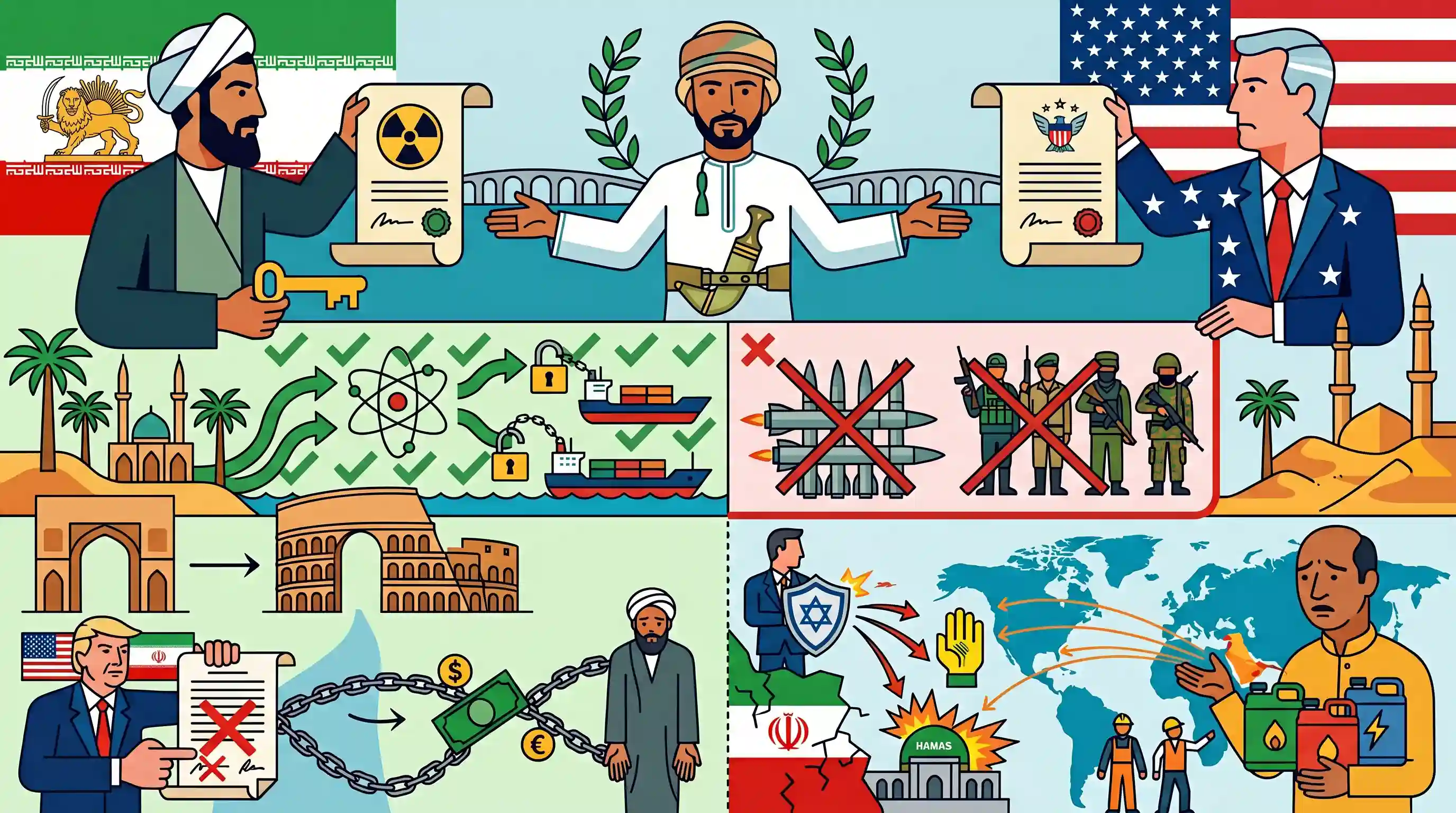
Iran and the United States are set to hold a second round of indirect nuclear negotiations in Rome, mediated by Oman. Following an initial meeting in Muscat between Iranian Foreign Minister Abbas Araghchi and U.S. Middle East envoy Steve Witkoff, Iran emphasized that discussions will focus exclusively on the nuclear agreement and the lifting of U.S. sanctions. Tehran firmly rejected expanding the agenda to include its ballistic missile program or its support for regional proxy groups known as the 'axis of resistance'. The resumption of talks comes as Iran seeks economic relief from crippling sanctions originally reimposed by Donald Trump in 2018 after his withdrawal from the 2015 JCPOA, and amid heightened regional vulnerability following Israel's recent attacks on Iranian allies Hezbollah and Hamas.
Key Points
- The second round of indirect nuclear talks between the U.S. and Iran, mediated by Oman, is set to be held in Rome following initial discussions in Muscat.
- Iran's Foreign Ministry confirmed that the negotiations will strictly focus on the nuclear issue and the lifting of U.S. sanctions, refusing to discuss its ballistic missile program or support for the 'axis of resistance'.
- The talks feature Iranian Foreign Minister Abbas Araghchi and U.S. Middle East envoy Steve Witkoff, marking the highest-level bilateral nuclear negotiations since the 2015 accord collapsed.
- Donald Trump withdrew the U.S. from the Joint Comprehensive Plan of Action (JCPOA) in 2018 and reimposed heavy sanctions, but recently urged renewed talks under threat of military action.
- Iran is engaging in these talks seeking economic relief as it deals with severe sanctions and the fallout from Israel's heavy strikes on its regional allies, Hezbollah and Hamas.
Important Terms
Joint Comprehensive Plan of Action (JCPOA)

A 2015 agreement between Iran and world powers (P5+1) to limit Iran's nuclear program in exchange for lifting international economic sanctions.
UPSC context
GS Paper II: Important for International Relations, testing knowledge of global nuclear non-proliferation frameworks and India's energy security interests.
Axis of Resistance
An informal, Iran-led geopolitical and military coalition of state and non-state actors (like Hezbollah and Hamas) aimed at countering Western and Israeli influence in West Asia.
UPSC context
GS Paper II: Regional groupings and their impact on India’s interests in the Middle East and maritime security.
Hezbollah
A Lebanon-based Shia militant group and political party, heavily funded by Iran, that serves as a primary proxy and member of the Axis of Resistance.
UPSC context
GS Paper II: Focuses on non-state actors and their role in regional instability affecting India’s diaspora and energy routes.
Hamas
A Palestinian Sunni-Islamist political and militant organization that governs the Gaza Strip and is a key participant in the regional conflict against Israel.
UPSC context
GS Paper II: Relevance to the Israel-Palestine issue, a recurring theme in UPSC international relations questions.
P5+1
The group of six world powers—China, France, Germany, Russia, the UK, and the US—that negotiated the original 2015 nuclear agreement with Iran.
UPSC context
GS Paper II: Testing understanding of major global power dynamics and multilateral diplomatic negotiations.
International Atomic Energy Agency (IAEA)
The United Nations' nuclear watchdog responsible for monitoring Iran's compliance with nuclear restrictions and ensuring its program remains peaceful.
UPSC context
GS Paper II: International organizations; critical for questions on nuclear safeguards and global governance.
Prelims Trap
"The JCPOA agreement restricted both Iran's nuclear enrichment and its ballistic missile program."
The 2015 JCPOA strictly covered the nuclear program. The exclusion of ballistic missiles and regional proxy funding was exactly why the US originally withdrew in 2018.
Static Concepts Connected
What are the core parameters of the JCPOA and the P5+1?
- P5+1 Composition: UN Security Council permanent members (US, UK, France, Russia, China) plus Germany.
- Nuclear Limits: Capped Iran's uranium enrichment at 3.67% and restricted its stockpile, subjecting facilities to extensive IAEA inspections.
- Quid Pro Quo: International economic and financial sanctions on Iran were lifted in exchange for verifiable curbs on its nuclear capabilities.
How do secondary US sanctions (like CAATSA) affect India?
- CAATSA Scope: A US law penalizing foreign entities doing significant business with adversaries like Iran, North Korea, and Russia.
- Energy Security: Forced India to completely halt cheaper Iranian crude imports in 2019 after US waivers (SREPs) expired.
- Strategic Projects: Casts a shadow on Indian investments in Iran, particularly slowing down the Chabahar Port and INSTC connectivity development.
Cross-Topic Patterns
Sanctions Relief & INSTC Viability
Lifting US sanctions on Iran is critical for fully operationalizing the International North-South Transport Corridor (INSTC) and making Chabahar Port a viable, sanction-free transit hub to Central Asia.
Oman as West Asia's Neutral Mediator
Oman's non-interventionist foreign policy contrasts with regional sectarian conflicts, making it a critical backchannel for US-Iran diplomacy. UPSC frequently tests the geopolitical roles of specific Middle Eastern states.

Mains 2026 will likely test how renewed US-Iran nuclear negotiations impact India's energy security and West Asian connectivity.
Linked PYQs · 2
Linked PYQs · 2
- 2018MainsGS2
In what ways would the ongoing US-Iran Nuclear Pact Controversy affect the national interest of India? How should India respond to this situation?
- 2012MainsGS2
How have the US sanctions against Iran affected India's bilateral relations with Iran?
