Higher Education Reforms for Vikshit Bharat Goals
Source:The Hindu ↗
Why It Matters
Higher education quality directly impacts India's ability to utilize its demographic dividend. The topic is frequently tested in Mains GS2 (Education/Human Resources) and GS3 (Employment/Economy), especially in the context of NEP 2020 implementations and employability challenges.
Summary
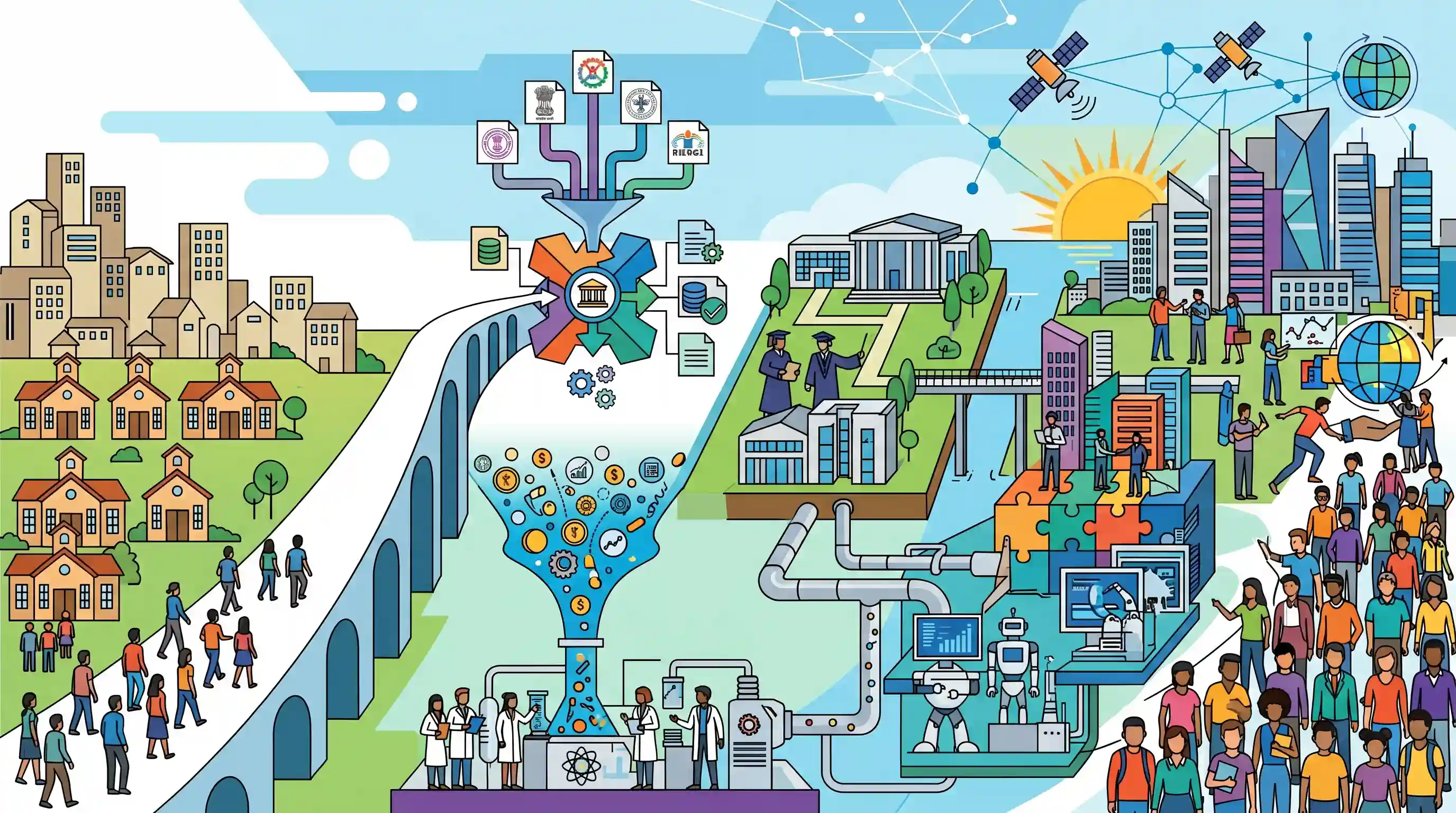
The article emphasizes the urgent need for "second-generation reforms" in India's higher education sector to realize the vision of becoming a developed nation by 2047. While initial efforts focused on increasing access and expanding the number of institutions, the next phase must prioritize qualitative improvements, institutional autonomy, research capabilities, and global competitiveness. Key interventions include overcoming regulatory bottlenecks through unified bodies like the Higher Education Commission of India (HECI), increasing R&D investments via the National Research Foundation (NRF), and aligning academic curricula with industry needs to solve the employability crisis. Effectively achieving these reforms will enable India to harness its demographic dividend and transition into a robust knowledge-based economy.
Key Points
- Current challenges in India's higher education system include low Gross Enrolment Ratio (GER), lack of industry relevance resulting in low graduate employability, and insufficient investment in R&D.
- Second-generation reforms are necessary to transition from mere quantitative expansion (access) to qualitative enhancement (excellence, research, and innovation).
- Implementing structural changes like the proposed Higher Education Commission of India (HECI) can provide institutions with greater academic, administrative, and financial autonomy.
- Strengthening the National Research Foundation (NRF) and fostering university-industry linkages are vital steps to create a knowledge economy.
- Reforming higher education is pivotal for India to harness its demographic dividend and achieve the vision of becoming a developed nation (Viksit Bharat) by 2047.
Important Terms
National Education Policy (NEP) 2020

A comprehensive framework introduced to transform India’s education system, emphasizing holistic, multidisciplinary learning and a 50% Gross Enrolment Ratio in higher education by 2035.
UPSC context
GS Paper 2: Social Sector/Education. Tests knowledge of fundamental shifts in human resource development policy.
University Grants Commission (UGC)
A statutory body established in 1956 responsible for coordinating and maintaining standards of university education, including the recognition of universities and disbursement of funds.
UPSC context
GS Paper 2: Statutory Bodies/Education. Essential for understanding the current governance of higher education.
Higher Education Commission of India (HECI)
A proposed overarching regulatory body designed to replace UGC and AICTE, aiming to streamline higher education through four verticals: regulation, accreditation, academic standards, and funding.
UPSC context
GS Paper 2: Government Policies. Crucial for discussing second-generation reforms and regulatory simplification.
National Research Foundation (NRF)
An apex statutory body established in 2023 to provide strategic direction for research and innovation, fostering collaborations between industry, academia, and government departments.
UPSC context
GS Paper 3: Science and Technology. Relevant for R&D ecosystem and India’s transition to a knowledge economy.
All India Council for Technical Education (AICTE)
A statutory council responsible for planning and maintaining standards in technical education, covering fields like engineering, management, pharmacy, and architecture.
UPSC context
GS Paper 2: Education. Important for understanding the regulation of professional and skill-based technical sectors.
Prelims Trap
HECI will be the sole overarching regulator for all higher education institutions in India.
HECI explicitly excludes medical and legal education from its regulatory purview. Aspirants often miss these exceptions in 'overarching body' statements.
Static Concepts Connected
What are the four independent verticals of the proposed HECI?
- NHERC (Regulation): Will function as the single point regulator for the higher education sector, barring medical and legal education.
- NAC (Accreditation): Will conduct meta-accreditation and oversee independent accrediting institutions, shifting from the current NAAC model.
- HEGC (Funding): Will carry out funding and financing of higher education, legally separating financial powers from the regulatory body.
- GEC (Standard Setting): Will frame expected learning outcomes for higher education programs, also formulating a National Higher Education Qualifications Framework.
What differentiates India's Anusandhan National Research Foundation (ANRF) from previous R&D bodies?
- Subsumes SERB: It legally repeals and subsumes the Science and Engineering Research Board (SERB) established in 2008.
- Private Funding Focus: It aims to raise ~70% of its ₹50,000 crore budget (over 5 years) from non-government sources, including industry and philanthropists.
- State University Focus: Specifically mandates building research capacity in under-funded state universities and colleges, not just elite IITs/central universities.
Cross-Topic Patterns
Education quality + PLI Schemes
Solving the higher education 'employability crisis' is the missing prerequisite for GS3 industrial policies like PLI to succeed in semiconductor and advanced manufacturing sectors.
ANRF + Private R&D Funding
Links GS2 education to GS3 science: ANRF aims to crowd-in private sector R&D investment, addressing India's chronically low (sub-0.7% of GDP) research spending.

Expect a GS2 Mains question linking HECI's structural reforms to the qualitative shift required to harness the demographic dividend.
Linked PYQs · 5
Linked PYQs · 5
- 2023MainsGS2
Skill development programmes have succeeded in increasing human resources supply to various sectors. In the context of the statement analyse the linkages between education, skill and employment.
- 2015MainsGS2
The quality of higher education in India requires major improvements to make it internationally competitive. Do you think that the entry of foreign educational institutions would help improve the quality of higher and technical education in the country? Discuss.
- 2020MainsGS2
National Education Policy 2020 is in conformity with the Sustainable Development Goal-4 (2030). It intends to restructure and reorient education system in India. Critically examine the statement.
- 2023MainsGS2
The crucial aspect of development process has been the inadequate attention paid to Human Resource Development in India. Suggest measures that can address this inadequacy.
- 2014MainsGS3
While we flaunt India's demographic dividend, we ignore the dropping rates of employability. What are we missing while doing so? Where will the jobs that India desperately needs come from? Explain.
