Tamil Nadu Economic Survey Highlights Growth and Women Work
Source:The Hindu ↗
Why It Matters
It provides valuable state-specific data on GDP growth trends compared to the national average, serving as a case study for state-led economic development and the role of women in the economy for GS Paper 3 and GS Paper 1.
Summary
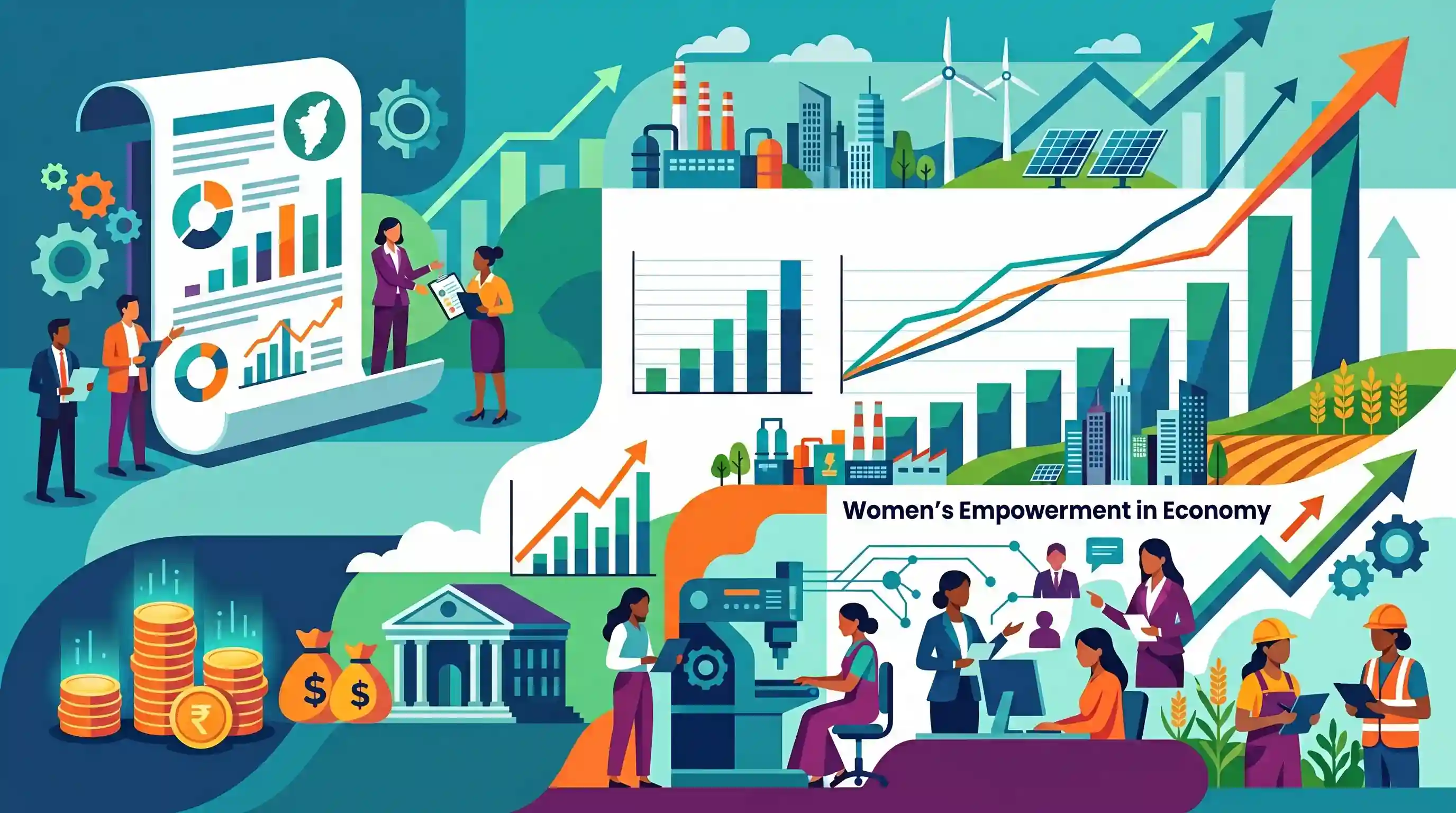
The Tamil Nadu government is preparing to release the second edition of its Economic Survey ahead of the state's interim budget for 2026-27. Prepared by the State Planning Commission, the document will highlight the state's economic performance and is likely to include a chapter on women's workforce participation. Data indicates that Tamil Nadu has consistently outpaced the national average in real economic growth, registering an average growth of 6.37% between 2012-13 and 2023-24, and achieving an 11.2% GSDP growth rate in 2024-25.
Key Points
- Tamil Nadu is set to release its second Economic Survey ahead of the state's interim budget presentation for 2026-27.
- The economic survey has been prepared by the State Planning Commission with inputs from the State Finance Department.
- The survey is expected to feature a special chapter focusing on women's participation in the economy.
- From 2012-13 to 2023-24, Tamil Nadu recorded an average real economic growth rate of 6.37%, outperforming the national average of 6.1%.
- According to the RBI's handbook of statistics, Tamil Nadu's Gross State Domestic Product (GSDP) grew at a robust 11.2% in 2024-25.
Important Terms
Gross State Domestic Product (GSDP)

The total monetary value of all final goods and services produced within a state's boundaries in a year. It serves as the primary indicator of regional economic health.
UPSC context
GS-III (Economic Development): Key metric for measuring state-level growth, determining borrowing limits, and analyzing regional disparities.
State Planning Commission
The principal advisory body to the state government (often renamed SDPC) responsible for preparing development plans, evaluating schemes, and drafting the annual Economic Survey.
UPSC context
GS-II (Governance): Understanding the role of state-level institutions in policy formulation and decentralized planning.
Interim Budget
A temporary financial statement presented during an election year to seek a 'Vote on Account' for expenditures until a new government takes office.
UPSC context
GS-II (Polity/Budgeting): Tests constitutional provisions for government spending and legislative procedures during transition periods.
Female Labour Force Participation Rate (FLFPR)
The percentage of the female population (aged 15+) that is either employed or actively seeking work, reflecting gender-inclusive economic growth.
UPSC context
GS-I (Social Issues) and GS-III (Employment): Critical for evaluating women's empowerment, demographic dividend, and labor market trends.
Economic Survey (State)
An annual document reviewing the previous year's economic performance, sectoral developments, and future outlook, presented by the government before the annual budget.
UPSC context
GS-III (Economy): Serves as an analytical foundation for policy interventions and provides data for evidence-based governance.
Prelims Trap
State Economic Surveys are prepared by the Department of Economic Affairs under the Chief Economic Advisor.
While the National Economic Survey is prepared by the DEA under the CEA, state-level surveys are drafted independently, typically by State Planning Commissions or local finance departments.
Static Concepts Connected
Who prepares the National Economic Survey in India?
- Nodal Agency: Prepared by the Economics Division of the Department of Economic Affairs (DEA), Ministry of Finance.
- Guidance: Drafted under the supervision and guidance of the Chief Economic Advisor (CEA) to the Government of India.
- Presentation: Traditionally presented in both houses of Parliament a day before the presentation of the Union Budget.
What are the structural drivers of high FLFPR at the state level?
- Targeted Interventions: Targeted state schemes providing affordable working women's hostels (e.g., Thozhi), free public transport, and mobility subsidies.
- Manufacturing Absorption: Labor-intensive manufacturing sectors like textiles, electronics, and footwear creating localized employment clusters that absorb female labor.
- Social Infrastructure: Accessible early childcare, higher education penetration, and strict enforcement of workplace safety and sanitation norms.
Cross-Topic Patterns
Sub-national Data & Fiscal Federalism
The RBI's 'Handbook of Statistics on Indian States' provides critical GSDP and fiscal data, linking state-level macroeconomics directly with GS2 themes of fiscal federalism.
Manufacturing clusters & FLFPR
Tamil Nadu accounting for 43% of registered female manufacturing workers links GS1 (women's empowerment) directly with GS3 (industrial policy and labor-intensive growth).

RBI's 'Handbook of Statistics on Indian States' and state-level FLFPR trends likely to form a multi-statement economy question in 2026.
Linked PYQs · 4
Linked PYQs · 4
- 2023MainsGS3
Faster economic growth requires increased share of the manufacturing sector in GDP, particularly of MSMEs. Comment on the present policies of the Government in this regard.
- 2024MainsGS3
Examine the pattern and trend of public expenditure on social services in the post-reforms period in India. To what extent this has been in consonance with achieving the objective of inclusive growth?
- 2021MainsGS1
Examine the role of 'Gig Economy' in the process of empowerment of women in India.
- 2024MainsGS1
Distinguish between gender equality, gender equity and women's empowerment. Why is it important to take gender concerns into account in programme design and implementation?
