SEBI IT Resilience Index Sets Global Benchmark in Financial Security
Source:The Hindu ↗
हे का महत्त्वाचे आहे
Understanding SEBI's ITRI is crucial for GS3 (Economy and Cybersecurity) as it illustrates how India is innovating in regulatory governance to protect critical financial infrastructure from emerging cyber and operational threats, setting a global standard in digital financial resilience.
सारांश
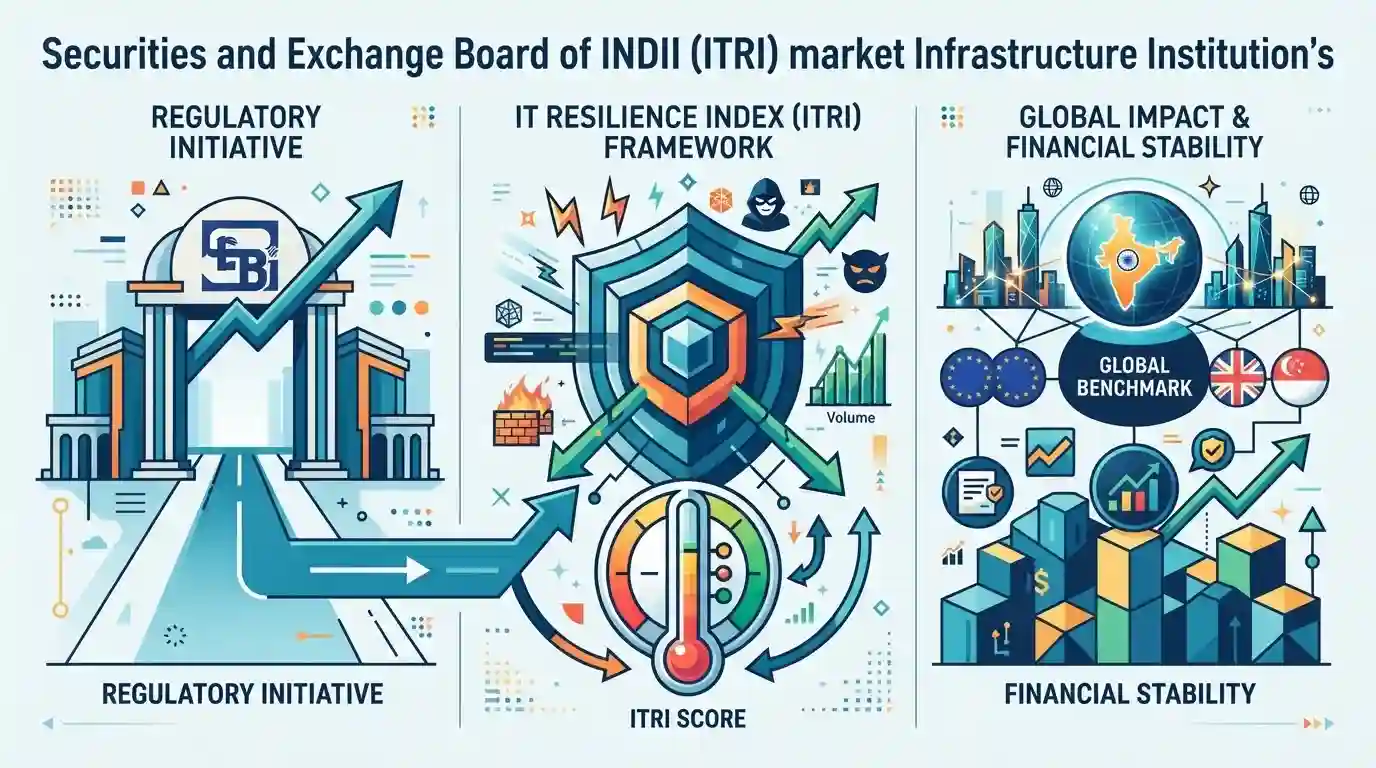
The Securities and Exchange Board of India (SEBI) has launched the IT Resilience Index (ITRI), a pioneering framework designed to quantitatively assess the IT and cybersecurity robustness of Market Infrastructure Institutions (MIIs). Moving away from traditional binary compliance, the ITRI provides a dynamic score evaluating an institution's ability to handle operational shocks, cyberattacks, and sudden surges in trading volumes. By adopting this quantitative index, India sets a global benchmark, differing from the qualitative, guideline-based approaches of regulators like the EU (via DORA), the UK, and Singapore. The initiative underscores the critical need to secure the digital infrastructure of capital markets to ensure overall financial stability.
मुख्य मुद्दे
- SEBI has introduced the IT Resilience Index (ITRI) to quantitatively measure the capability of Market Infrastructure Institutions (MIIs) to withstand and recover from IT shocks, cyber threats, and high market volatility.
- MIIs encompass critical financial entities like stock exchanges, clearing corporations, and depositories.
- The ITRI shifts regulatory oversight from binary compliance checks to continuous, dynamic risk assessment, assigning a standardized score based on a comprehensive set of parameters.
- SEBI's approach is globally pioneering, contrasting with the EU's DORA, the UK's FCA, and Singapore's MAS, which primarily rely on qualitative guidelines and compliance checklists rather than a quantitative index.
- The index emphasizes capacity planning, continuous technology upgrades, and swift recovery mechanisms to ensure systemic financial stability amid growing digitalization.
महत्त्वाच्या संज्ञा
IT Resilience Index (ITRI)

A quantitative, system-driven framework launched by SEBI to assess the cybersecurity, operational robustness, and IT infrastructure availability of India's Market Infrastructure Institutions (MIIs).
UPSC context
GS Paper III (Economy/Cybersecurity); tests knowledge of technology-driven financial reforms and critical market security.
Market Infrastructure Institutions (MIIs)
Systemically important entities, including stock exchanges, clearing corporations, and depositories, that provide the foundational infrastructure, trading platforms, and settlement systems for a nation's capital markets.
UPSC context
GS Paper III (Economy); tests knowledge of capital market structure, financial stability, and domestic market regulation.
Securities and Exchange Board of India (SEBI)
The statutory regulatory authority established under the SEBI Act, 1992, mandated to protect securities investors, regulate capital markets, and oversee domestic market intermediaries and infrastructures.
UPSC context
GS Paper III (Regulatory Bodies); assesses statutory mechanisms governing financial markets and protecting investor interests.
Digital Operational Resilience Act (DORA)
A comprehensive European Union regulation designed to strengthen and harmonize the digital operational resilience of financial entities by enforcing strict ICT risk management and cybersecurity standards.
UPSC context
GS Paper III (Cybersecurity/Economy); benchmarks global regulatory practices for digital operational resilience in financial sectors.
Principles for Financial Market Infrastructures (PFMIs)
International benchmarks jointly established by CPMI and IOSCO to enhance the safety, efficiency, and financial resilience of systemically important payment, clearing, and settlement systems.
UPSC context
GS Paper III (Economy/Global Institutions); covers international standards for mitigating systemic risk in financial infrastructure.
Committee on Payments and Market Infrastructures (CPMI)
A global standard-setting committee hosted by the Bank for International Settlements (BIS) that promotes the safety, efficiency, and stability of payment and market settlement systems.
UPSC context
GS Paper III (IR/Economy); covers global banking standards and multilateral monetary cooperation architecture.
संबंधित PYQ · 3
संबंधित PYQ · 3
- 2020MainsGS3
Discuss different types of cyber crimes and measures required to be taken to fight the menace.
- 2024PrelimsGS1
Consider the following statements : 1. In India, Non-Banking Financial Companies can access the Liquidity Adjustment Facility window of the Reserve Bank of India. 2. In India, Foreign Institutional Investors can hold the Government Securities (G-Secs). 3. In India, Stock Exchanges can offer separate trading platforms for debts. Which of the statements given above is/are correct?
- 2021MainsGS3
Keeping in view India's internal security, analyse the impact of cross-border cyber attacks. Also discuss defensive measures against these sophisticated attacks.
