Institutional Investment in Non Agricultural Commodity Derivatives
Source:The Hindu ↗
Why It Matters
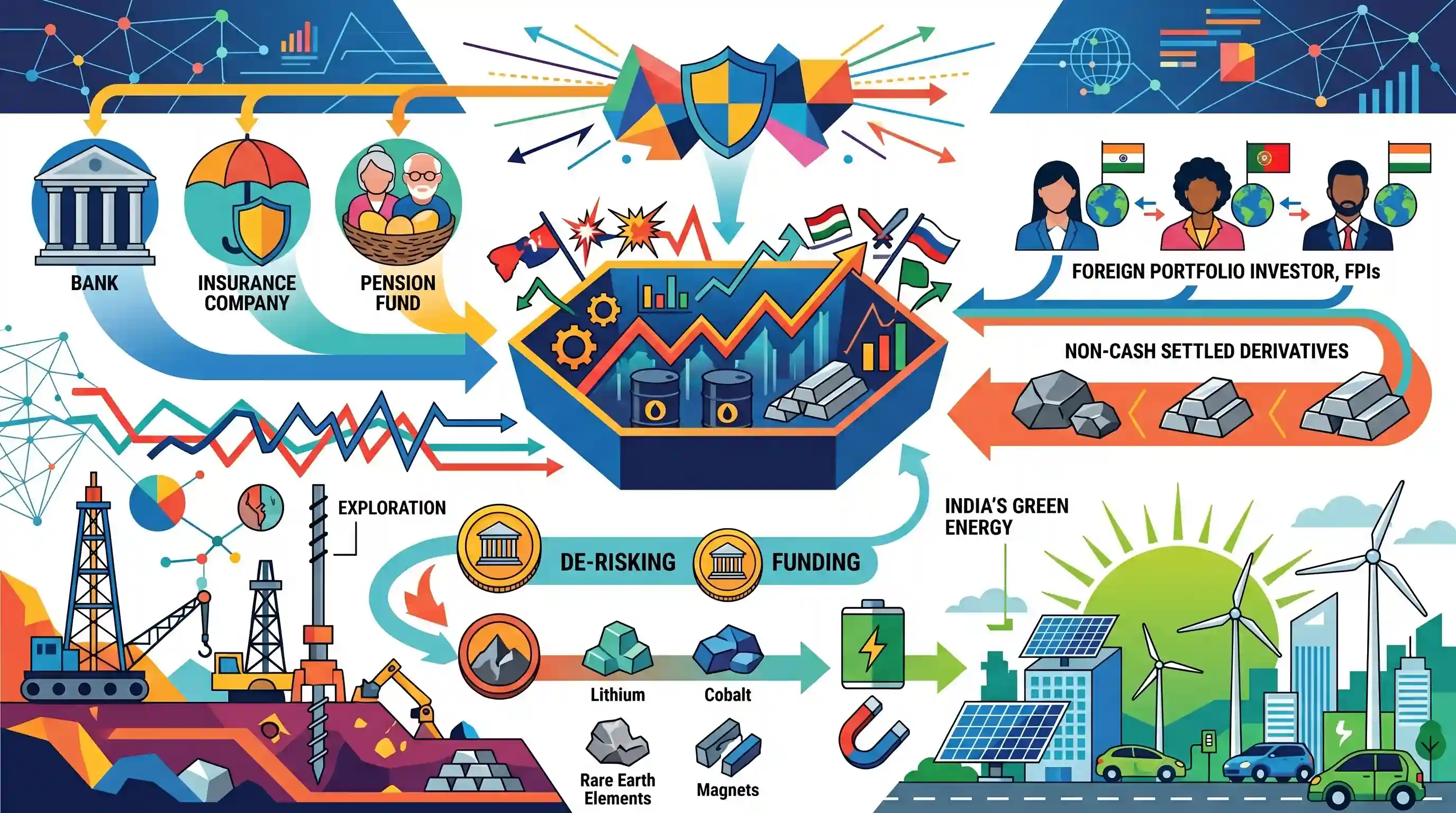
The deepening of commodity derivative markets through institutional and foreign participation is vital for economic stability, allowing industries to hedge against raw material price shocks. Furthermore, linking financial instruments to critical mineral exploration highlights the intersection of finance, strategic resources, and climate goals.
Summary
SEBI is actively working to permit banks, insurance companies, and pension funds to participate in the non-agricultural commodity derivatives market. SEBI Chairman Tuhin Kanta Pandey emphasized that bringing in institutional investors will deepen the market and help real economy players hedge against global price volatility caused by geopolitical events and trade tariffs. Additionally, the regulator is exploring non-cash settled derivatives for Foreign Portfolio Investors (FPIs). SEBI also stressed the strategic need to create financial instruments that can fund and de-risk the mining and exploration of critical minerals, such as lithium, cobalt, and rare earth elements, which are essential for India's green energy transition.
Key Points
- SEBI plans to engage with the government to allow banks, insurers, and pension funds to invest in non-agricultural commodity derivatives.
- Increasing institutional participation aims to deepen market liquidity and provide better price insurance against global volatility, such as US tariffs on metals.
- SEBI is also examining the possibility of allowing Foreign Portfolio Investors (FPIs) to trade in non-cash settled, non-agricultural commodity derivatives.
- SEBI Chairman highlighted the urgent need to develop financial instruments to de-risk and finance the exploration of critical minerals (lithium, cobalt, nickel) crucial for India's green energy transition.
Important Terms
Securities and Exchange Board of India (SEBI)

Statutory regulatory body established in 1992 to regulate India's securities and commodities markets, protect investors, and ensure market transparency and stability.
UPSC context
GS Paper 3: Indian Economy and statutory bodies; essential for understanding financial market regulation and investor protection.
Foreign Portfolio Investors (FPIs)
Investments by foreign entities in a country's financial assets (stocks, bonds) without seeking managerial control; known for high liquidity and market sensitivity.
UPSC context
GS Paper 3: Investment models and capital markets; tested on differences between FPI and FDI and impact on volatility.
Commodity Derivatives
Financial contracts (like futures and options) deriving value from physical goods like metals or energy, used for price discovery and risk management.
UPSC context
GS Paper 3: Financial markets; relevant for hedging strategies and the role of institutional investors in market deepening.
Critical Minerals
Metallic elements (e.g., lithium, cobalt, rare earths) vital for high-tech, defense, and green energy technologies like electric vehicles and solar panels.
UPSC context
GS Paper 3: Resources and Energy; key to India's net-zero 2070 goals and supply chain security.
Hedging
A risk management strategy involving an offsetting investment position to reduce the impact of adverse price movements in an asset.
UPSC context
GS Paper 3: Indian Economy; understanding how firms protect against global price volatility and trade tariffs.
Non-agricultural Commodity Derivatives
Commodity derivatives where the underlying assets are natural resources that are mined or processed, such as crude oil, gold, and base metals.
UPSC context
GS Paper 3: Economy; focuses on market expansion and institutional participation in non-farm sectors.
Prelims Trap
FPIs can freely trade in physically settled non-agricultural commodity derivatives in Indian markets.
FPIs are currently restricted to cash-settled non-agricultural commodity derivatives. SEBI is only now evaluating allowing them into physically (non-cash) settled contracts.
Static Concepts Connected
How did the regulation of commodity derivatives evolve in India?
- Pre-2015 Era: Commodity futures were previously regulated by the Forward Markets Commission (FMC) under the Ministry of Consumer Affairs.
- 2015 Merger: The FMC was merged into SEBI to create a single, unified regulatory authority for both the securities and commodities markets.
- Current Framework: SEBI now regulates exchange-traded commodity derivatives under the Securities Contracts (Regulation) Act, 1956.
What is the difference between cash and physical settlement in derivatives?
- Cash Settlement: At expiration, the buyer and seller exchange only the net cash difference based on current spot prices. No actual goods are delivered.
- Physical Settlement: The seller is strictly obligated to deliver the actual underlying physical commodity (such as metals or bullion) to the buyer upon contract expiration.
Cross-Topic Patterns
Financializing the critical minerals supply chain
De-risking mineral exploration through commodity derivatives links capital markets (SEBI) directly with India's clean energy goals, green transition funding, and import dependency mitigation.
Inter-regulatory coordination for institutional funds
Allowing banks, insurers, and pension funds into commodity exchanges requires joint regulatory consensus across RBI, IRDAI, and PFRDA, highlighting the role of the Financial Stability and Development Council (FSDC).

Expect a 2026 prelims question merging SEBI's commodity derivatives jurisdiction with FPI investment rules and critical mineral strategy.
Linked PYQs · 4
Linked PYQs · 4
- 2019PrelimsGS1
Which of the following is issued by registered foreign portfolio investors to overseas investors who want to be part of the Indian stock market without registering themselves directly?
- 2024PrelimsGS1
Consider the following statements : 1. In India, Non-Banking Financial Companies can access the Liquidity Adjustment Facility window of the Reserve Bank of India. 2. In India, Foreign Institutional Investors can hold the Government Securities (G-Secs). 3. In India, Stock Exchanges can offer separate trading platforms for debts. Which of the statements given above is/are correct?
- 2025PrelimsGS1
In the context of electric vehicle batteries, consider the following elements : I. Cobalt II. Graphite III. Lithium IV. Nickel How many of the above usually make up battery cathodes?
- 2025PrelimsGS1
Consider the following statements : Statement I: Some rare earth elements are used in the manufacture of flat television screens and computer monitors. Statement II : Some rare earth elements have phosphorescent properties. Which one of the following is correct in respect of the above statements?
