UN Report Highlights Sea Level Rise Risks for Coastal Cities
Source:indiatoday ↗
Why It Matters
It underscores critical climate risks facing India's major coastal urban centers, directly aligning with geography, environment, and disaster management syllabus components.
Summary
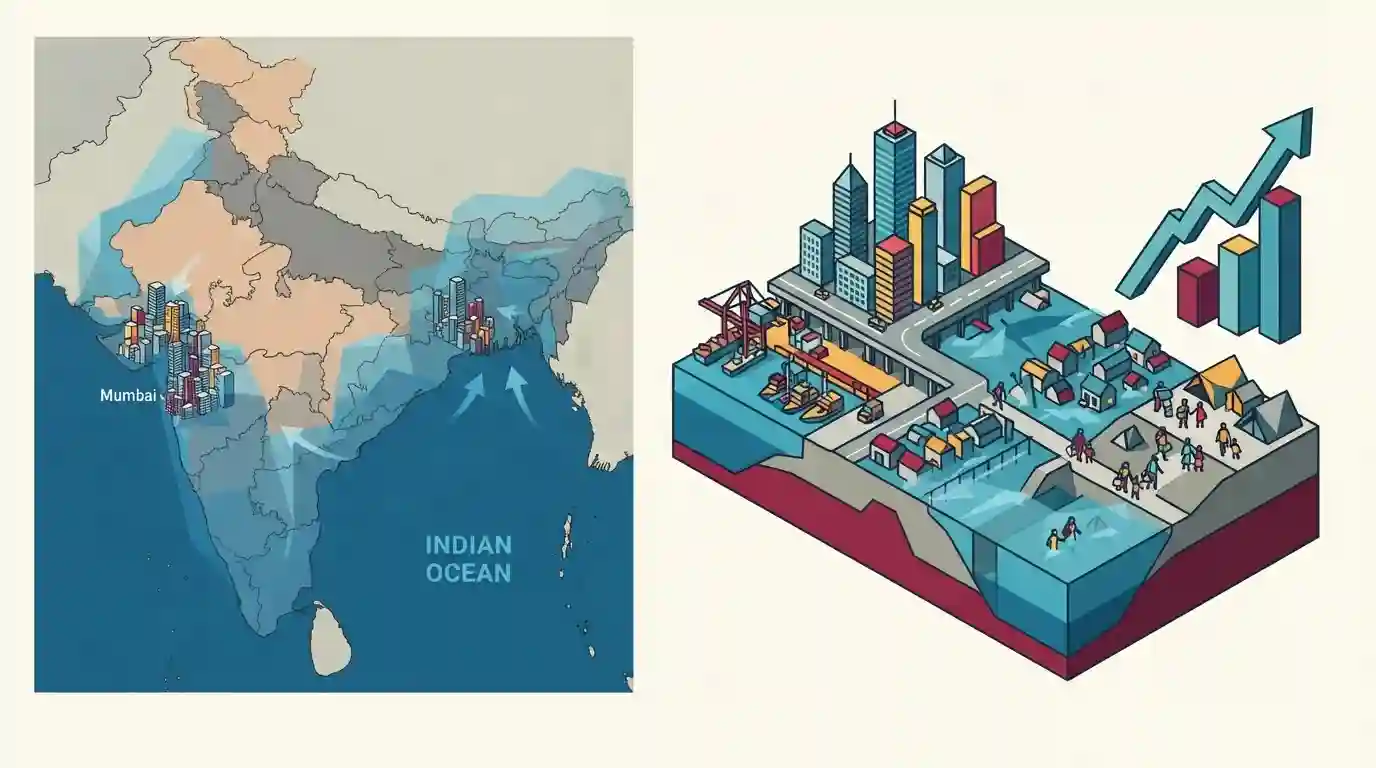
A UN report warns that millions of people in Indian coastal cities like Kolkata and Mumbai face severe inundation risks and displacement due to accelerating sea-level rise, posing a major threat to South Asian coastal security and urban planning.
Key Points
- A recent UN report highlights that millions of residents in coastal megacities like Kolkata and Mumbai are at immediate risk of losing their homes due to accelerating sea-level rise.
- South Asia is identified as one of the most vulnerable regions globally to climate-induced inundation and coastal flooding.
- The report underscores the urgent need for robust climate adaptation strategies, coastal protection infrastructure, and global emission-reduction targets.
Important Terms
United Nations

An international organization founded in 1945 to promote global peace, security, and cooperation, which regularly issues critical assessments on climate change impacts like sea-level rise.
UPSC context
Relevant for WBCS Paper II (International Relations and Global Organizations). Tests knowledge of international governance and global policy reports.
UN
The principal intergovernmental organ of the United Nations responsible for maintaining international peace and security, often evaluating existential threats such as climate-induced displacement.
UPSC context
Important for WBCS General Studies, assessing familiarity with international bodies, global environmental declarations, and policy frameworks.
Prelims Trap
The primary catastrophe associated with rising seas in South Asian urban centers is the destruction of high-value physical assets.
Aspirants often confuse high-income Western asset risks with South Asian risks; in South Asia, the primary catastrophe is mass human displacement rather than just property damage.
Static Concepts Connected
What are the primary causes and institutional frameworks addressing climate change and sea-level rise in India?
- NAPCC Missions: National Action Plan on Climate Change (NAPCC) comprises eight core national missions including the National Mission for Sustaining the Himalayan Ecosystem and Strategic Knowledge for Climate Change.
- Drivers of SLR: Ocean Thermal Expansion and melting of polar ice caps and glaciers are the primary anthropogenic drivers of accelerating global sea-level rise.
- CRZ Framework: Coastal Regulation Zone (CRZ) notifications under the Environment Protection Act, 1986 regulate developmental activities in coastal stretches to protect fragile ecosystems.
Cross-Topic Patterns
Climate Migration + Urban Planning Crises
Sea-level rise forces rapid migration from deltaic deltas (Sundarbans) to metropolitan fringes, testing urban municipal capacities and creating internal climate refugee crises.
Coastal Salinity + Food Security Linkages
Rising sea levels accelerate saltwater intrusion into coastal aquifers, directly impacting agricultural productivity and drinking water security in states like West Bengal and Maharashtra.

Expect statements on sea-level rise figures (e.g. 2024 global rise rate) or delta vulnerability in WB civil services prelims.
Linked PYQs · 2
Linked PYQs · 2
- 2024WBCS_PRELIMSGS1
East Kolkata Wetland has been declared as
- 2023WBCS_PRELIMSGS1
Ocean Thermal Energy Conversion — process was used for energy production in India in
