Methodological Flaws in Global Sea Level Rise Projections
Source:The Hindu ↗
Why It Matters
Directly relates to UPSC questions on climate change impacts and coastal disaster management, emphasizing the need for policymakers to use dynamically adjusted scientific models rather than static geographical data when drafting adaptation strategies for coastal communities in India.
Summary
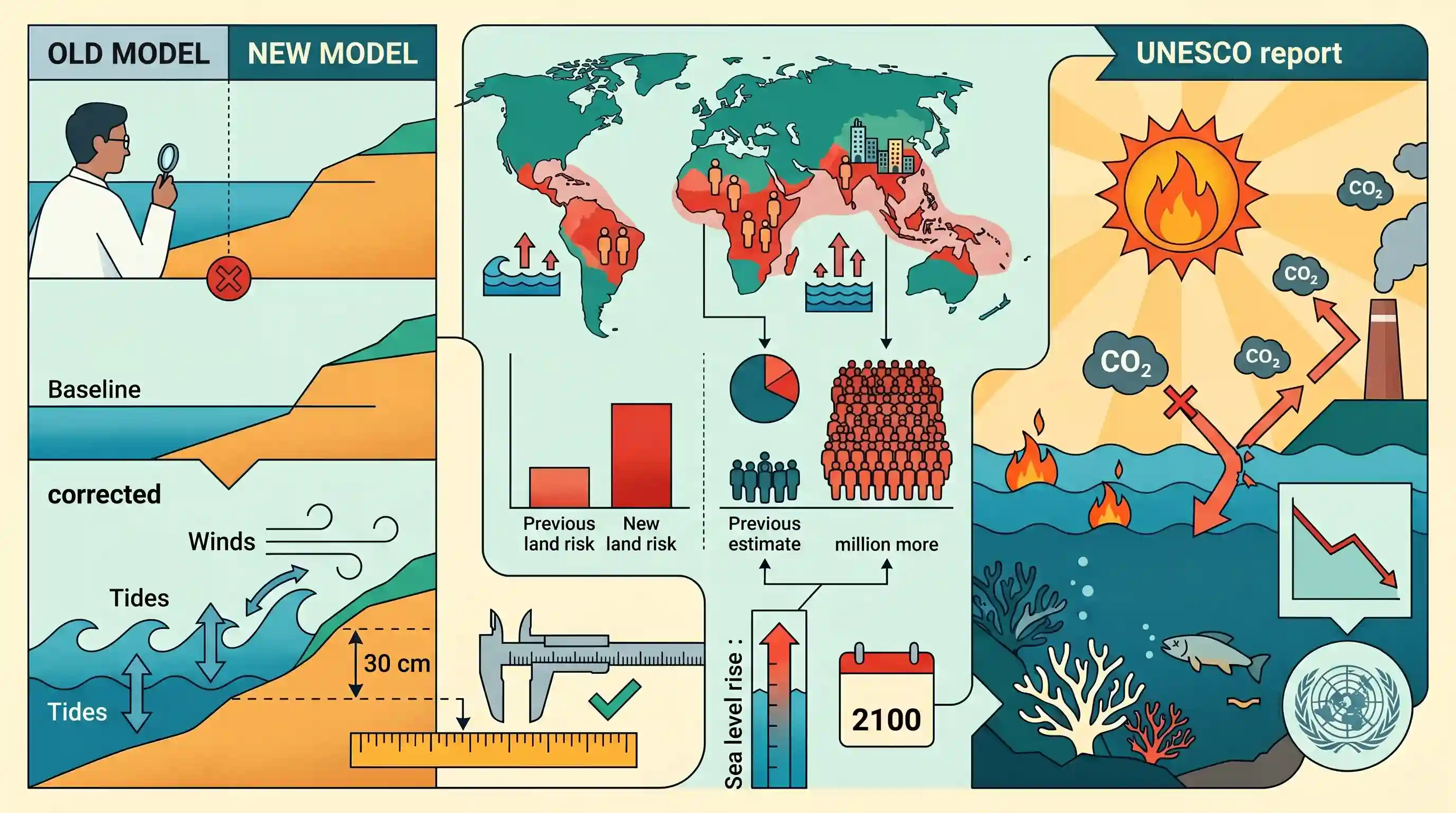
A study published in Nature reveals a critical error in previous coastal hazard assessments, showing that baseline coastal water heights have been underestimated by an average of 30 cm globally. This "methodological blind spot" occurred because models used a flat zero-metre land elevation baseline rather than accounting for the dynamic interaction of waves, tides, and winds at the coastline. Consequently, the projected impacts of a 1-metre sea level rise by 2100 are far more severe than anticipated, putting up to 37% more land and 132 million additional people at risk of inundation. The revised data spells out disproportionate threats for the Global South, Southeast Asia, and Pacific nations. Adding to the urgency, a separate UNESCO report indicates that marine heatwaves are steadily degrading the ocean's capacity to absorb carbon dioxide.
Key Points
- A new study highlights a 'methodological blind spot' in calculating sea level rise, where scientists incorrectly assumed a zero-metre baseline for coastal water heights instead of accounting for dynamic ocean factors like tides, waves, and winds.
- The actual coastal water level is on average 30 cm higher than previously estimated in hazard models.
- By 2100, an expected 1-metre sea level rise could inundate up to 37% more land and affect 77 to 132 million more people globally than previous assessments projected.
- Regions most vulnerable to these recalibrated estimates include Southeast Asia, the Pacific, and the broader Global South (e.g., island nations like Vanuatu).
- A concurrent UNESCO report warns that the ocean's ability to act as a carbon sink is declining due to marine heatwaves and slowing ocean currents, compounding global warming risks.
Important Terms
Sea-level Rise (SLR)

An increase in the ocean's volume caused by thermal expansion (warming water) and the melting of land-based ice (glaciers and ice sheets), leading to higher coastal water levels.
UPSC context
GS I (Geography) and GS III (Environment); critical for understanding coastal erosion, displacement, and climate adaptation strategies.
Global South
A geopolitical term for developing, less-developed, or under-developed nations, primarily in Africa, Asia, and Latin America, which often face disproportionate impacts from global climate change.
UPSC context
GS II (International Relations); relevant for climate justice, 'Common but Differentiated Responsibilities' (CBDR), and India's leadership in the developing world.
Marine Heatwaves (MHWs)
Prolonged periods of unusually high ocean temperatures (at least five days of 90th percentile heat) that disrupt marine ecosystems, cause coral bleaching, and reduce the ocean's carbon-absorption capacity.
UPSC context
GS I (Geography) and GS III (Environment); tested as a specific climate phenomenon affecting biodiversity and extreme weather events.
Geoid
The mathematical model of the Earth's surface if it were entirely covered by water and influenced solely by gravity and rotation, used as a reference baseline for sea level.
UPSC context
GS I (Physical Geography); understanding baselines is vital for accurate topographical mapping and coastal hazard modeling.
Intergovernmental Oceanographic Commission (IOC-UNESCO)
The specialized United Nations body responsible for supporting international ocean science and services, including monitoring sea-level rise and the ocean's role in the carbon cycle.
UPSC context
GS II (International Organizations); key body for global scientific cooperation on marine research and disaster warning systems.
Coastal Vulnerability
The susceptibility of coastal areas to hazards like flooding and erosion, often measured by assessing land elevation, population density, and protective infrastructure.
UPSC context
GS III (Disaster Management); essential for disaster resilience planning and evaluating the socio-economic risk of low-lying regions.
Prelims Trap
"Higher ocean temperatures and marine heatwaves enhance the ocean's biological capacity to absorb CO2."
Warmer water holds less dissolved gas. As sea surface temperatures rise during marine heatwaves, the ocean's physical capacity to dissolve atmospheric CO2 strictly decreases.
Static Concepts Connected
How does the ocean act as a global carbon sink?
- Solubility Pump: CO2 naturally dissolves in seawater; colder, denser water sinks, taking dissolved carbon to the deep ocean for long-term storage.
- Biological Pump: Phytoplankton absorb CO2 via photosynthesis. This carbon enters the food web and is sequestered when organisms die and sink to the ocean floor.
- Temperature Effect: Warmer waters hold less dissolved gases, directly reducing the efficiency of the solubility pump and slowing carbon absorption.
What constitutes a Marine Heatwave (MHW)?
- Definition: Prolonged periods (typically 5+ days) of anomalously high sea surface temperatures (SSTs) for a specific location and season.
- Drivers: Driven by ocean currents, air-sea heat flux, and amplified by large-scale climate drivers like El Niño.
- Ecological Impacts: Causes coral bleaching, altered marine species migration, intensified tropical cyclones, and reduced CO2 absorption capacity.
Cross-Topic Patterns
SLR recalibration and CRZ norms
Revised coastal inundation risks directly challenge India's recent relaxations of Coastal Regulation Zone (CRZ) norms, heightening vulnerability for coastal infrastructure, ports, and communities.
Marine heatwaves driving rapid cyclogenesis
The same marine heatwaves reducing carbon absorption also provide the latent heat necessary to rapidly intensify tropical cyclones, altering disaster preparedness paradigms for the Bay of Bengal and Arabian Sea.

Expect a 2026 multi-statement question linking marine heatwaves, reduced ocean carbon solubility, and deep ocean current stagnation.
Linked PYQs · 3
Linked PYQs · 3
- 2023MainsGS3
The Intergovernmental Panel on Climate Change (IPCC) has predicted a global sea level rise of about one metre by AD 2100. What would be its impact in India and the other countries in the Indian Ocean region?
- 2022MainsGS3
Explain the causes and effects of coastal erosion in India. What are the available coastal management techniques for combating the hazard?
- 2019MainsGS1
How do ocean currents and water masses differ in their impacts on marine life and coastal environment? Give suitable examples.
