SD Sanjay Appointed as New Advocate General of Bihar
Source:The Hindu ↗
Why It Matters
Appointments of key constitutional officers like the Advocate General of the State, along with their governing constitutional provisions (Article 165 and 177), are high-yielding topics for BPSC Prelims polity section.
Summary
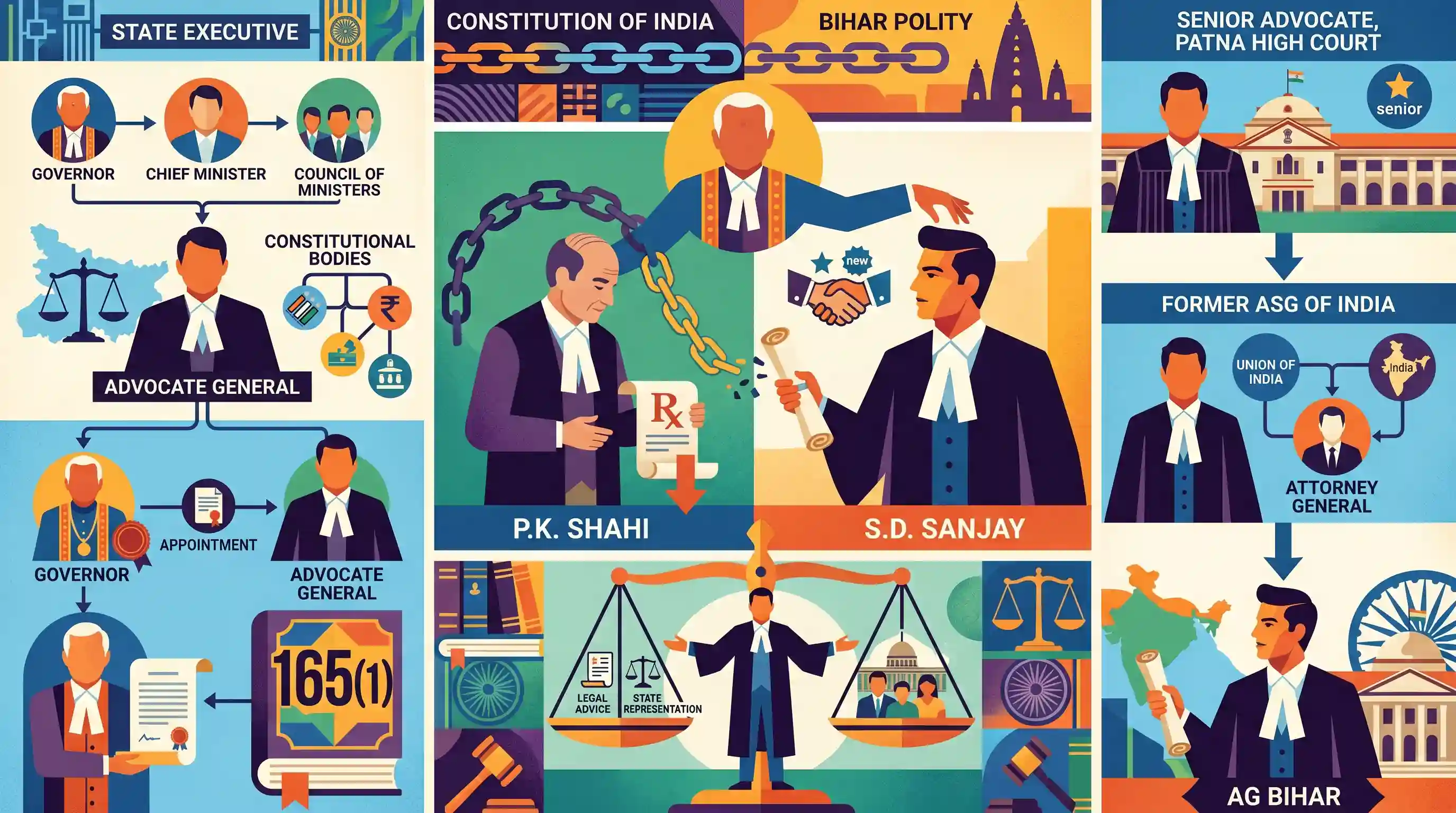
Senior Advocate S.D. Sanjay (Shri Satya Darshi Sanjay) has been appointed as the new Advocate General of Bihar by the Governor under Article 165(1) of the Constitution. A Patna High Court Senior Advocate who has been serving as an Additional Solicitor General (ASG) of India, he succeeds P.K. Shahi, who recently resigned from the post.
Key Points
- Senior Advocate S.D. Sanjay (Shri Satya Darshi Sanjay) has been appointed as the new Advocate General (AG) of Bihar.
- The appointment was officially made by the Governor of Bihar under Article 165(1) of the Constitution of India.
- The notification of appointment was issued on June 18, 2026, by Balram Dubey, Secretary of the Bihar Law Department.
- S.D. Sanjay is a Senior Advocate at the Patna High Court and is currently an Additional Solicitor General (ASG) of India in the Supreme Court; he has represented the central government as ASG in the Patna High Court since 2015.
- He succeeds P.K. Shahi, who voluntarily resigned from the post. Shahi had started his second term as AG on January 16, 2023.
- Under Article 165 of the Constitution, the Advocate General is the highest law officer in the state, appointed by the Governor, and must possess the qualifications required to be a High Court Judge.
- Under Article 177, the Advocate General has the right to speak and participate in the proceedings of the State Legislature (including committees), but does not possess the right to vote.
Important Terms
Article 165 of the Constitution of India

A constitutional provision establishing the office of the Advocate General for each State, appointed by the Governor, who serves as the state government's chief legal advisor.
UPSC context
GS Paper II (Polity); tests understanding of constitutional bodies, the state executive, and the appointment, qualifications, and role of the state's top law officer.
Article 177 of the Constitution of India
A constitutional provision granting State Ministers and the Advocate General the right to speak and participate in state legislative proceedings and committees, without the right to vote.
UPSC context
GS Paper II (Polity); tests legislative procedures and the privileges, rights, and immunities of non-member state functionaries in assembly proceedings.
Article 76 of the Constitution of India
A constitutional provision establishing the office of the Attorney-General for India, appointed by the President, serving as the chief legal advisor to the Government of India.
UPSC context
GS Paper II (Polity); tests knowledge of Union executive offices and the comparative analysis of Union versus State law officers.
Article 300 of the Constitution of India
A constitutional provision defining the legal capacity of the Union and State governments to sue or be sued in courts as juristic personalities.
UPSC context
GS Paper II (Polity & Governance); tests concepts of state liability, government litigation, sovereign immunity, and the state's status as a juristic person.
Patna High Court
The highest constitutional judicial body in the state of Bihar, exercising original, appellate, and supervisory jurisdiction over state-level legal and public matters.
UPSC context
GS Paper II (Judiciary); tests structure, jurisdiction, and power of state High Courts, and their role in judicial review and public interest litigation.
Prelims Trap
The Advocate General of a State is appointed by the President and has a constitutionally fixed tenure of five years.
The Advocate General is appointed by the Governor (not the President, unlike HC judges) and holds office during the pleasure of the Governor, with no constitutionally fixed tenure.
Static Concepts Connected
What are the constitutional provisions governing the Advocate General of a State?
- Appointment & Eligibility: Appointed by the Governor; must be qualified to be appointed a High Court judge (citizen, 10 years judicial office or High Court advocate).
- Tenure & Removal: No fixed tenure or specific grounds for removal are prescribed by the Constitution; holds office during the pleasure of the Governor.
- Legislative Rights: Under Article 177, can speak and participate in state legislature proceedings and committees but has no right to vote.
Cross-Topic Patterns
Executive pleasure vs. Judicial independence
While High Court judges enjoy security of tenure under the Constitution, the Advocate General serves at the absolute pleasure of the Executive, highlighting distinct constitutional designs for law officers.
Article 131 and Centre-State litigation
As cooperative federalism faces friction, the Advocate General plays a critical role in representing states in original jurisdiction disputes against the Union before the Supreme Court.

UPSC 2026 may test the dual comparison of Attorney General and Advocate General on tenure security, voting rights, and right of audience.
Linked PYQs · 3
Linked PYQs · 3
- 2025BPSC_PRELIMSGS1
Attorney General of India:
- 2022BPSC_PRELIMSGS1
Article 300 of the Indian Constitution deals with
- 2019BPSC_PRELIMSGS1
Who was the Chief Justice of the Patna High Court who administered the oath of office to Mr. Fagu Chauhan as the Governor of Bihar in July 2019?
