Industrial Disputes Act: Sovereign functions and industry definition
Source:The Hindu ↗
Why It Matters
The definition of 'industry' directly determines whether millions of workers in hospitals, municipalities, and state welfare schemes receive statutory protections under labor laws, such as protection from arbitrary termination. It is a critical overlap of Polity (Supreme Court precedents) and Governance (labor rights vs. state obligations).
Summary
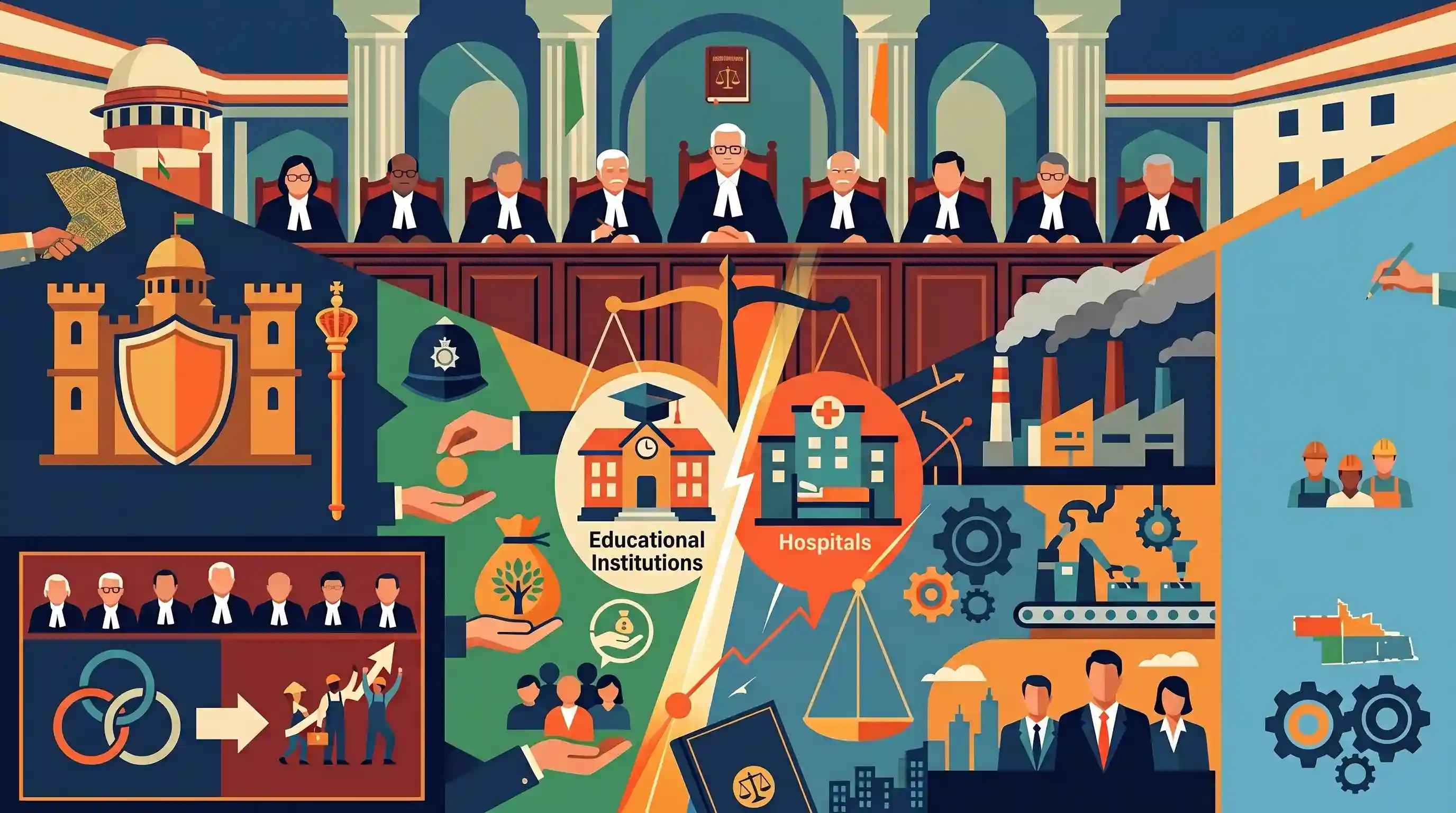
A nine-judge Constitution Bench of the Supreme Court, led by Chief Justice Surya Kant, is set to review whether sovereign functions, social welfare schemes, educational institutions, and hospitals qualify as an 'industry' under Section 2(j) of the Industrial Disputes Act, 1947. The bench will re-evaluate the precedent established by the 1978 Bangalore Water Supply judgment—a pro-labor ruling by a seven-judge bench that used a 'triple test' to expansively interpret the definition of industry, explicitly exempting only sovereign functions. The outcome of this case will critically demarcate the boundary between state welfare obligations and industrial operations, fundamentally impacting the labor rights and legal protections of employees in government instrumentalities.
Key Points
- A nine-judge Constitution Bench led by CJI Surya Kant will determine if 'sovereign functions' and state welfare activities fall under the definition of 'industry'.
- The case involves Section 2(j) of the Industrial Disputes Act, 1947, which legally defines what constitutes an industrial activity.
- This re-examines the landmark 1978 Bangalore Water Supply case (7-judge bench), which established a 'triple test' expanding the definition of 'industry' to protect more workers, irrespective of a profit motive.
- The core issue revolves around clarifying whether hospitals, municipalities, educational institutions, and state-run social welfare schemes should grant their employees labor law protections typical of industrial workers.
Important Terms
Industrial Disputes Act, 1947

A central legislation regulating the investigation and settlement of disputes between employers and workmen, providing mechanisms like conciliation and adjudication to ensure industrial peace.
UPSC context
GS II: Governance and Labour Laws; tested for worker protections and mechanisms for industrial harmony.
Bangalore Water Supply Case (1978)
A landmark 1978 Supreme Court ruling that adopted an expansive 'Triple Test' to define 'industry,' bringing public utilities and welfare bodies under labour law protections.
UPSC context
GS II: Judiciary; tested as a major precedent defining the scope of labour rights in the public sector.
Triple Test
A legal doctrine requiring systematic activity, employer-employee cooperation, and production/distribution of goods or services to classify an entity as an 'industry' under the 1947 Act.
UPSC context
GS II: Statutory Bodies; tested as a specific judicial tool for interpreting legislative definitions.
Sovereign Functions
Inalienable state powers (e.g., defense, justice, law and order) that are typically exempt from industrial regulations, as distinguished from welfare or commercial state activities.
UPSC context
GS II: Governance; tests the boundary between state authority and its liabilities as a welfare provider.
Constitution Bench
A Supreme Court bench of five or more judges, mandated by Article 145(3) to decide substantial questions of law regarding constitutional interpretation or review of major precedents.
UPSC context
GS II: Polity and Judicial Review; tested for understanding the hierarchy and procedural depth of the judiciary.
Section 2(j) (Industrial Disputes Act)
The specific statutory provision of the Industrial Disputes Act that defines 'industry,' currently under review to determine if state welfare operations fall within its ambit.
UPSC context
GS II: Social Justice; tests the legal interpretation of terms that secure labor rights for government employees.
Prelims Trap
All government departments and welfare schemes are inherently exempt from the Industrial Disputes Act as they are sovereign functions.
Under the 1978 ruling, welfare activities like hospitals and schools were deemed 'industries'. Only strict sovereign functions (police, defense) were exempt. This distinction is exactly what the new 9-judge bench is reviewing.
Static Concepts Connected
What are the constitutional rules governing the formation of Supreme Court Constitution Benches?
- Article 145(3): Mandates that any case involving a substantial question of constitutional law requires a minimum of five judges to decide.
- Overruling Precedents: To overrule a precedent, a larger bench must be constituted. Therefore, a 9-judge bench is required to review the 1978 7-judge Bangalore Water Supply ruling.
- CJI's Prerogative: The Chief Justice of India, acting as the 'Master of the Roster', possesses the exclusive administrative prerogative to constitute these benches.
What distinguishes 'sovereign' from 'non-sovereign' functions in Indian Constitutional law?
- Sovereign Functions: Core, inalienable duties of the State (e.g., defense, justice administration, taxation, foreign affairs) where the State possesses strict immunity from standard industrial or tortious claims.
- Non-Sovereign Functions: Commercial, socio-economic, or welfare activities (e.g., hospitals, transport, education) that the State undertakes but could theoretically be performed by private entities.
- Article 300: Governs the tortious liability of the Government of India and states, historically relying on this sovereign/non-sovereign distinction to determine if the state can be sued for acts of its employees.
Cross-Topic Patterns
New Labour Codes & Judicial Precedent
The impending Industrial Relations Code 2020 redefines "industry". This 9-judge verdict will dictate how the new Code's definitions are legally applied to millions of workers in government welfare and municipal schemes.
DPSPs vs. State Fiscal Capacity
Expanding "industry" fulfills Article 43 (workers' rights) but imposes massive fiscal and compliance burdens on cash-strapped state machinery, highlighting the tension between DPSPs and state capacity.

Expect a Prelims question mixing Article 145(3) bench-size rules with the definition of 'industry' under the Industrial Relations Code 2020
Linked PYQs · 4
Linked PYQs · 4
- 2016MainsGS2
What was held in the Coelho case? In this context, can you say that judicial review is of key importance amongst the basic features of the Constitution?
- 2024MainsGS3
Discuss the merits and demerits of the four 'Labour Codes' in the context of labour market reforms in India. What has been the progress so far in this regard?
- 2022PrelimsGS1
In India, which one of the following compiles information on industrial disputes, closures, retrenchments and lay-offs in factories employing workers ?
- 2017PrelimsGS1
The Trade Disputes Act of 1929 provided for
