Uttarakhand High Court Orders Scrutiny of Domicile Certificates
Source:garhwalpost ↗
Why It Matters
Highlights the role of judicial review and PILs in ensuring transparency in public employment. It also underscores the administrative challenges surrounding domicile certificates and interstate qualification rules, which are relevant to constitutional rights regarding equality of opportunity in public employment (Article 16).
Summary
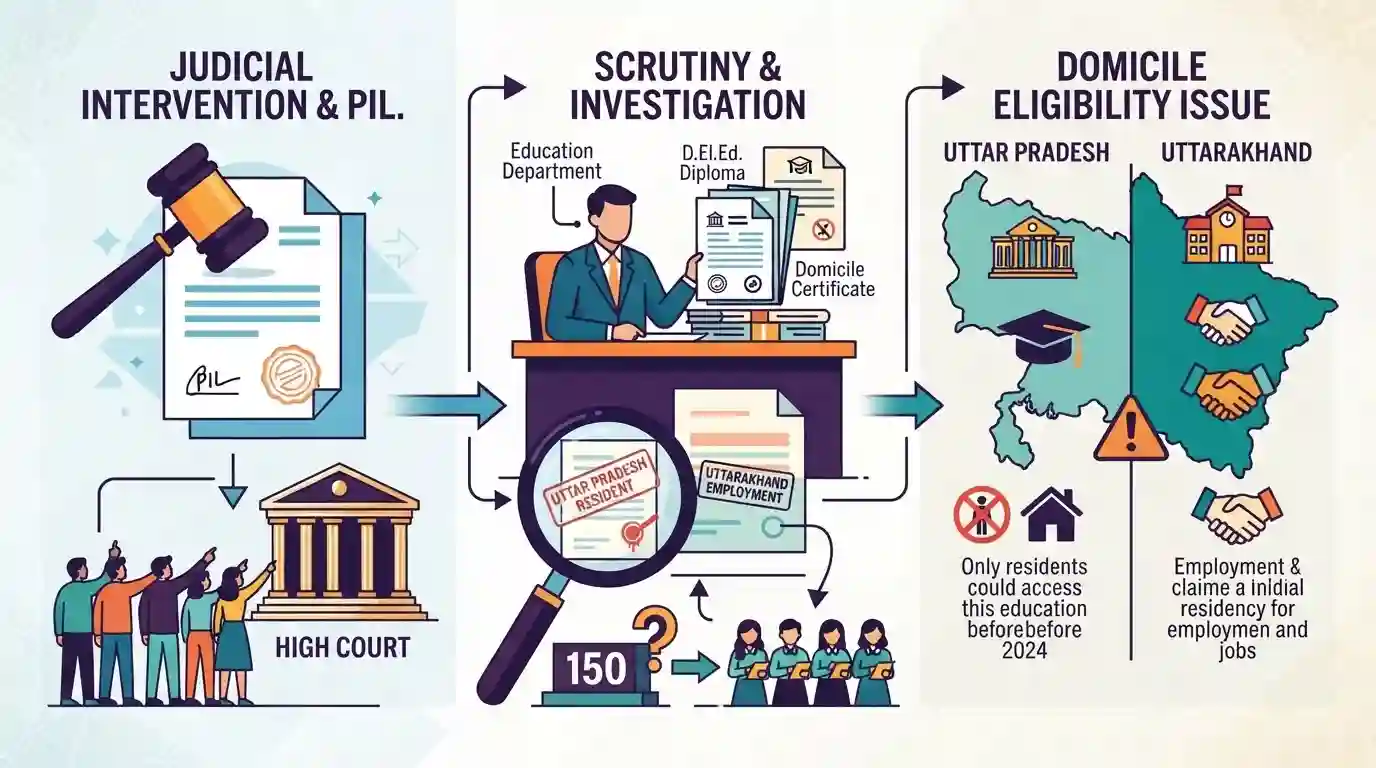
Following an order from the Uttarakhand High Court in response to a Public Interest Litigation (PIL), the state's Education Department has begun scrutinizing the documents of around 150 government teachers. The investigation focuses on teachers who secured employment in Uttarakhand after obtaining a Diploma in Elementary Education (D.El.Ed) from Uttar Pradesh before 2024. The core issue revolves around domicile eligibility: prior to 2024, only permanent residents of UP were eligible for the D.El.Ed course there. The dual claim of UP residency for education and Uttarakhand residency for employment has raised suspicions of fraudulent permanent resident certificates being used to secure government jobs.
Key Points
- The Uttarakhand Education Department has initiated an investigation into the documents of approximately 150 government teachers following an order from the High Court based on a PIL.
- The scrutiny focuses on teachers who obtained government jobs in Uttarakhand after completing their Diploma in Elementary Education (D.El.Ed) from Uttar Pradesh before 2024.
- Before 2024, only permanent residents of Uttar Pradesh were eligible to pursue D.El.Ed there, which raises suspicions about how these candidates concurrently held valid permanent resident certificates for Uttarakhand to secure employment.
- Authorities suspect the use of improper or fake domicile certificates, prompting a detailed verification of the targeted teachers' credentials.
Important Terms
Public Interest Litigation (PIL)

A legal mechanism allowing any public-spirited individual or group to approach constitutional courts to protect public interest, especially enforcing the fundamental rights of marginalized communities.
UPSC context
Crucial for GS Paper 2 (Polity); tests knowledge of judicial activism, locus standi, and Articles 32 and 226.
Diploma in Elementary Education (D.El.Ed)
A two-year professional teacher training program designed to prepare educators for primary and upper-primary schools, focusing on child development, pedagogical skills, and foundational learning.
UPSC context
Relevant to GS Paper 2 (Education); highlights teacher qualification standards, Right to Education (RTE) compliance, and state employment policies.
Permanent Resident Certificate (PRC)
An official state-issued document certifying continuous residency in a region, commonly required to claim domicile-linked eligibility or reservation benefits in local public employment and education.
UPSC context
Relates to GS Paper 2 (Polity); tests understanding of Article 16 (equality of opportunity), state domicile policies, and federalism.
High Court (Article 226)
The apex judicial body in an Indian state, empowered by Article 226 to issue writs enforcing Fundamental Rights and addressing other legal or administrative grievances.
UPSC context
Important for GS Paper 2 (Polity); tests state judiciary powers, writ jurisdiction, and the mechanism for challenging executive actions.
Prelims Trap
State Legislatures have the constitutional power under Article 16(3) to prescribe residence as a requirement for public employment.
Under Article 16(3), only the Parliament—and NOT individual State Legislatures—possesses the legislative competence to enact laws prescribing residence requirements for state public employment.
Static Concepts Connected
What are the constitutional rules governing residence-based reservation in public employment and education?
- Parliamentary exclusivity: Under Article 16(3), only Parliament can prescribe residence requirements for state-level public employment. State legislatures do not possess this power.
- Employment vs Education: Article 15 (education) omits 'residence' as a prohibited ground, allowing state-level reservation. Article 16(2) explicitly prohibits residence-based discrimination in employment.
- Single Unified Domicile: Article 5 establishes only a single unified 'Domicile of India'. There is no constitutional concept of a separate state or provincial domicile.
Cross-Topic Patterns
State protectionism vs Constitutional freedom of movement
Local reservation laws and restrictive state-level domicile rules for public employment directly clash with Article 19(1)(g) and federal integration.
RTE Act and regulatory centralization
The NCTE acts as the sole central 'Academic Authority' under the RTE Act, minimizing state-level deviations in teacher qualifications.

The absolute exclusion of State Legislatures from enacting residence-based employment rules under Art 16(3) is a high-yield 2026 MCQ focus.
Linked PYQs · 2
Linked PYQs · 2
- 2012UKPSC_PRELIMSGS1
Where the Public Interest Litigation (PIL) can be filed?
- 2016UKPSC_PRELIMSGS1
The provisions of reservation for O.B.C. is made in the Constitution under which Articles?
