Rural Employment Guarantee Scheme Restructuring and Federal Funding
Source:Indian Express ↗
Why It Matters
The transition from MGNREGA to the VB-G RAM G Act marks a fundamental shift in India's rural employment guarantee and poverty alleviation strategy. It raises crucial debates about fiscal federalism, the decentralization of power to local self-governments, and the restructuring of centrally sponsored schemes, all of which are core components of the UPSC syllabus.
Summary
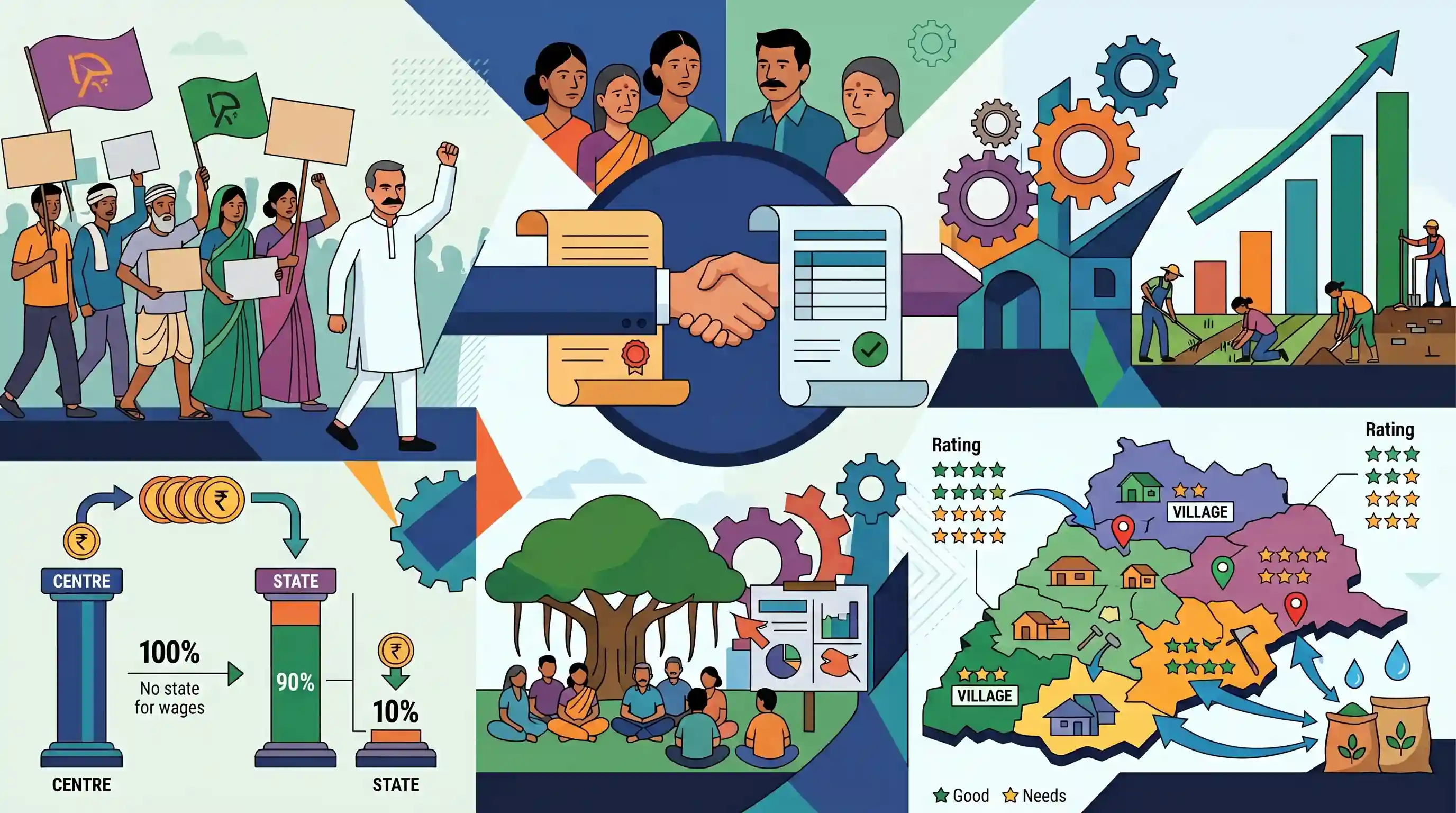
Himachal Pradesh Chief Minister Sukhvinder Singh Sukhu and other Congress leaders have launched statewide protests against the Centre's decision to replace the Mahatma Gandhi National Rural Employment Guarantee Act (MGNREGA), 2005 with the Viksit Bharat-Guarantee for Rozgar and Ajeevika Mission (Gramin) (VB-G RAM G) Act, 2025. Critics argue the new scheme undermines decentralization by sidelining Gram Panchayats and Sabhas in planning. Furthermore, it shifts financial responsibilities, reducing the Centre's wage burden from 100% to 90%. Conversely, the BJP maintains that the new Act is a stronger framework that increases guaranteed employment to 125 days and uses a panchayat grading system to better allocate resources to backward regions.
Key Points
- Himachal Pradesh CM Sukhvinder Singh Sukhu led a protest against the replacement of MGNREGA with the new Viksit Bharat-Guarantee for Rozgar and Ajeevika Mission (Gramin) Act, 2025.
- The Congress government criticized the new scheme for centralizing planning and sidelining Gram Panchayats and Gram Sabhas in the decision-making process.
- The new funding mechanism reduces the Centre's share of the wage component from 100% to 90%, passing additional financial burden onto the states.
- The BJP defended the new Act, stating it expands guaranteed employment from 100 to 125 days and incorporates a grading system for panchayats to reduce regional imbalances.
- Salaries of officers and employees posted in Zila Parishads under MGNREGA have reportedly been discontinued, which the state argues will hamper implementation.
Important Terms
Mahatma Gandhi National Rural Employment Guarantee Act (MGNREGA), 2005

A 2005 law guaranteeing 100 days of unskilled wage employment per year to rural households. It is demand-driven and primarily funded by the Central Government (100% wage cost).
UPSC context
GS Paper II: Social Justice and Governance; crucial for poverty alleviation and rights-based welfare analysis.
Viksit Bharat-Guarantee for Rozgar and Ajeevika Mission (Gramin) (VB-G RAM G) Act, 2025
Legislation replacing MGNREGA, guaranteeing 125 days of work. It shifts funding to a 60:40 (or 90:10) sharing ratio and introduces 'normative allocation' instead of a demand-driven labour budget.
UPSC context
GS Paper II: Government Policies/Interventions; key for current affairs and comparative policy evaluation.
Gram Sabha
The primary assembly of all registered voters in a village. Under PRIs, it is the cornerstone of grassroots democracy and decentralized planning for rural employment schemes.
UPSC context
GS Paper II: Panchayati Raj Institutions (PRIs); tests understanding of local governance and bottom-up planning.
Demand-driven Model
A mechanism where the government must provide work whenever an eligible citizen asks for it, with legal entitlement to wages or an unemployment allowance if work isn't provided.
UPSC context
GS Paper III: Indian Economy/Development; highlights the difference between welfare entitlements and administrative schemes.
Centrally Sponsored Scheme (CSS)
Schemes implemented by State governments but funded by both Centre and States in a fixed ratio (e.g., 60:40). They are the main vehicle for social welfare programs.
UPSC context
GS Paper II: Fiscal Federalism; essential for understanding Centre-State financial relations and administrative structures.
Fiscal Federalism
The financial relationship and distribution of tax revenues and expenditure responsibilities between different levels of government (Centre and States) in a federal system.
UPSC context
GS Paper II: Constitution/Polity; critical for discussing the impact of revised funding ratios on State autonomy.
Prelims Trap
The Centre retains 100% funding for unskilled wages under the new VB-G RAM G Act, similar to MGNREGA.
The new Act shifts to a cost-sharing model (e.g., 90:10) and is budget-capped, ending the Centre's historic 100% unskilled wage liability and open-ended funding.
Static Concepts Connected
How are Centrally Sponsored Schemes funded, and what is 'Core of the Core'?
- Funding Splits: Typically funded in a 60:40 ratio (Centre:State) for general states, or 90:10 for North Eastern and Himalayan states.
- Implementation: They are executed by State governments but are primarily designed and funded by the Union Government to achieve national goals.
- Core of the Core: High-priority umbrella schemes (historically including MGNREGA) that retain specific statutory mandates, funding protections, and national priority status.
What are the constitutional powers of the Gram Sabha under Article 243A?
- Composition: Comprises all registered voters within the electoral rolls of a village (or group of villages) under a Panchayat.
- Legislated Powers: Exercises powers and performs functions at the village level as specifically endowed by the respective State Legislature.
- Decentralized Planning: They are traditionally empowered to identify local public works, select welfare beneficiaries, and conduct mandatory social audits for transparency.
Cross-Topic Patterns
Centralization of welfare planning
The shift from Gram Sabha-led work selection to top-down normative allocations echoes the broader centralization debate seen in recent Centrally Sponsored Scheme reforms.
Fiscal federalism stress points
Reducing the Centre’s unskilled wage share from 100% to 90:10 compounds existing state grievances over financial burdens, tying into debates around Finance Commission devolutions.

Mains 2026 will likely contrast MGNREGA's demand-driven, decentralized model with VB-G RAM G's budget-capped, top-down funding approach.
Linked PYQs · 5
Linked PYQs · 5
- 2011PrelimsGS1
Among the following who are eligible to benefit from the “Mahatma Gandhi National Rural Employment Guarantee Act”?
- 2025MainsGS2
Examine the evolving pattern of Centre-State financial relations in the context of planned development in India. How far have the recent reforms impacted the fiscal federalism in India?
- 2024MainsGS2
Analyse the role of local bodies in providing good governance at local level and bring out the pros and cons merging the rural local bodies with the urban local bodies.
- 2024MainsGS2
What changes has the Union Government recently introduced in the domain of Centre-State relations ? Suggest measures to be adopted to build the trust between the Centre and the States and for strengthening federalism.
- 2015MainsGS2
In absence of a well-educated and organized local level government system, 'Panchayats' and 'Samitis' have remained mainly political institutions and not effective instruments of governance. Critically discuss.
