India Strategic Objectives and Regional Security at SCO Summit
Source:Indian Express ↗
Why It Matters
The SCO is a vital Eurasian platform for India to project its strategic autonomy, engage with Central Asian Republics, address regional security threats like cross-border terrorism, and manage bilateral frictions with regional powers like China and Pakistan.
Summary
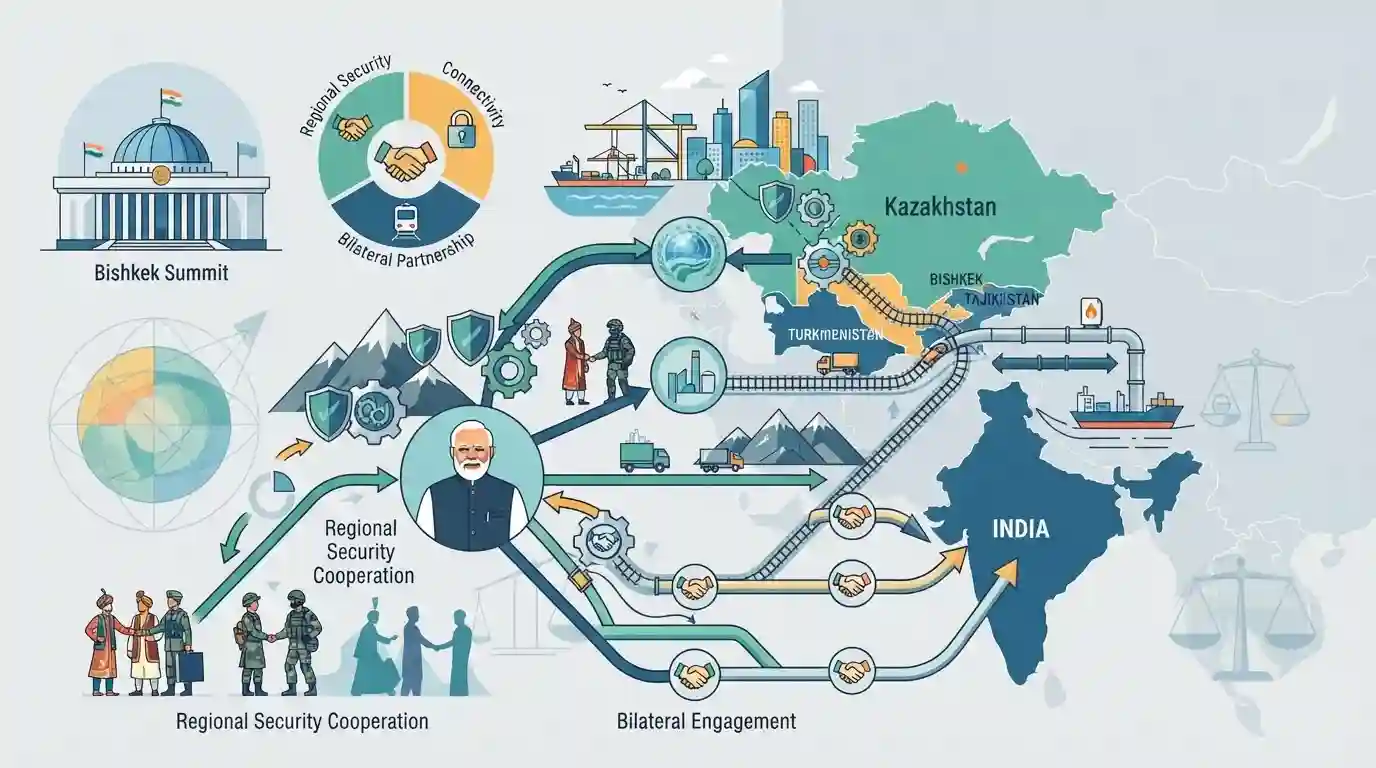
An analysis of India's strategic objectives and diplomatic priorities at the SCO Summit in Bishkek, focusing on regional security, connectivity, and India's engagement with Central Asian Republics amidst complex geopolitical dynamics.
Key Points
- The article examines India's objectives and diplomatic positioning at the Shanghai Cooperation Organisation (SCO) Summit in Bishkek.
- It highlights India's strategic imperatives in Central Asia, including regional security, counter-terrorism (RATS-SCO), and trade connectivity.
- Discusses the nuances of minilateral engagements within the SCO framework, balancing ties with Russia, China, and the Central Asian Republics.
- Focuses on India's 'Connect Central Asia' policy and challenges related to overland connectivity and trade barriers.
Important Terms
Shanghai Cooperation Organisation (SCO)

A Eurasian political, economic, and security organization focused on counter-terrorism, regional stability, and economic cooperation, consisting of ten member states including India.
UPSC context
Important for UPSC Civil Services Prelims and Mains (IR / International Groupings) covering India's strategic footprint in Eurasia.
Shanghai Cooperation Organisation (SCO) Charter
The foundational treaty adopted in 2002 that formalizes the SCO's structure, goals, principles, and mechanisms for regional security, political, and economic cooperation.
UPSC context
Tested in Prelims or Mains regarding the foundational legal framework, institutional mandates, and principles governing regional blocs.
India Ministry of External Affairs
The central government agency of India responsible for the conduct of foreign relations, execution of foreign policy, and diplomatic representation at multilateral bodies.
UPSC context
Core entity for UPSC Mains General Studies Paper-II (International Relations) focusing on institutional mechanisms of Indian foreign policy execution.
Prelims Trap
India was a founding member of the Shanghai Cooperation Organisation established in 2001.
Aspirants often assume India and Pakistan are founding members of the SCO since its inception in 2001, whereas both joined as full members much later in 2017.
Static Concepts Connected
What are the key structural pillars and mechanisms of the Shanghai Cooperation Organisation (SCO)?
- Headquarters: Permanent bodies include the SCO Secretariat in Beijing and the Regional Anti-Terrorist Structure (RATS) in Tashkent.
- Security Focus: Focuses on regional security, counter-terrorism, intelligence sharing, and joint military exercises (Peace Mission).
- Membership Expansion: India and Pakistan became full members at the Astana Summit in 2017; Iran joined later in 2023.
Cross-Topic Patterns
SCO Connectivity vs. Overland Transit Barriers
The challenge of bypassing Pakistan for Central Asian trade tests the intersection of regional connectivity corridors (INSTC) and minilateral diplomacy (SCO).
Multi-alignment Strategy in Eurasian Groupings
Balancing Western partnerships with Eurasian groupings like SCO and BRICS showcases India's contemporary multi-alignment strategy.

Expect statement-based questions on SCO organs like RATS, India's Connect Central Asia policy, and alternative corridors like INSTC.
Linked PYQs · 2
Linked PYQs · 2
- 2024MainsGS2
Critically analyse India's evolving diplomatic, economic and strategic relations with the Central Asian Republics (CARs) highlighting their increasing significance in regional and global geopolitics.
- 2024MainsGS2
‘The West is fostering India as an alternative to reduce dependence on China's supply chain and as a strategic ally to counter China's political and economic dominance.’ Explain this statement with examples.
